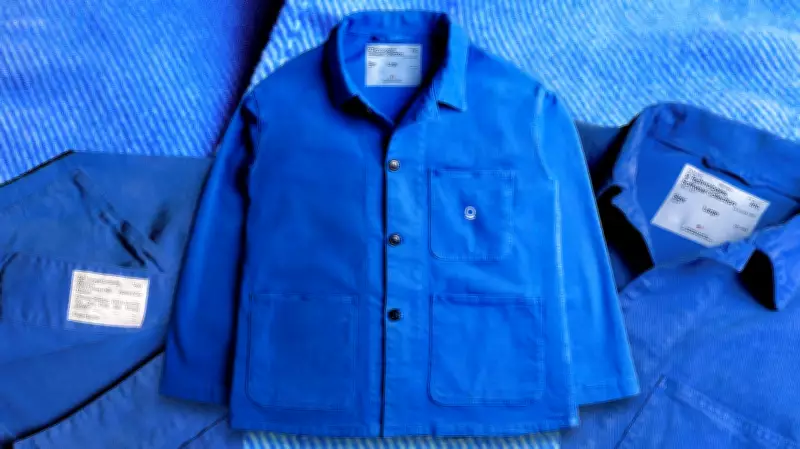
Palantir, the controversial data-mining firm and major United States government contractor, is known for creating surveillance tools used to fulfill President Donald Trump's deportation agenda. And now apparently, the company also is in the business of mainstream streetwear. Last week, Palantir dropped an exclusive chore coat for its fans. The garment, which came in bright blue and black, retailed for $239 and sold out within a day.
Palantir's Merchandise History
Palantir has sold merchandise before, including a T-shirt with the caption "Dominate," but a chore coat is different and a bit of a paradox. The fashion product has a unique European Union and labor history that is at odds with a private firm that champions U.S. military dominance and generates $1.4 billion in revenue, in part by building systems used by U.S. Immigration and Customs Enforcement (ICE) and the Israel Defense Forces (IDF).
Company's Rationale
On social media, Eliano Younes, head of strategic engagement at Palantir, said that the company chose to release a chore coat over familiar corporate merchandise because the firm wanted to sell something "deployed colleagues and supporters of Palantir could wear that wasn't a bland corporate polo or vest." And a chore coat is definitely not bland it has great historic weight, according to experts.

Historical Significance of the Chore Coat
Marie Remy, the founder of the French Workwear Company, which has been selling these popular coats since 2014, said she thought the Palantir chore coat was "a joke" when she first heard about it. A chore coat isn't the same as a "neutral T-shirt with a logo," Remy said. Remy's French mechanic father wore his blue boiler suit six days of the week for his job. In Remy's view, Palantir's version is disconnected from this workwear lineage. "Obviously, they have no connection whatsoever to that past," Remy said. She believes Palantir is selling the coat to "buy into the cool side and the ethos of what they're not."
Criticism and Response
Palantir did not respond to HuffPost questions about the criticism of how disconnected the coat is from its workwear past, but Younes previously told The New York Times that the firm's chore coat is "not political ... It's about people who love Palantir and are aligned with our mission." But fashion and costume historians disagree. Charles McFarlane, a costume historian who researches where fashion and the military intersect on his Substack, said it's a "non-possibility for a defense-contracting company to claim that something that they are making has no politics in it." McFarlane said the choice of a chore coat reflects Palantir's "striving desire": "Not only do they want to run the world and dominate things, they also want to be told they're cool." This, in turn, makes the coat "deeply uncool," McFarlane told HuffPost.
The Chore Coat's Evolution
Although luxury designers sell chore coats for runway fashion, the garment used to be worn for hard manual labor during the 20th century. French factory workers used the chore coat as personal protective equipment, because peasant shirts sleeves would get caught in machines, Remy explained. So in France, unions secured the right to have employers provide chore coats to staff, and workers would get a few a year, she said. Back then, the blue color wasn't for color-blocking your outfit. In Europe, blue was chosen for chore coats because indigo was the cheapest dye, Remy explained. In the U.S., blue denim and chambray shirts worn by 1920s manual laborers also led to the term "blue-collar" to distinguish professionals from "white-collar" office workers.

Modern Usage
Remy said people who buy chore coats today still use it for outside activities like gardening but they also use it because their favorite celeb might too. The modern chore coat is no longer an employer-issued uniform; it's for off-duty lounging. Beyond factory workers and French mechanics, the garment has entered mainstream fashion and can be seen on celebrities regularly. Public figures, like pop star Harry Styles and actor Jeremy Allen White, have been photographed wearing the coat while running errands. "Now it's become this gentrified thing that looks good on everyone, that's very practical, because it's got big pockets," Remy said. If you're buying a vintage chore coat now, you signal that you're "saying no to fast fashion," she said, because it's a quality garment that was made to last. Perhaps, so many of us want to wear classic chore coats because of this rich workwear history. A chore coat signals that you could still be working with your hands even though you might spend the whole day typing on your computer. Remy said people's lasting interest in chore coats speaks to a disconnection that people with digital, abstract jobs feel from jobs "where they actually make things."
Military-Industrial Fashion
Palantir's chore coat is not the first or last time a private company with connections to the military has dropped a merch line. Ultimately, McFarlane does not think this merch release is an attempt by the company to soften their image, citing the provocative writing of Palantir CEO Alex Karp. Recently, a 22-point summary of Karp's book on Palantir's X account suggested that the tech industry must be more supportive of U.S. national security and the nation should reinstate a draft for military service. Karp "is a deeply provocative person who's interested in provoking the chattering classes," he said. "I think that this [merch release] is an extension of that as well, and also an ideological project."
Other Examples
This is not the first time a private firm with deep ties to the military has sold street merch. Weapons manufacturer Lockheed Martin licenses its name and logo to Doojin Yanghang, a South Korean streetwear brand. And Qilo, a New York tactical streetwear brand, sells a Team USA jersey filled with defense contractor names that proclaims to "invest in the military industrial complex." With brands like Qilo, there is a winking humor and level of detachment to their merch, McFarlane said. "You can do that when you're a little bit more on the outside," he said. "With Palantir, you can't really do that, because you actually are the thing."
Target Audience
The audience for this jacket might not be the actual U.S. military, though, McFarlane suggested: "The guys who work on Palantir tech in the Pentagon are not going to start wearing the blue chore jackets when they're sitting at their desk. They're still wearing their camo fatigues." By selling a classic fashion item, the Palantir chore coat might be aimed at winning over people who are ambivalent about working for a firm that supports Trump's agenda. McFarlane believes that Palantir's chore coat is meant "to make something that's socially acceptable for a young 20-something to not feel embarrassed about graduating from MIT and going to work for Palantir," he said. But whether you love or hate it, this won't be the last Palantir jacket. Younes said Palantir plans "to do another one in the fall with a thicker/rugged material."