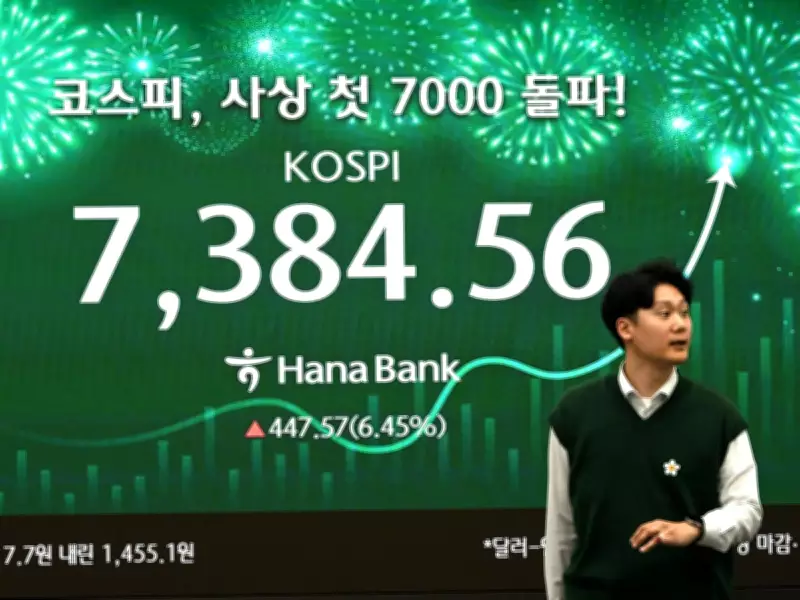
South Korea's equity market has overtaken Canada's as the world's seventh largest, propelled by insatiable demand for chips powering artificial intelligence. The total market capitalization of Korea-listed companies has surged 71 percent this year to US$4.59 trillion, while Canada's has climbed about seven percent to US$4.5 trillion, data compiled by Bloomberg show.
AI Chip Demand Drives Growth
Samsung Electronics Co., which recently crossed the US$1 trillion valuation mark, and SK Hynix Inc. have both more than doubled this year as their dominance in the AI chip segment made their products and stocks highly sought after. With the two chip heavyweights accounting for 45 percent of the benchmark's weighting, Korea's market valuation has ridden a wave of semiconductor demand to shoot past major European markets like the United Kingdom and France.
Index Composition Determines Fortunes
The crossover underscores how index composition is determining national equity fortunes. The Kospi gauge has added more than 70 percent so far this year, while Canada's resource and finance-heavy equity benchmark S&P/TSX Composite Index has risen just seven percent.

“Korea's market capitalization is likely to expand further, driven by the AI-led memory cycle, while Canada's is more constrained given its heavy concentration in energy and financials,” said Ha SeokKeun, chief investment officer at Eugene Asset Management Co.
Canada's equity market, heavily weighted toward energy and financial sectors, has not benefited from the same technological tailwinds. The divergence highlights how global capital flows are increasingly favoring markets with exposure to high-growth technology sectors, particularly those related to artificial intelligence and semiconductors.
Korea's benchmark Kospi index has risen more than 70 percent year-to-date, outperforming most major global indices. The surge has been fueled by strong earnings from semiconductor companies and expectations of continued demand for AI chips. Analysts expect the trend to persist as global investments in AI infrastructure accelerate.