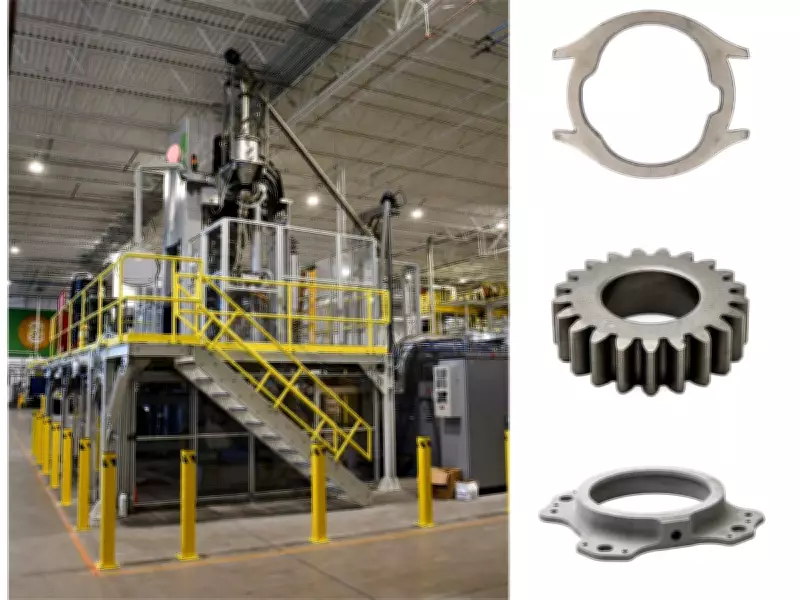
IperionX Limited has announced the successful commissioning of a state-of-the-art 300-ton six-axis SACMI powder metallurgy press at its Titanium Manufacturing Campus in South Boston, Virginia. This advanced press triples the company's existing powder metallurgy capacity and significantly expands the range of high-value titanium components that can be produced in the United States.
Enhanced Manufacturing Capabilities
The new SACMI press provides higher compaction force, multi-axis movement, improved repeatability, and enhanced geometry control compared to conventional uniaxial pressing systems. These capabilities enable the production of more complex near-net-shape titanium components, including fasteners, gears, brackets, actuators, and other high-value parts for defense, aerospace, and industrial applications.
High-Productivity Platform
The press is capable of up to 24 pressing cycles per minute, which translates to approximately 11 million single-cavity parts per year under standard operating assumptions. Higher part rates are achievable using multi-cavity tooling for simpler components. The platform is designed to integrate with additional HSPT furnace capacity expected to arrive in June, supporting customer qualification and scale-up of titanium component manufacturing.

Innovative Powder Metallurgy Process
The SACMI press utilizes titanium powder produced from IperionX's low-cost, U.S.-sourced feedstocks through the company's patented HAMR titanium process. The press forms near-net-shape titanium preforms that are then sintered and forged using IperionX's patented HSPT process. This powder metallurgy pathway bypasses the traditional titanium sponge supply chain, ingot melting, billet production, and extensive machining, reducing waste, production costs, and lead times while maintaining titanium's high strength-to-weight ratio and corrosion resistance.
Strategic Importance
Titanium fasteners and other complex components are critical to U.S. defense, aerospace, automotive, consumer electronics, and industrial supply chains. The expanded capacity addresses historical constraints on titanium adoption, such as high costs and supply chain concentration, by enabling large-scale domestic production of strong, lightweight, and corrosion-resistant parts.