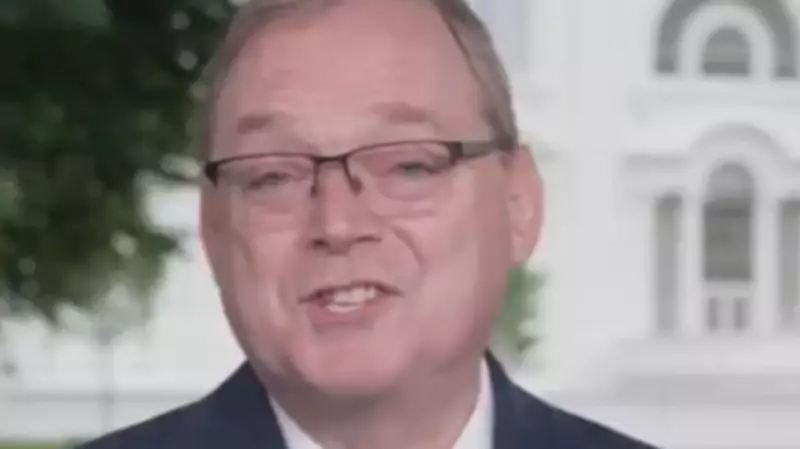
Top White House economic adviser Kevin Hassett has come under fire for attempting to downplay reports of low consumer confidence with a striking display of spin. According to The Associated Press, data indicates that high gas prices and inflation have soured Americans on Donald Trump's economic policies. However, during an appearance on Fox Business on Tuesday, Hassett claimed that consumers spending more money on virtually everything is evidence of their confidence in the economy.
"The thing that I've seen when I look at credit card data and other things that I can get from the private sector is that while people have been spending more money at gas stations, they've been spending more money on everything else," Hassett said, maintaining his characteristic grin.
While most people might interpret increased spending driven by higher gas prices and inflation as a negative sign, Hassett offered an alternative perspective. "[This] means that they're still very, very optimistic about the state of the economy. And they should be," he asserted. "If you look at GDP now, right now, it's north of 4%. And so, despite this disruption, all the momentum that we built with the big, beautiful bill and AI and everything else is really what the main economic story of the U.S. is."

K-Shaped Economy Concerns
Hassett is correct that the economy continues to grow and the unemployment rate remains low. However, some economists warn that the country is experiencing a "K-shaped" economy, where higher-income Americans benefit from rising stock market prices while lower-income individuals struggle to make ends meet.
Hassett Dismisses Consumer Sentiment Index
When host Maria Bartiromo noted that the consumer sentiment index had fallen for the third consecutive month and reached a new all-time low, Hassett attempted to dismiss the metric as a political construct. "They call it 'consumer sentiment' but I don't think those words mean what they think they mean anymore," Hassett said. He added that his office had examined "the political affiliation" of the respondents and found that "the correlation between what independents say and Democrats say ... it's almost exactly perfectly correlated." He concluded, "So what they've done is they've somehow devised a political survey that tells us how Democrats are feeling about things."
Bartiromo pressed him on the issue, asking, "What is the most important messaging that you can put out there for consumers to help sentiment here?" Hassett's response drew criticism from social media users, who accused the administration of gaslighting the public.
Social Media Backlash
Hassett's comments sparked widespread mockery and outrage online. One user remarked, "2 Cabinet spokesmen in an hour saying that you are not feeling what you are feeling and that you are not seeing what you're seeing." Another wrote, "The Trump administration thinks you're stupid. You have to be stupid to believe this horse chitte." A third comment stated, "We're literally being held hostage by the unprecedented stupidity of a fraction of the world's population." Some compared the tactic to authoritarian regimes, with one user noting, "This is a page from the authoritarian playbook. If the number looks bad, dismiss it as a fabrication of dissenters. If that doesn't work, simply stop collecting it. Works for Xi and Putin."
Hassett's Pattern of Dubious Claims
Hassett has a reputation for making bold and often dubious statements. Earlier this month, he attempted to spin increased credit card spending as a sign of robust consumer confidence, a claim that many economists found questionable.