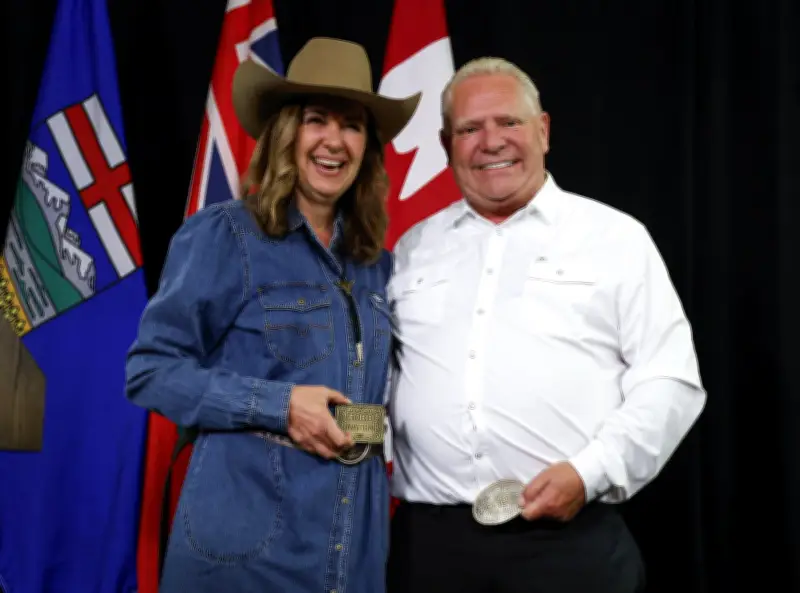
At the Calgary Stampede, the intersection of fashion and politics has become a pronounced social phenomenon, with political leaders using western attire as a tool for branding and public connection. Alberta Premier Danielle Smith and Ontario Premier Doug Ford exemplified this trend when they swapped belt buckles after announcing the Northern Shield pipeline proposal in Calgary on July 6, 2026.
Political Branding Through Western Wear
The Calgary Stampede, an annual rodeo and festival, has long been a venue for politicians to don cowboy hats and boots, signaling solidarity with Alberta's ranching culture. This year, the trend has intensified, with observers noting that fashion choices are increasingly strategic. According to political analyst Dr. Sarah Jenkins of the University of Calgary, “The Stampede has become a stage where politicians perform authenticity. The clothes are not just clothing; they are a message.”
Prime Minister Mark Carney is set to attend the last day of the Stampede, following in the footsteps of predecessors who have used the event to connect with Western Canadian voters. Carney's appearance is expected to include traditional western garb, continuing the tradition of political leaders embracing Stampede fashion.

Social Phenomenon or Political Strategy?
The phenomenon extends beyond mere photo opportunities. Belt buckles, hats, and boots have become symbols of political alliances and regional identity. When Smith and Ford exchanged belt buckles, it was interpreted as a gesture of interprovincial cooperation on energy policy. The buckle swap was captured by The Canadian Press photographer Jeff McIntosh, highlighting the visual power of such exchanges.
Fashion experts note that the Stampede's dress code allows politicians to soften their image. “It’s a way to break down barriers,” says Calgary-based stylist Maria Lopez. “When a politician wears a cowboy hat, they are saying, ‘I’m one of you.’ It humanizes them.” This strategy is particularly effective in Alberta, where the Stampede is a source of provincial pride.
Impact on Public Perception
The use of western fashion at the Stampede has not gone unnoticed by the public. Social media posts analyzing politicians' outfits have become a staple of the event. Some critics argue that it is a superficial attempt to gain favor, while supporters see it as a respectful nod to local culture. A 2025 survey by the Angus Reid Institute found that 62% of Albertans believe politicians should dress in western attire at the Stampede, indicating broad public acceptance.
The trend also raises questions about authenticity. When politicians like Smith and Ford, who are not typically seen in western wear, adopt it for the Stampede, it can appear calculated. However, for many attendees, the gesture is appreciated. “It shows they respect our traditions,” said Stampede-goer Tom Harrison. “Even if it’s just for a day, it means something.”
Broader Implications for Canadian Politics
The fashion-politics nexus at the Stampede reflects broader trends in Canadian political communication. As media coverage becomes more visual, politicians are increasingly aware of the messages sent by their attire. The Stampede offers a unique platform because of its iconic status and the strong regional identity associated with western wear.
Political scientist Dr. Michael Chen of the University of Toronto notes, “The Stampede is a microcosm of Canadian federalism. When leaders from different provinces come together in western dress, it symbolizes unity and shared purpose.” This was evident in the Smith-Ford buckle swap, which accompanied a major energy announcement.
As the Stampede continues, the role of fashion in politics is likely to evolve. With Prime Minister Carney’s upcoming appearance, the trend shows no signs of abating. Whether viewed as a genuine cultural embrace or a strategic political move, the phenomenon underscores the power of clothing in shaping public perception.