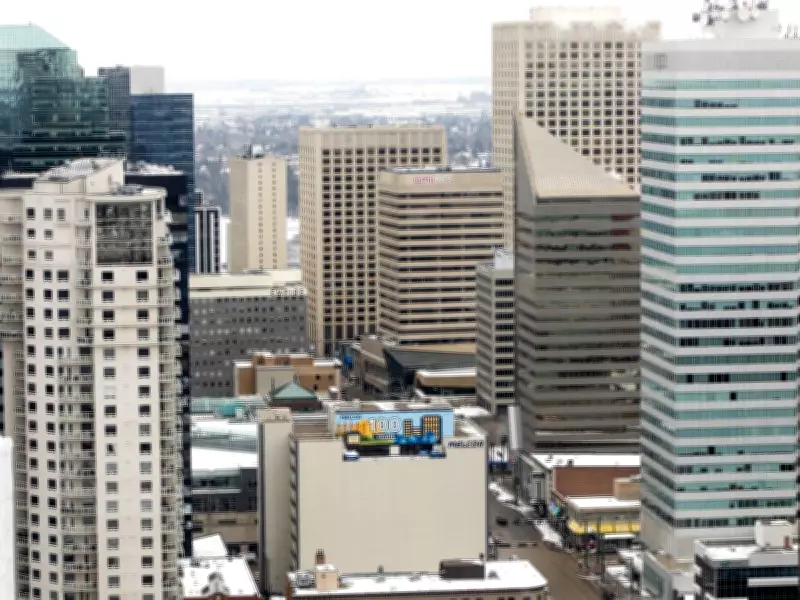
There's a tendency in conversations about downtown Edmonton to dwell on what's missing. But the data tells a far more constructive story. Quietly and steadily, billions of dollars have flowed into the core, reshaping not just the skyline, but the trajectory of the city itself.
There's a gap between what people say about downtown and what investors are actually doing. Nearly $4.7 billion in projects have either been completed or are underway, reflecting sustained investment activity and continued confidence. That figure includes renovations and isn't a pure measure of new construction, but it still signals something important: sustained activity, continued commitment, and a market that, despite the noise, is still betting on downtown's future.
More telling is where investors have actually put money on the table. Since 2019, downtown has seen approximately $1.93 billion in completed property transactions across office, multifamily, retail, post-secondary and hotel assets. That is real capital changing hands, arguably the clearest signal that sophisticated investors see long-term value in the core.

Tangible and Diverse Investments
The investment is tangible, visible, and increasingly diverse. Over the past few years, downtown has seen a series of significant private-sector real estate transactions. A key example is the recent investment in ATB Place, a major multi-year redevelopment modernizing one of downtown's largest office complexes. Similarly, National Bank's long-term downtown commitment, anchored at the former CWB headquarters (now National Bank Centre), included approximately $45 million in podium and building renovations.
ATCO has also made a long-term commitment to remain downtown through its relocation to the former CWB tower (now ATCO Place). The Rice Howard Place reinvestment underscores a strong commitment to downtown, modernizing a fully occupied landmark to enhance competitiveness, extend its lifespan, and support continued economic activity.
Return-to-Office Driving Foot Traffic
Increasing return-to-office activity among large tenants is driving higher daytime foot traffic and gradually improving market sentiment. Collectively, these moves underscore a clear theme: Capital is concentrating in best-in-class and re-positioned assets, while renewed in-office activity is reinforcing confidence and vitality.
Major Institutional Projects
Major institutional projects are also contributing. The $190-million MacEwan University School of Business building and the planned $240–250-million NorQuest Career Skills Centre are not just education facilities; they are long-term population drivers. Thousands of students, faculty, and staff bring consistent, year-round foot traffic, something every downtown needs to thrive.
Layer in transformative infrastructure like the Valley Line LRT projects, roughly $3 billion combined, and the picture sharpens. Connectivity is destiny for urban cores, and Edmonton is investing accordingly.
Residential and Mixed-Use Developments
Residential and mixed-use developments, from Encore Tower to The Switch at Station Lands, Falcon Tower, and projects surrounding Warehouse Park, such as The Parks and Lotus, are steadily adding density. Even smaller-scale projects like the Connect Centre retail podium demonstrate that retail confidence, while cautious, is still present.
As downtown Edmonton turns a corner, the hard part lies ahead: ensuring that this momentum translates into lasting vibrancy, addressing challenges like homelessness and safety, and fostering a downtown that works for everyone.