

A groundbreaking report released by the National Angel Capital Organization (NACO) in partnership with Startup Genome has uncovered a severe structural gap in Canada's early-stage funding landscape, resulting in staggering economic losses. The analysis, based on approximately 65,000 funding rounds since 2006, reveals that this deficiency has cost Canada an estimated $66 billion USD in ecosystem value and approximately 133,000 high-quality jobs.
The Widening Seed Funding Disparity
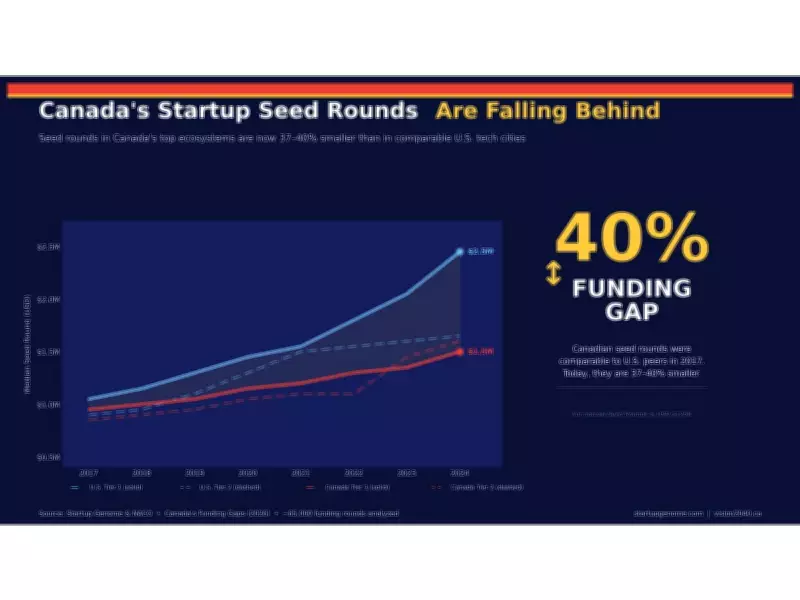
Canadian seed rounds were once comparable to those in the United States as recently as 2017. However, the report highlights a dramatic shift: startups in Canada's top ecosystems now raise seed rounds that are 37–40% smaller than their counterparts in similar American tech cities. This gap has not narrowed but has instead expanded under successive federal venture capital initiatives, indicating a systemic failure in the funding architecture.
Impact on Major Canadian Ecosystems
The consequences are evident in Canada's leading startup hubs. Toronto-Waterloo, Vancouver, and Montreal have collectively shed $66 billion USD in ecosystem value since their peaks. Global rankings reflect this decline, with Toronto falling from 13th to 20th, Vancouver from 15th to 36th, and Montreal from 20th to 39th over the past 6-8 years. The report attributes these drops to a structurally broken foundation at the seed stage, where inadequate investment stifles growth from the outset.

Compounding Effects Across Funding Stages
The seed funding shortfall creates a ripple effect throughout the startup lifecycle. Proportionally, 12–15% fewer Canadian startups receive seed funding compared to U.S. Tier 1 ecosystems. This leads to fewer companies advancing to Series A, reduced breakout rounds, and ultimately fewer successful exits. The gap compounds at each successive stage, with Canadian startups taking over five months longer on average to close a seed round and 13 months longer to reach Series A than their U.S. peers.
Estimates place Canada's minimum annual funding shortfall at $141 million USD at the seed and pre-seed stage, with an additional $181 million gap at Series A. The report emphasizes that Canada's Series A deficiency is a direct consequence of persistent underinvestment at the seed level, undermining the entire venture capital pipeline.
Challenges for AI Startups
Particularly concerning is the situation for AI-native startups, which represent the fastest-growing category globally. In Canada, these startups raise only half as much at seed as their U.S. equivalents and face significantly longer fundraising timelines. This is despite AI-related companies now accounting for 20% of all Canadian startups formed in the past two years, up from just 4–5% five years ago, highlighting a missed opportunity in a critical innovation sector.
Structural Underinvestment and Policy Implications
Canada has long grappled with structural underinvestment in seed-stage capital. While federal programs like VCAP and VCCI have successfully expanded later-stage financing, capital has disproportionately flowed through institutional managers focused on Series A and beyond. Data from the report shows that under VCAP, the Seed-to-Series A funding ratio was approximately 95%, but following VCCI, Series A investment grew 2.5 times while seed investment increased only 1.6 times.
This imbalance underscores the need for policy adjustments to rebalance funding toward early-stage ventures. Without addressing this foundational gap, Canada risks further erosion of its competitive position in the global tech landscape, perpetuating job losses and diminished economic returns from its innovation ecosystems.






