

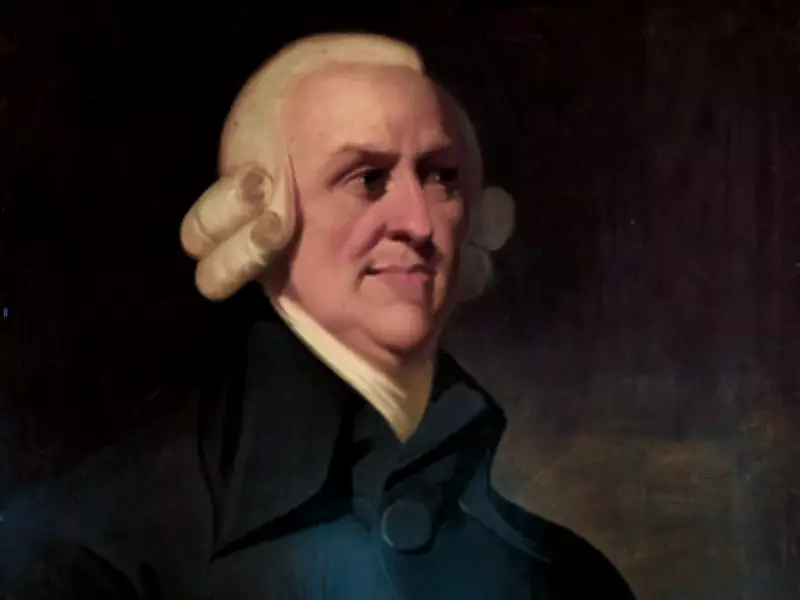
Adam Smith's Wealth of Nations at 250: The Unseen Market Forces That Shape Prosperity
This year marks the 250th anniversary of Adam Smith's groundbreaking economic treatise, An Inquiry into the Nature and Causes of the Wealth of Nations, published on March 9, 1776. This seminal work shares its birth year with another revolutionary document: the United States Declaration of Independence. Both texts fundamentally reshaped their respective domains, with Smith's book establishing itself as the foundational text of modern economics.
A Revolutionary Vision for Commerce and Colonies
Smith described his magnum opus as a "very violent attack ... on the whole commercial system of Great Britain." His critique targeted the mercantilist policies that dominated 18th-century European economies. Despite this harsh assessment of British practices, Smith expressed remarkable optimism about the North American colonies, viewing them as a potential laboratory for his free market principles.
He accurately predicted that the United States would evolve into a great nation and eventually become Britain's primary trading partner. This foresight demonstrated Smith's profound understanding of how economic freedom could drive national development and international commerce.

The Intellectual Journey of a Scottish Philosopher
Adam Smith was born in Kirkcaldy, a small seaport town across the Firth of Forth from Edinburgh. His academic journey took him to the Universities of Glasgow and Oxford before he returned to Glasgow as a professor. During this period, he produced his first major work, The Theory of Moral Sentiments, which earned praise from contemporary thinkers including Edmund Burke.
Burke noted that Smith's work revealed "a man of uncommon observation, not only of his own mental states, but of the life and ways of men about him." This philosophical foundation would inform Smith's later economic theories, connecting moral philosophy with practical economics.
The Path to Economic Enlightenment
Smith's intellectual reputation attracted the attention of Charles Townshend, a prominent British politician who eventually persuaded Smith to accompany his stepson, the Duke of Buccleuch, on an educational Grand Tour of Europe. This assignment came with a pension that allowed Smith to return to his mother's home in Kirkcaldy to write his masterpiece.
As Smith prepared his manuscript for publication in London, the North American colonies were embroiled in crisis, partly triggered by taxes Townshend had imposed as Chancellor of the Exchequer. Smith's insights would become part of the intellectual atmosphere that both informed America's founding fathers and helped catalyze the Industrial Revolution.
The Three Pillars of Economic Growth
Smith identified three fundamental drivers of economic growth and national wealth:
- The universal human desire to "better their condition"
- The division of labor
- Free trade
In perhaps his most famous passage, Smith wrote: "It is not from the benevolence of the butcher, the brewer, or the baker that we expect our dinner, but from their regard to their own interest." This observation wasn't meant to suggest these tradespeople lacked kindness, but rather to highlight how systemic good emerges from profit-driven voluntary exchange.
The Power of Specialization and Productivity
Smith observed that people naturally divide their labor between trades and professions because this increases productivity—the amount of goods or services produced within a given timeframe. He provided the compelling example of a pin factory to illustrate this principle.
While an individual working alone might struggle to produce a single dress pin in a day, Smith calculated that ten individuals with basic machinery could manufacture an astonishing 48,000 pins. This dramatic increase in output demonstrated how specialization and division of labor could transform productive capacity.

Smith further argued that widespread free trade was essential because larger markets encouraged greater specialization, leading to additional productivity gains. His vision created a framework for understanding how market systems invisibly coordinate human activity to meet societal needs, even when individuals are primarily pursuing their own interests.
Contemporary Relevance and Policy Debates
Intriguingly, some current economic policies pursued by the White House resemble those Smith criticized in his time. This tension highlights the ongoing relevance of Smith's ideas in contemporary policy debates. As we commemorate the 250th anniversary of The Wealth of Nations, Smith's insights continue to inform discussions about economic freedom, market regulation, and the fundamental drivers of prosperity.
The enduring legacy of Smith's work lies in its ability to explain how decentralized market systems, driven by individual self-interest and voluntary exchange, can generate widespread benefits that often go unappreciated by those who benefit from them. This invisible coordination remains one of the most powerful yet misunderstood forces shaping modern economies.





