

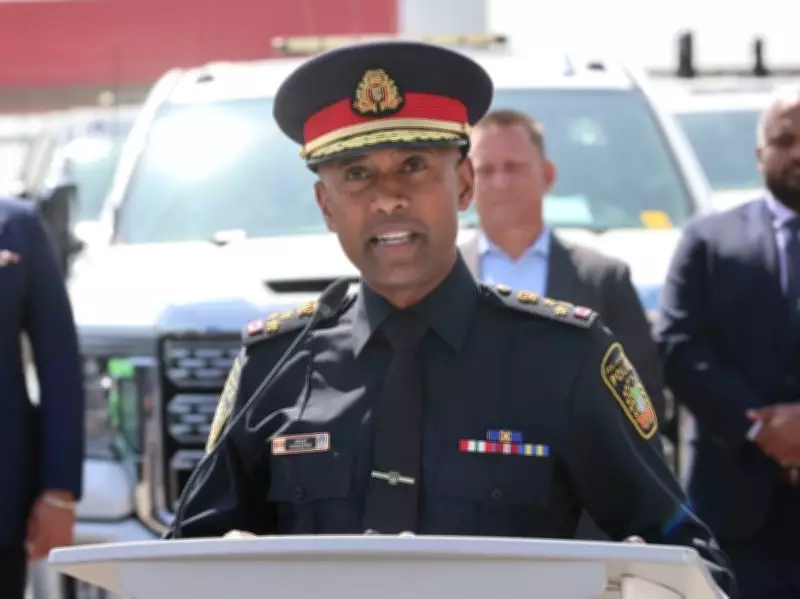
Peel Regional Police Chief Leads Nation in Police Compensation
While many might assume the police chief of a major metropolitan area like Toronto would command the highest salary among Canadian police leaders, the reality is quite different. According to the latest Ontario Sunshine List data from 2025, Peel Regional Police Chief Nishan Duraiappah holds the distinction of being the highest-paid police chief in the country, and by a significant margin.
Substantial Earnings Growth Since Appointment
Chief Duraiappah, who assumed leadership of the Peel Regional Police in October 2019, has seen his compensation nearly double since his first full year in the role. In 2020, he earned a total of $311,254, comprising a salary of $299,196 plus $12,058 in benefits. By 2025, his earnings had surged to $611,668, which included a salary of $604,449 and benefits totaling $7,229. This represents a remarkable 25.9% increase from his 2024 compensation.
Notably, Duraiappah's 2025 earnings place him as the 58th highest-paid public sector employee in Ontario. His compensation exceeds that of the second-highest-paid police chief in the Golden Horseshoe region by $118,975. Perhaps more strikingly, he earned approximately $340,000 more than Ontario Premier Doug Ford, about $190,000 more than Canada's Prime Minister Mark Carney, and roughly $370,000 more than Toronto Mayor Olivia Chow.

Leadership Team Also Commands High Salaries
The Peel Regional Police leadership team, consisting of Chief Duraiappah and five deputy chiefs, collectively earned $2,256,297 in 2025. Deputy Chief Nick Milinovich was the highest earner among the deputies, with total compensation of $496,580. The other deputy chiefs and their earnings were:
- Anthony Odoardi: $449,453
- Mark Dapat: $418,688
- Marc Andrews: $410,023
- Lauren Jackson (civilian): $366,465
Interestingly, Deputy Chief Milinovich's earnings of $496,580 were nearly $4,000 higher than those of Niagara Regional Police Chief Bill Fordy, who was the second-highest-paid police chief in the Golden Horseshoe with total compensation of $492,693.
Comparison with Other Regional Police Chiefs
The 2025 Sunshine List reveals how other police chiefs in the Golden Horseshoe region compared in terms of compensation:
- Niagara Regional Police Chief Bill Fordy: $492,693 (32.7% increase from 2024)
- York Regional Police Chief Jim MacSween: $488,509 (9.7% increase from 2024)
- Halton Regional Police Chief Stephen Tanner: $473,182 (12.2% increase from 2024)
- OPP Commissioner Thomas Carrique: $469,031 (28.3% increase from 2024)
- Toronto Police Chief Myron Demkiw: $458,250 (13% increase from 2024)
- Hamilton Police Chief Frank Bergen: $431,193 (8.3% increase from 2024)
- Durham Regional Police Chief Peter Moreira: $361,443 (18.3% increase from 2024)
Chief Demkiw's earnings were $153,418 less than those of Chief Duraiappah, despite Toronto having more than double the population of Peel Region. Toronto's population is approximately 3.3 million, while Peel Region, encompassing Brampton, Mississauga, and Caledon, has about 1.6 million residents.
Toronto Police Leadership Costs Less
The Toronto Police Service leadership team, which includes only four members compared to Peel's six, cost taxpayers significantly less in 2025. The Toronto team's total compensation was $1,428,724, which is $827,573 less than the Peel leadership team. The Toronto Police Service also employs approximately 4,870 uniformed members and 2,230 non-uniformed members, essentially double the staffing levels of the Peel Regional Police Service, which has about 2,200 uniformed and 875 non-uniformed members.
If Chief Duraiappah's salary were calculated based on a standard 40-hour work week, he would have earned more than $290 per hour in 2025, or over $11,600 weekly before benefits. This hourly rate exceeds what most doctors in Ontario earn and stands in stark contrast to the province's minimum wage, which increased to $17.95 per hour in October 2025. A minimum-wage earner working 40 hours per week would make $718 weekly or $37,336 annually.

The substantial compensation for Peel's police leadership comes as the region continues to grapple with significant crime challenges, including gun and gang violence, home invasions, carjackings, robberies, and fraudulent activities. These figures highlight ongoing discussions about public sector compensation, policing priorities, and resource allocation in Ontario's municipal jurisdictions.





