

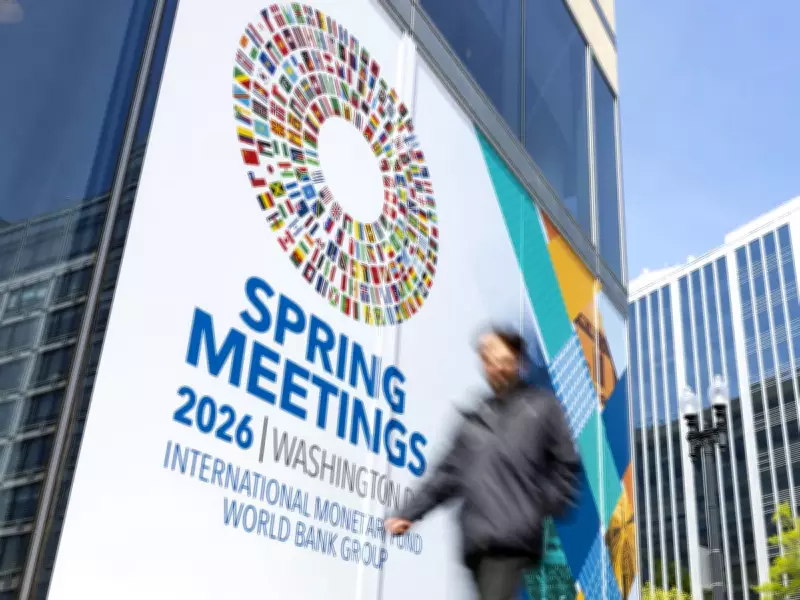
Global Finance Chiefs Return to IMF with Familiar Concerns Over Trump Policies
Economic policymakers from around the world are preparing to gather in Washington D.C. for the International Monetary Fund and World Bank spring meetings, scheduled for April 13-18, 2026. This year's assembly carries a distinct sense of déjà vu for many attendees, who recall last year's event being dominated by discussions about punitive trade tariffs implemented by former President Donald Trump.
Assessing the Damage from Middle East Conflict
The 2026 meetings will focus heavily on evaluating the economic damage caused by Trump's war on Iran and its ripple effects across global markets. Despite marathon weekend talks in Pakistan aimed at turning a two-week ceasefire into lasting peace, the United States and Iran failed to reach a comprehensive agreement, leaving economic uncertainty in their wake.
IMF Managing Director Kristalina Georgieva has already warned participants that the international community is becoming less capable of responding to economic shocks. She cited multiple challenges including limited fiscal space, policies that protect individual nations at the expense of others, and great-power politics that increasingly fuel conflicts rather than resolve them.

Downgraded Forecasts and Warning Signs
"Buckle up" was Georgieva's primary advice ahead of new economic forecasts scheduled for release on Tuesday, alongside a report on global financial stability. She confirmed that the IMF will downgrade its projections due to the impact of the Middle East conflict.
In January, world output was projected to rise 3.3 percent this year, with expansions of 2.1 percent in the United States, 1.4 percent in the euro zone, and 5.4 percent across emerging Asia. These optimistic forecasts were shattered when bombs began hitting Iran at the end of February, creating new economic headwinds.
Long-Term Consequences and Market Resilience
Ludovic Subran, chief economist at Allianz SE, told Bloomberg Television that "the next couple of quarters are going to be essential to understand how much this has tested the resilience of some economies that were a bit in a muddle-through period before the war."
What appears increasingly clear is that the ripple effects of Trump's aggression and the mistrust it has generated will persist even if the current ceasefire holds, peace is restored, and shipping through critical waterways like the Strait of Hormuz returns to normal operations.
Commodity Markets and Global Implications
Ewa Manthey, a commodities strategist at ING, noted that "this ceasefire has clearly removed the most extreme downside risk" but cautioned that "for this to be a true turning point, we would need to see sustained and uneventful flows through the Strait of Hormuz, not just the headlines about reopening."
Bloomberg Economics analysis suggests that "last year it was tariffs. This year it's oil prices. Trump's America First instincts are injecting significant volatility into the global economy." While the tariff shock proved less severe than initially anticipated, the Iran war shock could follow a similar pattern—though continued closure of the Strait of Hormuz would keep oil prices elevated, deepen the blow to global growth, and increase inflationary pressures worldwide.
Broader Economic Context
With top monetary policy officials converging in Washington, central bank activity elsewhere appears relatively subdued. However, important economic indicators are scheduled for release across multiple regions, including GDP data from China and the United Kingdom, along with inflation readings from diverse economies ranging from India to Nigeria to Argentina.
The spring meetings will also address how governments and central banks can best support their economies without creating new problems, particularly as fiscal constraints become more pronounced and policy coordination between nations grows increasingly challenging.






