

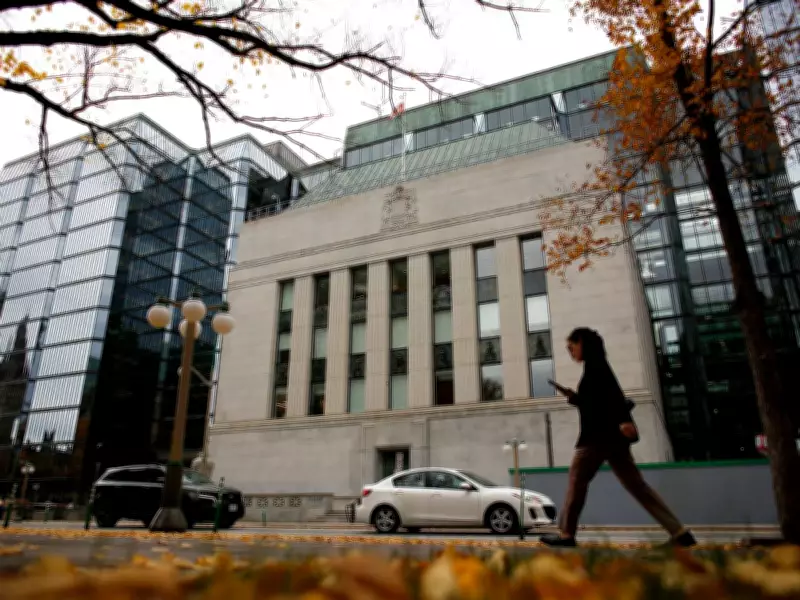
Economists Raise Concerns Over Bank of Canada Growth Projections Following Weak GDP Data
The Bank of Canada's latest economic growth forecasts face significant scrutiny after November's gross domestic product (GDP) figures came in weaker than anticipated, according to financial analysts. The monthly economic data reveals underlying challenges that could complicate the central bank's projections for the coming year.
November GDP Falls Short of Expectations
Economic growth remained essentially flat in November, registering a 0.0% change that slightly missed estimates predicting a 0.1% increase. While this represents an improvement over October's 0.3% contraction, economists note the figures suggest persistent economic headwinds. Statistics Canada estimates the economy expanded by just 0.1% in December, indicating the fourth quarter likely contracted by an annualized 0.5%.
This performance contrasts sharply with the Bank of Canada's projections outlined in its recent Monetary Policy Report, which anticipated fourth-quarter GDP at zero percent. The central bank had forecasted a more robust 1.8% GDP rebound for the first quarter of 2026.

Manufacturing Sector Shows Particular Weakness
The manufacturing sector experienced a significant 1.3% decline in November, driven primarily by a 1.9% contraction in durable goods. This follows an even steeper 2.6% drop in October. Transportation equipment manufacturing, machinery manufacturing, and fabricated metal product manufacturing all registered month-over-month declines, with automotive manufacturing contracting sharply by 6.4%.
"The monthly data for November is grimmer than it first appears," noted Alexandra Brown, North America economist at Capital Economics Ltd. "Statistics Canada attributed the weakness in manufacturing to supply chain bottlenecks, such as a global semiconductor shortage." Manufacturing activity has fallen to levels not seen since 2011, excluding pandemic-related disruptions.
Economists Express Concern Over Economic Momentum
"The Canadian economy was still struggling to eke out growth towards the end of the fourth quarter," observed Andrew Grantham, an economist at CIBC Capital Markets. He pointed out that even positive developments in the retail sector resulted from temporary factors, specifically the resolution of an industrial dispute in British Columbia that had previously impacted liquor sales.
Grantham highlighted particular concerns about trade uncertainty and tariffs continuing to negatively affect Canadian manufacturing and wholesaling sectors. "It's apparent that the economy is also struggling for momentum in other areas," he added.
Implications for Monetary Policy
The sluggish economic performance raises questions about the Bank of Canada's ability to achieve its growth targets. "The still sluggish momentum towards quarter end may be a concern, as monthly growth rates will need to accelerate for the economy to achieve the Bank of Canada's near two per cent MPR forecast for the first quarter," Grantham explained.
Given the current economic conditions, Grantham suggested that interest rates may need to remain in stimulative territory throughout 2026 and into early 2027 to address persistent economic slack. The discrepancy between Statistics Canada's preliminary estimates and the Bank of Canada's projections may become clearer when complete fourth-quarter data is published at the end of February.
Economists will closely monitor upcoming economic indicators to determine whether the Canadian economy can regain sufficient momentum to align with central bank expectations or if further adjustments to growth forecasts will be necessary.






