

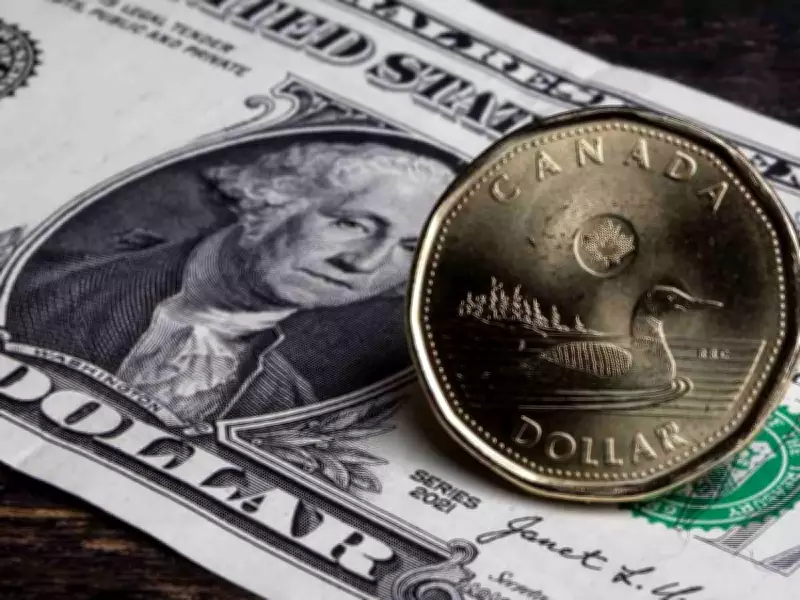
CIBC Forecasts Canadian Dollar as Future Underperformer Once Conflict Subsides
The Canadian dollar, commonly known as the loonie, has shown signs of recovery after a challenging March where it declined by two percent. However, currency analysts remain skeptical about its ability to sustain momentum and fully regain lost ground in the coming months.
Analysts Point to Structural Weaknesses Despite Oil Price Surge
Erik Nelson, an analyst at Wells Fargo & Co., highlighted in a recent note that the loonie's performance has been surprisingly weak given the substantial increases in oil prices. He attributed this underperformance to a combination of factors including a weaker growth outlook and lower expectations for interest rate hikes compared to other major economies like Great Britain and the eurozone.
"These central banks have seen greater repricing toward hikes in the last month," Nelson stated, emphasizing the comparative disadvantage for Canada's monetary policy trajectory.

Market Expectations and Geopolitical Influences
Current market data indicates that investors are pricing in one 25-basis-point interest rate hike in Canada, with approximately 70 percent probability of a second hike this year. In contrast, the eurozone is fully priced for two hikes, reflecting stronger economic signals from that region.
The early stages of the United States-Israel-led conflict with Iran initially boosted the loonie as oil prices surged dramatically. This rally was short-lived as the war persisted, driving investors toward the safety of the U.S. dollar, which appreciated by 2.4 percent last month alone.
On Wednesday, the Canadian dollar managed to claw back some losses, gaining nearly a quarter of a percent to briefly exceed 72 cents U.S., after reaching a peak of 73.7 cents U.S. in March. This minor recovery coincided with news that U.S. President Donald Trump was considering ending the war within two to three weeks, though he simultaneously warned of continued aggressive actions against Iran.
Post-War Projections and Economic Headwinds
Despite the potential easing of U.S. dollar pressure, Nelson cautioned that the loonie faces a turbulent path ahead. "The second quarter could still be a bumpy ride with the labour market still on shaky footing and Canada-U.S.-Mexico Agreement uncertainty still lingering," he explained in his analysis.
Wells Fargo has set a specific target, forecasting the loonie to trade at 72.5 cents U.S. during the second quarter of 2026. Similarly, CIBC Capital Markets does not anticipate significant appreciation for the Canadian dollar even if the war concludes, projecting it to remain around 72 cents U.S.
Geopolitical Risk Premium and Oil Price Vulnerability
Sarah Ying, head of FX strategy in fixed income, currency and commodities at CIBC Capital Markets, noted that geopolitical sentiment has been the primary driver of recent currency movements, disproportionately benefiting the U.S. dollar. "In an end-of-war scenario, we suspect this geopolitical risk premium is unwound. However, opposite that is oil prices selling off, which will weaken the Canadian dollar leg," she elaborated in a Monday note.
Ying anticipates that any correction in oil prices would be "rather sharp," further pressuring the loonie. Once hostilities cease, she expects investor focus to shift back to several concerning domestic issues:
- The ongoing review of the Canada-U.S.-Mexico Agreement
- Deteriorating economic fundamentals
- Persistently sluggish business investment
These factors collectively suggest that the Canadian dollar may struggle to maintain its strength in a post-conflict environment, positioning it as a likely underperformer among major currencies according to CIBC's assessment.






