

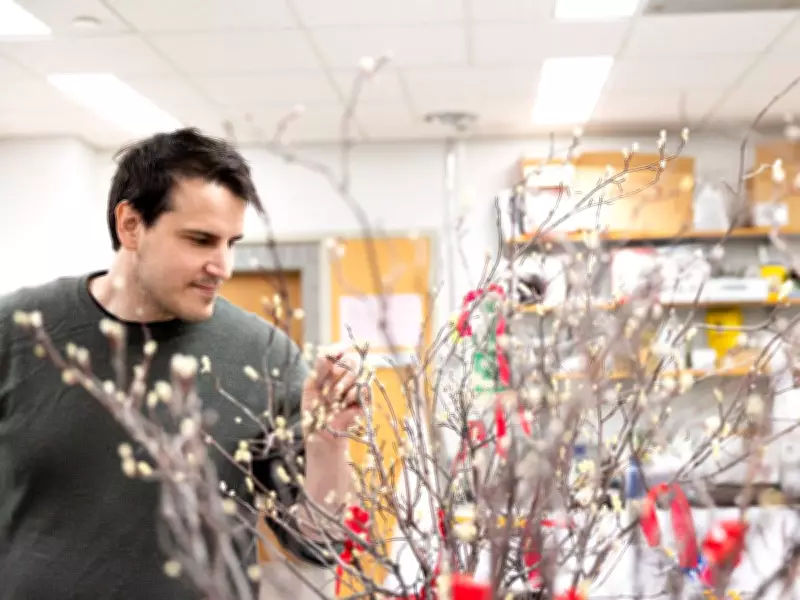
University of Saskatchewan Researcher Aims to Revolutionize Saskatoon Berry Breeding
Inside the fruit-breeding laboratory of assistant professor Anže Švara at the University of Saskatchewan, a specialized circular machine stands ready to analyze the humble Saskatoon berry. Each berry is carefully placed into slots, where a small probe methodically crushes it while recording precise pressure levels. This process yields valuable empirical data on texture and firmness for various genetic varieties within the university's extensive collection of approximately 2,000 plants.
Overcoming Genetic Challenges
Despite decades of accumulated plant specimens, researchers have faced significant obstacles in selectively breeding Saskatoon berries due to a peculiar genetic trait prevalent in popular varieties. Švara, who originally hails from Slovenia, is now spearheading a breeding program that could transform berry production in Saskatchewan and beyond.
"Just establishing or enabling a breeding program that can actually improve specific traits will be a big step forward," Švara explained during an interview in his office, where a box of Saskatoon berry tea sat on a shelf behind him.

The core challenge stems from the reproductive characteristics of most cultivated Saskatoon varieties. These plants typically produce offspring that closely resemble their maternal parent, creating limited genetic diversity for breeding purposes. Researchers have identified that most current varieties possess four sets of chromosomes, whereas they seek varieties with only two sets.
The Path to Improved Varieties
Švara and his research team, including graduate student Sumi Sarkar and research technician Justin Schaeffer, are working to identify Saskatoon plants with two chromosome sets. The hypothesis suggests that offspring from these plants would exhibit both maternal and paternal traits, creating the diverse gene pool necessary for effective selective breeding.
"So we are trying to go one step back, find those that can sexually reproduce first and then try to improve specific traits using those plants," Švara elaborated.
The research methodology involves multiple critical steps:
- Identifying varieties with two chromosome sets
- Crossing compatible plants
- Developing new seeds from successful crosses
- Selecting the most promising offspring for further development
Funding and Future Prospects
Švara's innovative project has received substantial support through the Agriculture Development Fund (ADF), which recently allocated $7.2 million for crop research initiatives across Saskatchewan. This funding enables the comprehensive research needed to potentially bring Saskatoon berries to mainstream grocery stores.
Currently, the Saskatoon berry industry primarily consists of U-pick operations, with fresh berries rarely appearing in supermarkets. Švara acknowledges that transforming this landscape will require patience and persistence.
"We might find a lot of plants immediately that can cross, and we start crossing them, and we see that it works great, and in three to five years we can already have some new plants that might be improved selections. But it could also take a decade, right?" he cautioned.
Beyond texture analysis, researchers employ additional probes to assess the sourness and sweetness of berry juice, ensuring comprehensive quality evaluation. Selective breeding has historically shaped the taste and texture of virtually all commercial fruit available today, and Švara's work aims to bring similar improvements to Saskatoon berries.
The research extends beyond Saskatoon berries to include complementary projects involving haskaps and hazelnuts, demonstrating the laboratory's broad commitment to advancing fruit cultivation in Saskatchewan. As the team continues their meticulous work, they remain optimistic about eventually developing berry varieties that could revolutionize both commercial production and consumer accessibility.






