Gardeners often lament about a shady spot where nothing seems to grow, but with careful plant selection that lament can turn into a beautiful melody. Many plants tolerate shade but are not genuinely happy about it: blooms may be delayed and fewer, and growth may become stretched out and spindly. The trick is to choose plants that truly thrive in the shade, such as those found in the forest understory.
Benefits of Shade Gardens
In addition to creating a calming garden, shade lovers are less susceptible to the drying summer sun and heat, which seems ever more persistent these days. However, shade may be a result of thirsty trees, which create dry conditions. Avoid planting close to tree trunks where roots are most abundant, and regularly water new plants to help them compete with tree roots as they become established.
Avoid Invasive Plants
You may be tempted by rapidly spreading plants, but many are invasive and can quickly dominate your garden. These include goutweed (Aegopodium podagraria), lily of the valley (Convallaria majalis), periwinkle (Vinca minor), and Japanese spurge (Pachysandra terminalis). Unless specified, the perennial plants listed below do not require moist conditions, though most will benefit from mulch, such as cedar chips, to help preserve moisture and combat weeds.

Early Spring Bloomers
Early risers emerge from the forest floor before trees leaf out. Bloodroot (Sanguinaria canadensis), a North American native, has beautiful deeply lobed leaves and gorgeous white flowers (10 cm tall). Beware though, its scarlet sap is toxic. The white trillium (Trillium grandiflorum) is Ontario's provincial flower (30-45 cm tall). There are five native species, including the red trillium (Trillium erectum), often called wake robin.
Hellebore
Hellebore (Helleborus spp.), a low-lying, evergreen clump, may bloom when there is still snow on the ground. Its rose-like blossoms come in a range of colours, from white to maroon.
Mid-Spring Favorites
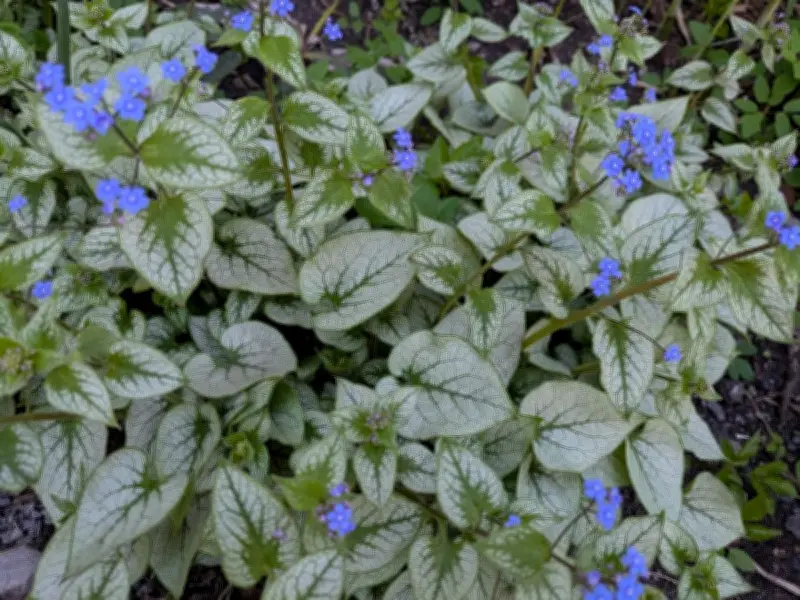
By mid-spring, Siberian bugloss (Brunnera macrophylla) offers delicate blue flowers, reminiscent of forget-me-nots, and heart-shaped leaves. It forms clumps about 75 cm wide and 45 cm tall. Barrenwort (Epimedium spp.), an underused, lovely groundcover (25 cm tall, 50 cm spread), has delicate spring flowers in many hues on arched stems. Its handsome, heart-shaped foliage can be tinged with red or orange. Barrenwort thrives in dry conditions, including under trees.
Groundcovers
Canadian wild ginger (Asarum canadense) is an ideal native ground cover with kidney-shaped leaves and brownish, bell-shaped flowers.
Late Spring Highlights
Later in spring, bleeding heart (Lamprocapnos spectabilis) lights up the garden with sprightly foliage and delicate pendulums of heart-shaped flowers in red, pink, or white (30-90 cm tall). It needs moist soil. Columbine (Aquilegia spp.) is a graceful, delicate plant that can self-seed prolifically and is very hardy (30-90 cm tall). It comes in a rainbow of colours. A favourite is the native red and yellow eastern columbine (Aquilegia canadensis).