

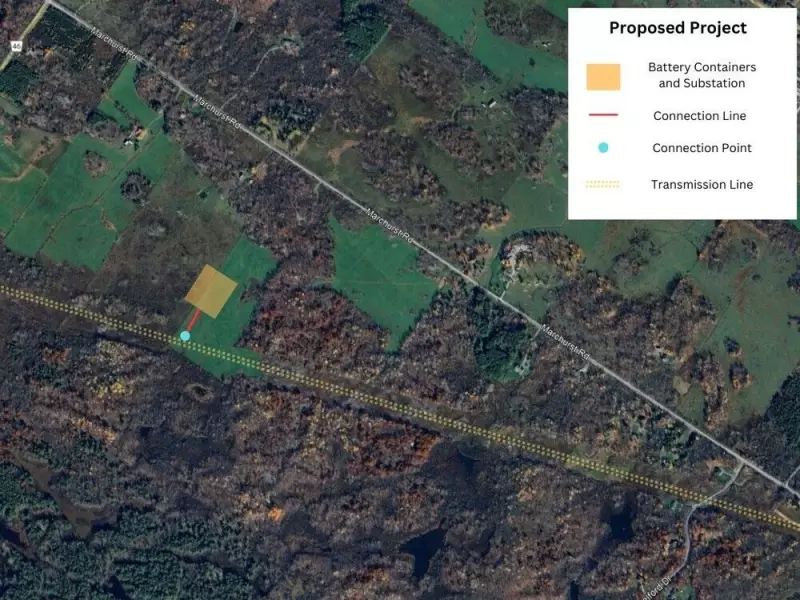
In a significant decision impacting Ontario's clean energy infrastructure plans, Ottawa's Agricultural and Rural Affairs Committee has voted against rezoning a rural property near Dunrobin for a massive battery storage facility. The vote, held on December 2, 2025, saw three of the five rural councillors reject the proposal from Brookfield Renewables.
Project Details and Community Opposition
The proposed South March Battery Energy Storage System (BESS) was slated for a 15-acre site at 2555 and 2625 Marchurst Road. The $650-million project involved constructing a substation, 256 lithium-ion battery containers with noise walls, and a stormwater management system. Proponents argued the facility was essential for storing electricity generated by wind and solar power, helping to manage supply and demand on Ontario's grid.
However, the plan faced fierce local opposition. Approximately 40 residents signed up to address the committee, voicing deep-seated concerns. Key issues included potential noise pollution, risks of fire from the lithium-ion batteries, contamination of local well water, and a lack of detailed plans for decommissioning the site after its projected 25-year lifespan.

The Debate: Clean Energy vs. Rural Preservation
Geoff Wright, senior vice-president of strategic partnerships at Brookfield, presented the company's case. He stated that the Independent Electricity System Operator (IESO) has contracted for 26 such batteries across Ontario, calling them the "safest and most cost-effective tool" to meet growing electricity needs. Wright emphasized Brookfield's global experience and the maturity of modern, containerized battery technology installed in open spaces.
Supporters like Rideau ward resident Nicky Trudell advocated for the project as a necessary step toward clean, affordable energy, stating it would help reduce reliance on dirtier, more expensive power sources.
Conversely, residents from the Marchurst Road area felt their community's voice was being ignored. They criticized Brookfield for holding a town hall meeting only six days before the crucial committee vote, arguing it demonstrated a lack of meaningful community engagement. Their core argument was that prime farmland is an inappropriate location for an industrial-scale energy project.
Outcome and Implications
The committee's rejection to change the zoning from "rural countryside" to "rural general industrial" represents a major setback for the project. This decision highlights the ongoing tension in Canada between the urgent push for renewable energy infrastructure and the desire of rural communities to preserve agricultural land and local character.
The vote underscores the challenges developers face in siting large-scale energy projects, even those critical to a greener grid. It remains to be seen if Brookfield Renewables will revise its proposal or seek an alternative location for the battery storage system.






