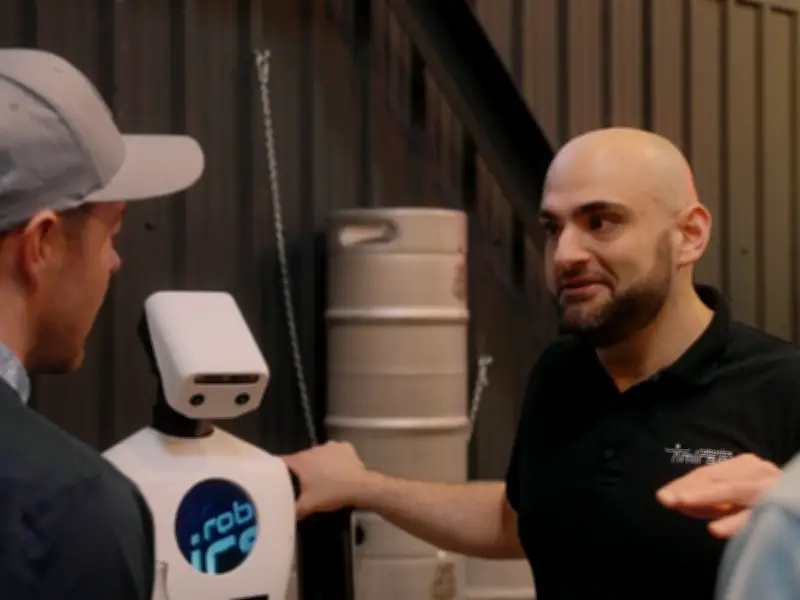
Cambridge, Ont.-based Mirsee Robotics Inc. is developing the third generation of its humanoid robot on wheels, the MH3, to automate labour-intensive and dangerous tasks that “shouldn’t be performed by humans,” said Tarek Rahim, co-founder and chief executive officer.
MH3 humanoid robot aims to replace backbreaking jobs
Founded in 2017, the startup is testing the new robots as it plans to scale up for mass production starting next year. “We’ve produced eight units of MH3 and once testing is complete and the robots are validated, we’re going to ramp up production into the thousands of units over the next three years,” said Rahim.
Mirsee is one of a handful of Canadian companies competing globally to develop humanoid robots for uses ranging from elder care to customer service, as well as industrial and remote operations. In Mirsee’s case, “We’re really going after repetitive, backbreaking jobs that aren’t high value like order fulfillment or total handling. These are the kinds of jobs that people don’t want to do, so there are consistent staffing issues. We can alleviate that with advanced automation,” said Rahim.

Improved mobility and strength in MH3
The previous models were not suitable for commercialization because their capabilities were limited in a factory environment. The MH3 differs with improved mobility and strength, including the ability to lift up to 30 kilograms in each arm, a 10-hour runtime and 31 degrees of freedom to mimic human arm and hand movement. Every subsystem is designed and assembled in Cambridge, including the arms, heads and vision systems, said Rahim.
The robots are currently designed to autonomously move materials, fulfill orders, handle bins and tend machines in warehouse settings. For specialized tasks, an operator can also remotely control MH3s from distances up to 1,500 kilometres away by using a virtual reality headset, which shows a live 3D video feed from the robot’s cameras, and gloves that track user’s hand movements so the robots can mimic those actions.
Remote control for hazardous environments
Remote control is suitable for applications in hard-to-reach or hazardous work-sites, such as remote water treatment plants. The MH3 robots use artificial intelligence to navigate complicated environments and adapt autonomously alongside remote operation for specialized tasks to “extend human capabilities,” Rahim said. This differentiates these robots from hard-coded ones currently used in manufacturing. Current industrial automation requires static assembly lines to repeat the same motions and cannot handle real-world unpredictability.