

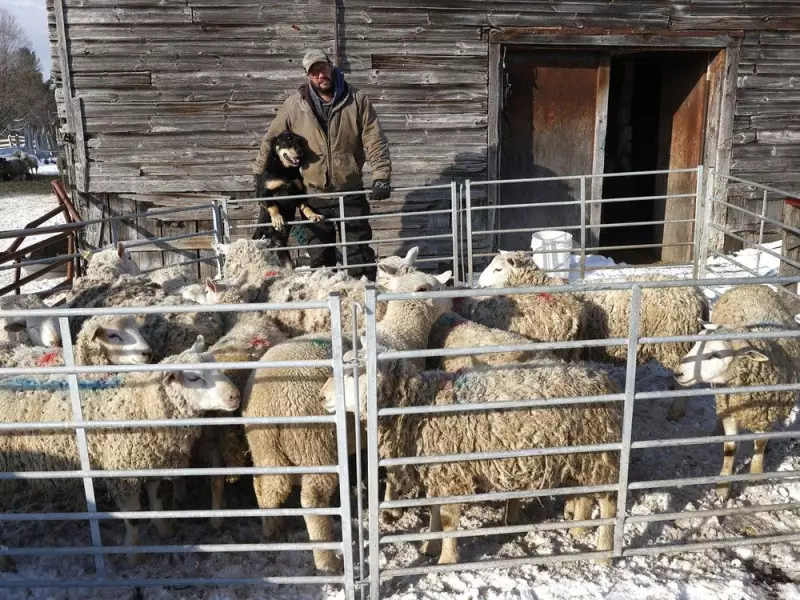
For Chris Moore, the sight of a massive solar farm near Galetta, Ontario, being mowed was a persistent call to action. The farmer, who has raised sheep since he was 12, saw a simple, elegant solution: his flock could do that job. That initial thought, sparked around eight years ago, grew into a thriving agricultural enterprise known as solar grazing, or "lamb-scaping."
From a Cold Call to a Sustainable Partnership
Moore and his wife, Lyndsey Smith, owners of Shady Creek Lamb Co. near Carp, Ontario, were facing a common farming challenge. Their 100-acre family farm, held for three generations, had grazing limitations. "It sounds like a lot of land if you live in the city," Smith notes. "But it's really not because we have winter." Land needed for growing winter feed couldn't also be used for year-round grazing, limiting their ability to scale up.
Buying more land or building barns was cost-prohibitive. Their innovative answer was twofold: raise sheep that "carry their own shelter" in their wool, and graze them on "other people's ground." The 200-acre solar farm near Galetta presented the perfect opportunity. Smith crafted a business proposal and, in her words, "literally cold-called them" with a finely worded email in 2017.

The gamble paid off. A pilot project that fall led to a one-year contract, then a three-year agreement. Now, eight years later, their partnership with the solar farm is a proven model. The practice is a win-win: sheep manage the vegetation without damaging the panels, the solar operator reduces mowing costs and chemical use, and the farmers gain valuable grazing land and produce lamb.
The Realities of Running a Solar Grazing Operation
What began as an experiment has evolved into a complex business. Smith, an agronomist and agricultural journalist, handles the substantial administrative load. "I do all the contract stuff and all the lawyer stuff and all the insurance stuff because there's a lot of it," she explains.
On the ground, the operation is far from simply turning sheep loose. The grazing areas are carefully managed using movable, solar-powered electric fences that contain the flock and deter predators like coyotes. The ewes lamb outdoors on the solar farm. The fences must be moved regularly to provide fresh pasture, a task aided by herding dogs.
Full-time protection comes from timber wolf-sized Maremma guardian dogs that live with the flock, offering a constant deterrent against wildlife threats. This meticulous management ensures the safety of the sheep and the security of the solar infrastructure.
A Model for the Future of Agrivoltaics
The success of Shady Creek Lamb Co. highlights the growing potential of "agrivoltaics"—the dual use of land for both agriculture and solar energy production. In a country like Canada, where land use pressures and climate goals intersect, such synergistic solutions are increasingly valuable.
For Moore and Smith, the venture solved their land constraint while contributing to a cleaner energy grid. Their story demonstrates how traditional farming knowledge and renewable energy technology can combine to create resilient, sustainable, and economically viable new practices for the 21st century.






