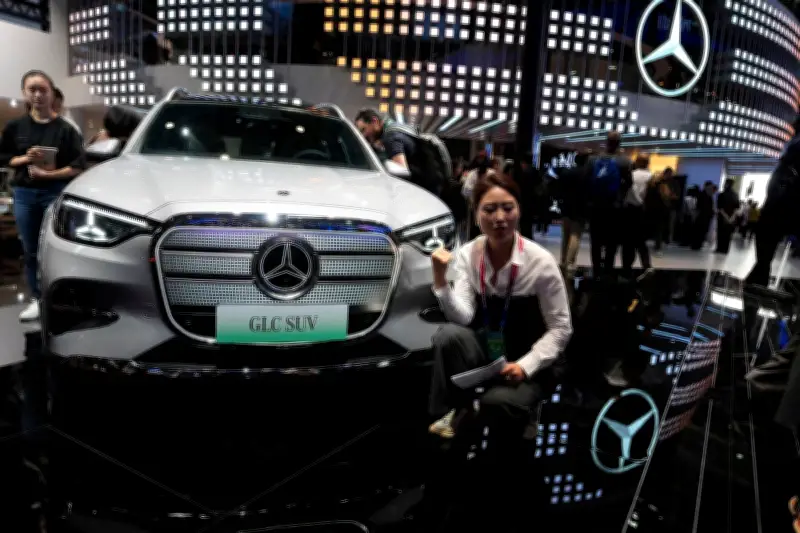
Major German carmakers reported steep quarterly sales declines in China during the second quarter of 2026, as weakening domestic demand and intensifying competition from local brands reshaped the world's largest auto market. The downturn was highlighted by a vlogger promoting the Mercedes-Benz GLC SUV at the Auto China 2026 show in Beijing on April 24, 2026, an event that underscored the shifting dynamics.
Sales Plummet Across German Brands
According to the Associated Press, the sales plunge affected all major German automakers, including Volkswagen, BMW, and Mercedes-Benz. The declines come as Chinese consumers increasingly turn to domestic electric vehicle manufacturers such as BYD and NIO, which offer competitive pricing and advanced technology. The trend has eroded the market share of traditional foreign automakers in China, a key profit center for German car companies.
In the April-to-June period, Mercedes-Benz reported a 15% drop in sales compared to the same quarter last year, while BMW saw a 12% decline. Volkswagen, which has a larger presence in the Chinese market, experienced a 10% reduction in sales. The numbers reflect broader challenges in the Chinese auto industry, where overall vehicle sales have slowed amid economic uncertainty.

Competition Heats Up
The rise of Chinese EV manufacturers has been a major factor in the sales decline. Companies like BYD have aggressively expanded their offerings, capturing consumer interest with affordable electric models. Additionally, Chinese tech giants such as Huawei and Xiaomi have entered the auto sector, further intensifying competition. "The market is changing rapidly, and German carmakers are struggling to keep up," said industry analyst Li Wei of the China Automobile Dealers Association. "Local brands are now seen as more innovative and better suited to Chinese consumer preferences."
The Chinese government's support for new energy vehicles has also boosted domestic manufacturers. Policies including subsidies, tax breaks, and charging infrastructure investments have accelerated EV adoption, with electric and hybrid vehicles now accounting for over 50% of new car sales in China.
Impact on German Carmakers
The sales slump in China has significant financial implications for German automakers, which have long relied on the Chinese market for a substantial portion of their profits. Volkswagen, for instance, generates about 40% of its global sales in China. The downturn is forcing these companies to reassess their strategies, including accelerating their own EV offerings and forming partnerships with local firms.
Mercedes-Benz has announced plans to launch new electric models tailored to the Chinese market, while BMW is expanding its joint venture with Chinese battery maker CATL. However, analysts warn that these efforts may take time to yield results. "The competition is fierce, and German carmakers are behind in the EV race in China," said Zhang Ming, an auto industry professor at Tsinghua University. "They need to innovate faster and adapt to local market trends."
The sales decline also highlights broader economic challenges in China, including a slowing economy and weakening consumer confidence. The country's GDP growth has decelerated, and rising unemployment has dampened demand for big-ticket items like cars.
Future Outlook
Looking ahead, German carmakers face an uphill battle in China. The market is expected to remain highly competitive, with domestic brands continuing to gain ground. To stay relevant, foreign automakers must invest heavily in local research and development, build stronger supply chains, and enhance their digital and smart features.
The situation is a stark contrast to just a few years ago, when German cars were synonymous with luxury and quality in China. Now, they are struggling to maintain their edge as Chinese consumers embrace homegrown alternatives. The coming months will be critical for German automakers as they navigate this challenging landscape.