

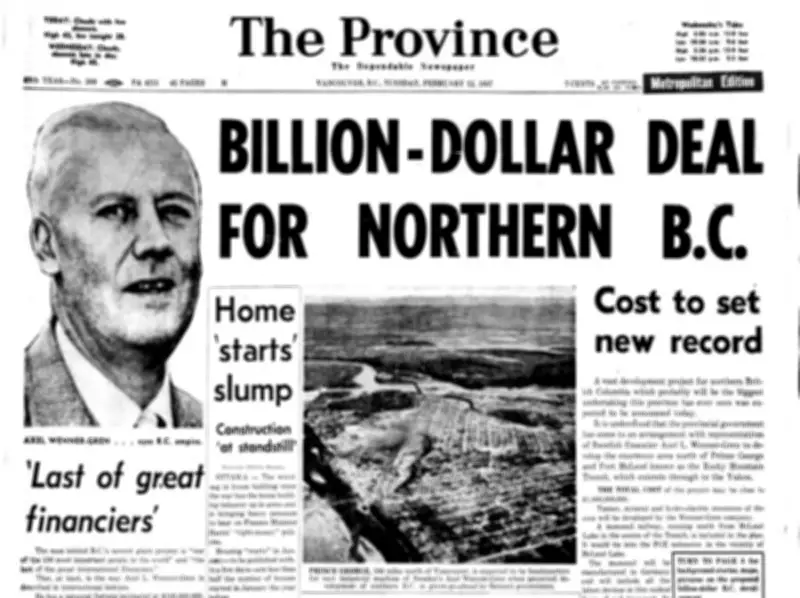
The Day Northern B.C. Was Poised to Become Wenner-Grenland
British Columbia has witnessed numerous ambitious development proposals throughout its history, but few matched the sheer audacity of Swedish millionaire Axel Wenner-Gren's 1957 vision for the province's northern territories. This bold plan, which captured front-page headlines and sparked intense debate, proposed transforming a vast wilderness area into a modern industrial corridor.
A Billion-Dollar Proposal That Made Headlines
On February 12, 1957, The Vancouver Province screamed with a front-page headline: "BILLION DOLLAR DEAL FOR NORTHERN B.C." The newspaper reported that provincial officials were expected to announce "the biggest undertaking this province has ever seen"—a comprehensive development agreement with representatives of Swedish financier Axel Wenner-Gren.
The project targeted the enormous Rocky Mountain Trench region north of Prince George and Fort McLeod, extending toward the Yukon border. This 40,000-square-mile territory (approximately 104,000 square kilometers) would be developed through Wenner-Gren's company, utilizing what the Province described as "timber, mineral and hydro-electric resources of the north."

W.A.C. Bennett's Development-Friendly Government Embraces the Plan
The massive scheme found a receptive audience in Premier W.A.C. Bennett and his Social Credit government, who were enthusiastic about B.C.'s economic development. The proposal aligned perfectly with their vision of transforming the province's northern wilderness into productive industrial land.
According to contemporary reports, the provincial government had "come to an arrangement" with Wenner-Gren's representatives to develop this enormous area, signaling what appeared to be a done deal that would reshape northern British Columbia for generations.
A Revolutionary Transportation System at the Plan's Core
Perhaps the most futuristic element of Wenner-Gren's proposal was a monorail railway system that would run from McLeod Lake in the center of the Trench, connecting to the Pacific Great Eastern extension in the same vicinity. This wasn't just any railway—it represented cutting-edge transportation technology of the era.
The monorail would be manufactured in Germany and incorporate "all the latest devices in this radical form of rail transport." With projected speeds exceeding 160 miles per hour (257.5 kilometers per hour), the elevated system could traverse the 640-kilometer (400-mile) length of the development in less than three hours.
Wenner-Gren was already familiar with monorail technology, having demonstrated it to West German Chancellor Konrad Adenauer at the Alweg Company's test grounds near Cologne, Germany.
Comprehensive Development Beyond Transportation
The Wenner-Gren proposal extended far beyond transportation infrastructure. The plan called for:
- Multiple pulp mills to process the region's timber resources
- Extensive mining operations to extract mineral wealth
- Hydroelectric dams to power the industrial development
- A string of new communities throughout the development area
These communities would be populated by both Canadian workers and "several thousand immigrants each year to work on the various projects in the development," creating what essentially amounted to new settlements in previously remote territory.
Mounting Costs and Growing Criticism
By February 13, 1957, The Vancouver Sun reported that the project's "ultimate investment could be $2 billion or more"—equivalent to approximately $23.07 billion in today's dollars. The sheer scale of the proposal began to draw criticism from various quarters.
Tom Elliot of the B.C. and Yukon Chamber of Mines expressed concern about the government "giving away so much Crown land," warning that such an arrangement could "dissuade or even block" other miners from exploring the area. Elliot cautioned that "We are giving away more than we have the right to give," suggesting the government was being "over-zealous in its attempts to develop the province."

The Man Behind the Vision: Axel Wenner-Gren
The Province described Wenner-Gren as "the last of the great international financiers," with a personal fortune estimated at $100 million. His proposal represented the kind of grand, sweeping development scheme that characterized mid-20th century thinking about resource exploitation and territorial transformation.
Vancouver Sun columnist Jack Scott, who toured the proposed development area by plane, described the experience as feeling like "Alice in Wenner-Grenland"—capturing both the wonder and surreal quality of imagining such comprehensive transformation of the northern landscape.
While the Wenner-Gren proposal ultimately never came to fruition as envisioned, it remains a fascinating chapter in British Columbia's development history—a moment when the province stood at the brink of a radically different future, with monorails speeding through what was then largely untouched wilderness.





