Humanoid Robot Shatters Half-Marathon World Record in Beijing by Nearly 7 Minutes
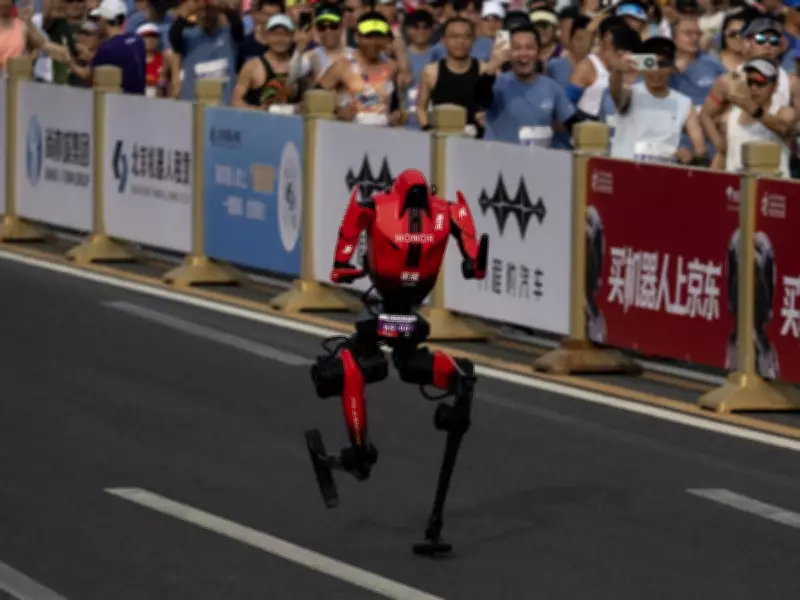
A humanoid robot competing against human runners broke the world record at a Beijing half-marathon on Sunday, demonstrating the rapid technological progress achieved by Chinese manufacturers. The event, held in Yizhuang in the capital's south, featured separate lanes for robots and humans to prevent accidents, with spectators lining the roads to witness the historic race.
Record-Breaking Performance
The winning humanoid, equipped with an autonomous navigation system and representing Chinese smartphone maker Honor, completed the approximately 21-kilometer (13-mile) course in 50 minutes and 26 seconds. This impressive time represents an average speed of about 25 kilometers per hour, far surpassing both the top human finisher in Sunday's race and the current men's world record of 57:20 held by Ugandan runner Jacob Kiplimo.
This result marks spectacular progress from just one year ago, when robot-runners frequently fell during competitions and the best performers required more than two hours and 40 minutes to complete similar distances. The dramatic improvement highlights the accelerating pace of robotics development in China.

Growing Popularity and Participation
According to event organizers, the number of humanoid entries jumped from approximately 20 last year to more than 100 this year, indicating the sector's growing popularity and investment. The humanoid half-marathon aims to encourage innovation and popularize the technologies used in creating and operating such advanced machines.
Some robots displayed remarkable agility during the race, moving with the fluidity of famous human runners like Usain Bolt, while others demonstrated more basic capabilities. The diversity of designs and performance levels showcased the breadth of robotics research and development currently underway.
Public Reaction and Future Implications
Han Chenyu, a 25-year-old student who watched the race from behind a safety barrier, described the event as "pretty cool" and expressed enthusiasm about technological leaps. However, she also voiced concerns about potential job displacement, noting that "technology is advancing so fast that it might start affecting people's jobs," particularly with artificial intelligence growing increasingly sophisticated.
Xie Lei, 41, who attended the race with his family, suggested robots could "become part of our daily lives" within several years, potentially serving in roles such as housework assistance, elderly companionship, basic caregiving, or even dangerous jobs like firefighting. He reflected on the broader implications, stating: "For thousands of years, humans have been at the top of planet Earth. But now, look at robots. Just in terms of autonomous navigation, at least in this specific sports event, they're already starting to surpass us."
Investment and Industry Strength
The robotics sector in China has seen substantial investment, with funding for robotics and embodied AI reaching 73.5 billion yuan ($10.8 billion) in 2025 according to a government agency study. Humanoid robots have become increasingly common in China in recent years, appearing regularly in media coverage and public spaces.
The Beijing event represents a significant milestone in robotics development, demonstrating not only improved physical capabilities but also sophisticated autonomous navigation systems that can handle complex, real-world environments. As Xie Lei noted while contemplating the technological achievement: "On one hand, it does make you feel a little bit sad for humanity. But at the same time, technology, especially in recent years, has given us so much imagination."