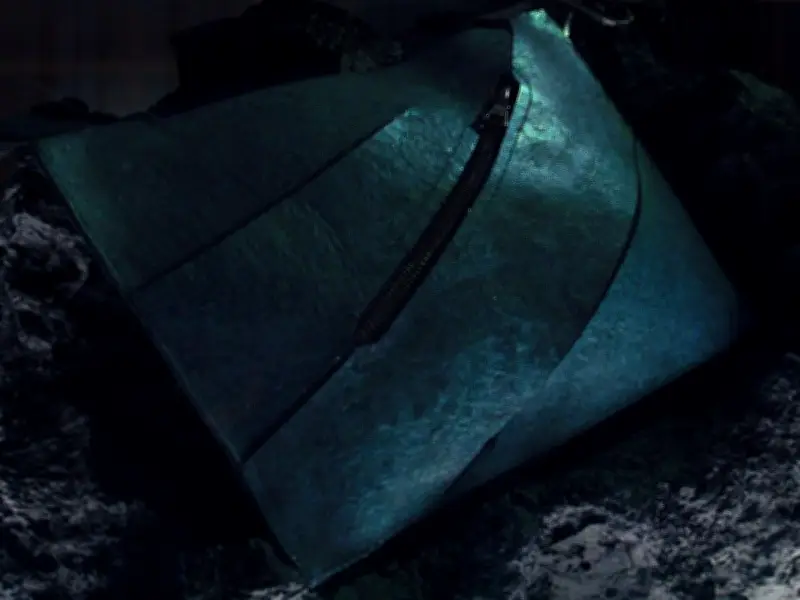
A handbag touted as the world's first product made from lab-grown Tyrannosaurus rex leather is set to go under the hammer in Paris, with bids expected to reach up to 500,000 Euros (approximately CAD$800,000). The accessory, trademarked as the "World's first T-Rex leather product," was created by a collaboration between a genomic engineering firm, a creative agency, and a sustainable biotechnology pioneer.
How Was the T-Rex Leather Made?
In 2005, researchers in the United States discovered soft tissue within the bones of a 68-million-year-old T. rex specimen, challenging the long-held belief that organic material could not survive for millions of years. This breakthrough led to new possibilities in cellular and molecular paleontology.
Last year, The Organoid Company, a genomic engineering firm, partnered with creative agency VML and sustainable biotechnology company Lab-Grown Leather. They used collagen sequences extracted from fossilized T. rex tissue to develop a high-quality, animal-friendly leather alternative. Using advanced computational biology and AI modeling, scientists reconstructed missing genetic information and inserted it into a carrier cell line to produce a collagen-based hide.

Thomas Mitchell, CEO of The Organoid Company, described the process as akin to solving a puzzle with only a few pieces. He acknowledged significant technical challenges during development. Notably, the same team previously created a novelty woolly mammoth meatball in 2023, using elephant DNA and sheep stem cells.
Scientific Skepticism
Despite the fanfare, some scientists remain skeptical about the leather's authenticity. Critics question whether the protein fragments extracted from the fossilized collagen are genuinely from T. rex or could have originated from other sources that infiltrated the remains over millions of years.
Jan Dekker, a postdoctoral researcher at the University of Turin, told German outlet DW that the boundary for protein survival is typically around 20 million years under exceptional circumstances. Given that T. rex went extinct approximately 60 million years ago, Dekker doubts any dinosaur DNA remains viable. The debate underscores the challenges of verifying ancient biomolecules in paleontological research.