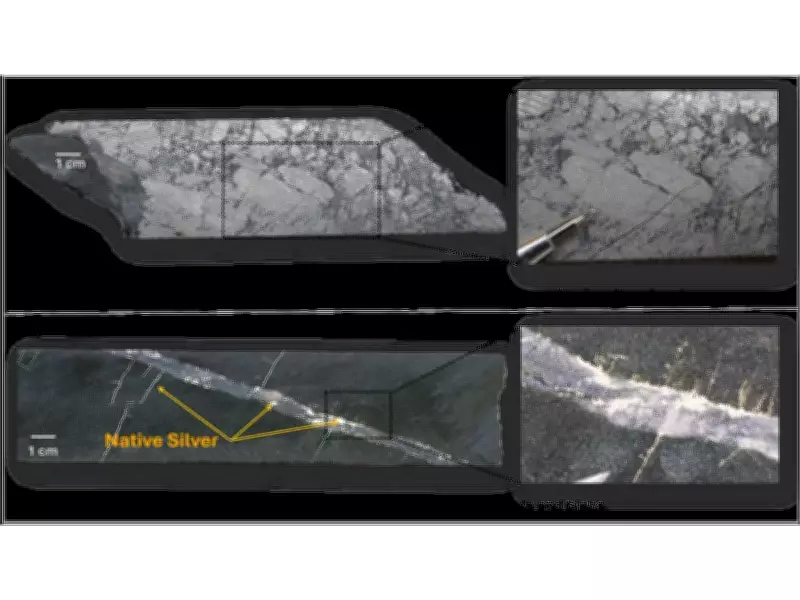
Brixton Metals Corporation has announced the fourth batch of results from its 2026 exploration program at the wholly owned Langis Silver Project, located in the historic Cobalt silver mining camp in Ontario, Canada. The company reported a significant intercept of 13.0 meters grading 594 grams per tonne (g/t) silver, including 0.5 meters of 7,900 g/t silver, from hole LM-26-350 in the Shaft 6-Southeast (S6-SE) target area.
Drilling Highlights
The 2026 drill campaign has reached 13,845 meters across 68 drill holes to date, focusing on both infill and expansion of established high-grade silver zones. Hole LM-26-350 intersected the high-grade mineralization in the S6-SE area, which has limited historic mine workings and drilling, indicating strong potential for new discoveries. The intercept occurs approximately 150 meters from the Shaft 6-South (S6-S) area, which has previously delivered some of the best results reported by Brixton.
Key Intercepts
- 13.0 meters of 594 g/t silver in hole LM-26-350
- Including 2.0 meters of 873 g/t silver
- Including 0.5 meters of 7,900 g/t silver
Additional high-grade intercepts were returned from holes LM-26-289 and LM-26-332 in the S6-S area, further confirming the continuity of mineralization.

CEO Commentary
Chairman and CEO Gary R. Thompson expressed excitement about the results, stating that they clearly indicate new mineralization remains to be discovered and reinforce Langis as a unique primary silver project. The company plans to add a second drill rig around mid-May to meet its goal of a minimum 60,000 meters of drilling at Langis this year, advancing toward a maiden resource estimate.
Thompson also highlighted an exploration target for the project of 400 g/t to 800 g/t silver in the range of 1 million to 2 million tonnes. Additionally, drilling has been initiated on the tailings at Langis to quantify silver content, followed by metallurgical recovery test work. He believes the tailings recovery project represents a short-term catalyst to unlock value for shareholders.
Geological Discussion
Brixton's exploration around the historic Shaft 6 area has outlined at least two zones of silver mineralization: Shaft 6 South (S6-S) and Shaft 6 Southeast (S6-SE). The latest results from hole LM-26-350 confirm S6-SE as a meaningful expansion opportunity. The 13.0-meter interval grading 594 g/t silver, including 0.5 meters of 7,900 g/t silver, is one of the strongest intercepts returned from an area with limited drilling and historic mine development.
Hole LM-26-350 is located approximately 150 meters from the S6-S area. Notably, the distribution of silver within veins in LM-26-350 is similar to that observed at S6-S. In both areas, silver mineralization is primarily hosted along the unconformity between the Keewatin Basalts and the Huronian Sediments, supporting the interpretation that S6-SE may represent a parallel or related high-grade zone within the broader mineralized system.