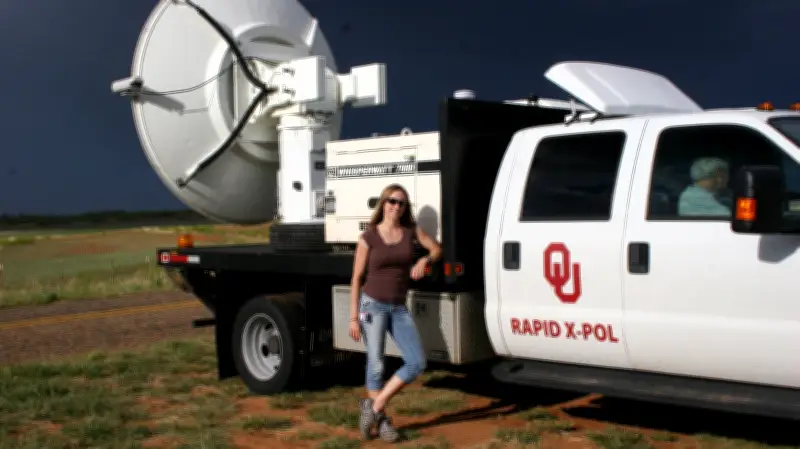
Meteorologist Emily Sutton knew she had to keep her voice calm. Nearby, a record-breaking tornado churned across the Oklahoma landscape. Sutton was chasing it, ready to relay information back to her news station. "It has multiple vortices. I see the vortices swirling around this tornado," Sutton said in a now-famous clip documenting the deadly El Reno tornado on May 31, 2013. The monster tornado grew to 2.6 miles across — the widest on record — and killed eight people, including several storm chasers. During that fateful chase, Sutton kept reporting, even when the violent winds blew out her back windshield. As the first female meteorologist at KFOR-TV News 4 in Oklahoma City, she has built a dedicated following in a media ecosystem historically dominated by men.
Like many STEM fields and high-octane pursuits, meteorology and storm chasing have long been disproportionately male. That has continued in the age of streamers and influencers, with men often getting more followers and engagement on storm content. But women are making their own vital contributions to the field, gathering crucial insights on storms and helping unravel persistent mysteries about tornadoes.
Inspiring a Generation
In Tornado Alley, where meteorologists double as celebrities, Sutton has in some ways followed in the footsteps of the lead from one of her favorite childhood movies: "Jo in the movie 'Twister' planted a seed of what is possible," she says. The film stars Helen Hunt as Jo Harding, a meteorologist leading a team of storm chasers during a historic tornado outbreak in Oklahoma. Many women cite Jo as inspiration, from Sutton in Oklahoma City to ABC News' Ginger Zee, the first female chief meteorologist at a major network.

In the 30 years since the film's release, scientific advancements have revolutionized researchers' understanding of tornadoes. But Jo still looms large as cultural shorthand for women in storm chasing. "It's kind of a blessing and a curse," says Jennifer Walton, who founded the initiative Girls Who Chase to provide support and greater exposure to the women who document extreme weather. "The character was way ahead of her time, just representing women in STEM." But, Walton adds, "we're still talking about Jo in the movie 'Twister,' and that movie is now 30 years old, and she's not real."
Real-Life Role Models
A big barrier for many women is not knowing how to get started, Walton says. It was something she grappled with herself when she began chasing. That is why Girls Who Chase offers resources on the basics — like how to read radar — and online training from experts. "Part of my goal has been to slowly but surely replace Jo with real women," Walton says. One of those women is tornado expert Jana Houser, a meteorologist at Ohio State University. ("She is Jo," Walton says.) Houser provided field support in forecasting and chasing for "Twisters," the 2024 standalone sequel to "Twister." Houser may have even helped inspire the film's female protagonist.
Like Sutton, Houser was out chasing the day of the 2013 El Reno tornado in Oklahoma. Using data from that storm and others, Houser and her colleagues have provided confirmation from the field that tornadoes do not actually "touch down" from the clouds. Instead, she said, there is evidence to suggest rotation intensifies on the ground first. Their research offers crucial insights that challenge long-held assumptions about how tornadoes form. Houser, who has three daughters, said initiatives like Girls Who Chase are supporting people to follow their passions — whatever those passions might be. "For some people, that dream is storm chasing," Houser says.

Narrowing the Gender Gap
There are some signs the gender gap is narrowing. In 1993 — three years before "Twister" was released — membership in the American Meteorological Society skewed overwhelmingly male, with women making up only 9% of members, according to data provided by the society. By 2024, that number had grown to 26%. At the University of Oklahoma — one of the top schools for meteorology in the country — recent university data shows the percentage of those working toward bachelor's degrees in the field who are women has risen from 18% in 1995 to 38% in 2025. And at this year's National Storm Chaser Summit, an annual gathering for extreme weather enthusiasts, event organizers say women accounted for nearly 33% of attendees, up from 15% to 20% in previous years.
Veteran storm chaser Melanie Metz has seen some of these shifts in the weather community firsthand. When she started chasing in 2000, she knew of only a few other women active in the field. One was Peggy Willenberg, who, alongside Metz, went on to be featured in the reality show "Twister Sisters," a groundbreaking portrayal of real women in chasing. Among her peers, Metz is known for capturing striking photos of tornadoes that others miss. While some chasers crunch endless data in pursuit of rare weather encounters, Metz leans on intuition and experience. "When I'm on the road chasing, I just look at a couple basic things, and I read the storm," she says. "I'm usually in the right place."
Overcoming Challenges
Being in the right place at the right time is essential in the competitive world of weather influencers, where social media algorithms often reward the most dramatic footage. While many of the largest streaming accounts belong to men, chasers like Paige Berdomas are also making a name for themselves and providing timely information to forecasters. Berdomas, who goes by Tornado Paigeyy online, chases with her fiancé, Bryce Shelton. The duo streams footage of extreme weather year-round, from blizzards and floods to wildfires and hurricanes. They also share important, on-the-ground information with the National Weather Service. As one of the few female chasers streaming full time, Berdomas said she sometimes gets comments minimizing her work compared with her fiancé's. "I left a full career to do this, was doing it on my own beforehand, and then I met Bryce while chasing storms at a Casey's gas station in Iowa," says Berdomas, who was a nurse practitioner prior to chasing full time. "We built this together."
Chelsea Burnett, a chaser and public speaker, is also no stranger to negativity online. Some men have put her down by calling her husband, veteran chaser Adam Lucio, "the real chaser," she says. "Being a woman in this field is definitely not for the faint of heart," Burnett says. Outside of chasing, Burnett has built her career around sharing storm science with others. She has spoken to thousands of students about severe weather awareness in visits to schools, libraries and community groups. "I've had such a genuine interest and passion for this that nothing's really going to stand in my way and get me down," she says.