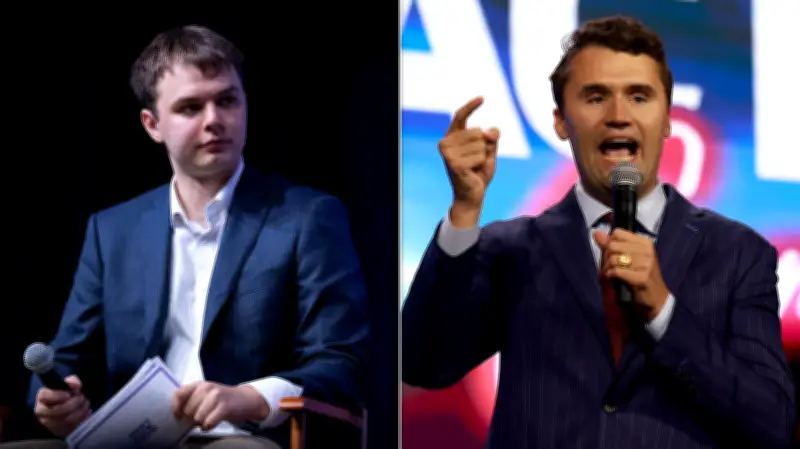
YouTuber Adam Mockler launched an independent political debate show last Wednesday, promising “honest conversation between people who disagree,” according to the show’s description. Mockler, who has grown to over 2 million subscribers on YouTube, is a Gen Z political commentator known for debating Scott Jennings on CNN about issues like the war in Iran.
Format and First Episode
“The Adam Mockler Debate Show” pairs Mockler with someone from an opposing political viewpoint for one-on-one, 20-minute debates on two topics. In the first episode, guest Brady Cupples, co-chair of the McLean County Young Republicans in Illinois, argued that “tariffs are an integral part of a necessary industrial policy.”
Mockler now joins a growing number of online political debate series that have accumulated millions of views over the last few years. Jubilee, which has over 10 million subscribers, started after the 2016 election and built its platform around debate videos where one person debates multiple people with opposing views. Its top-performing video, with 42 million views from September 2024, features Charlie Kirk debating “25 woke students.”

Origins of Online Political Debates
Kirk established himself as an online political debater in 2021 on Turning Point USA’s YouTube channel, which has over 7 million subscribers. The online success led to Kirk’s live, campus-based debate tours, which he advertised as a way to “expose leftist lies and progressive propaganda.”
Political debate videos are rarely about changing minds. Since these platforms launched after 2016—the same year political polarization in the United States saw a sharp uptick, according to the Pew Research Center—the format has thrived not on persuasion or influence, but on confirmation. Viewers click to watch someone who shares their politics dismantle someone who doesn’t, perhaps filing away the best arguments for their own use.
Expert Insights on Confirmation Bias
Amy Becker, a professor of communication at Loyola Marymount University, told HuffPost that these online debate videos present both sides of an argument and leave it open-ended—no “winner” is necessarily declared and no objective judge is involved. The result is mostly adding to the noise in already crowded online political echo chambers.
“You’re definitely not seeking out YouTube podcasts from those you don’t agree with,” said Becker, whose research focuses on political entertainment and its potential impact on public opinion and political participation. “You can only watch stuff that agrees with you.” Viewers who disagree are more likely to counter-argue than be persuaded. Most of these types of debates aren’t about finding the truth—they’re about clicks.
Engagement Over Truth
Unlike traditional debates, these videos do not have a set conclusion in which one side is declared a winner or an answer is reached. “The truth isn’t necessarily being pursued; it’s engagement, it’s clicks, it’s popularity,” Ethan Porter, an associate professor in the School of Media and Public Affairs and the Department of Political Science at George Washington University, told HuffPost. “It’s not as if democracy is some game between competing truth claims and the truthier side wins.”
Mockler’s debut episode suggests as much. In Mockler’s first video, there is no objective moderator or fact-checker involved. In Jubilee and Kirk’s videos, personal attacks are allowed. Each YouTube channel also clips its own longer videos into digestible, multi-minute bites that are then shared across other social platforms, like TikTok.
Mockler’s first video is titled “I Changed a MAGA Voter’s Mind in 20 MINUTES!” and is filed under “Adam’s Best Debates” on Mockler’s channel. There are also short clips from the full episode titled “MAGA Gets DEBUNKED In Live Debate” and “He Was UNPREPARED For This Debate.”
“It’s almost like, let’s talk at each other rather than explain things,” Becker said. “[These videos] are more combative, definitely more pointed.” Mockler did not respond to HuffPost’s request for comment as of publishing.

Psychological Appeal to Young Adults
Social media political debates are enticing for viewers because they tap into certain psychological impulses. Young adults may feel that the debate shows serve them better than traditional media, which already has low ratings among Gen Z, the News Literacy Project reported.
“There’s an honesty to it that feels unfiltered,” Becker said. “It feels a little more authentic than other media content, and I think that’s part of the appeal.” Young adults follow traditional news less closely than any other age group, Pew Research reported, and rely heavily on social media for their information.
The debates are also styled without any pop-up information or images—just two people facing one another. This allows the debates to play in the background while viewers do other things, an ideal setup for young people, Becker argued. “There’s engagement, but maybe not in-depth quality engagement,” she said. “When my university students engage with podcasts, they don’t listen to podcasts; they put them on YouTube while they’re doing all these other things. [These debates] are playing to the success of that format.”
Their success also feels like the end of explaining situations and a return to “let’s talk at each other,” Becker said. It’s a conflict-driven appeal, more emotional than traditional news media that break down information, and helps guide them into building their point of view on what is going on in the world, rather than just understanding the facts, she said.
“I’m definitely more of a glass half full—this political entertainment brings people into the conversation,” she said. “You can argue about the quality of that content, but I still think it gets people who would otherwise totally ignore political topics to think a little bit more about what’s going on around them.”
Do These Debates Actually Change Anyone’s Minds?
While these videos are designed to advocate for a particular side, they mainly reach audiences who already agree with them, Porter argued. “In that case, persuasion isn’t going to happen in any sort of meaningful sense because, by and large, the viewer and the host are in agreement,” he said. “Mockler is really good at attracting people and going viral because he appeals to people who already agree with him.”
It doesn’t mean all of Mockler’s video viewers agree with him—people who are not politically aligned with him or who oppose his stance can also be sent the video or come across it. But the amount of actual persuasion these videos can make is still very modest. A quarter of adults in the U.S. reported that social media helped change their views about a political or social issue, a Pew Research study found in 2020. (The study did not specify which specific social media platforms influenced these changes.)
The backfire effect, a cognitive bias in which people double down on their existing beliefs when corrected with facts, could come into play here. But the backfire effect is “extremely, vanishingly rare,” Porter said. “More common [is] people respond to factual information, regardless of what it’s saying,” he said. “If Trump supporters see that Trump says something like the crime rate is going up and we tell them the crime rate is going down, they will concede that the crime rate is going down, but it doesn’t mean they are any less supportive of Trump. It doesn’t change their broader political views.”
Future of the Show
Whether Mockler’s show will survive remains to be seen. These debate series either build careers or they don’t, Porter said. The viewership will ultimately decide. Millions of people are choosing to watch sustained political debates, Porter added, and it’s not something to dismiss just because it’s happening on social media and being packaged a certain way.
“People are choosing to watch serious debate shows; politics is being taken seriously,” he said. “I think all too often we can be cynical or pessimistic about American democracy, but the fact that people are choosing to watch [and] sustain political debate is not a bad thing. I would say it’s democracy in action.” Whether it’s the honest conversation Mockler is promoting, the research suggests, is complicated.