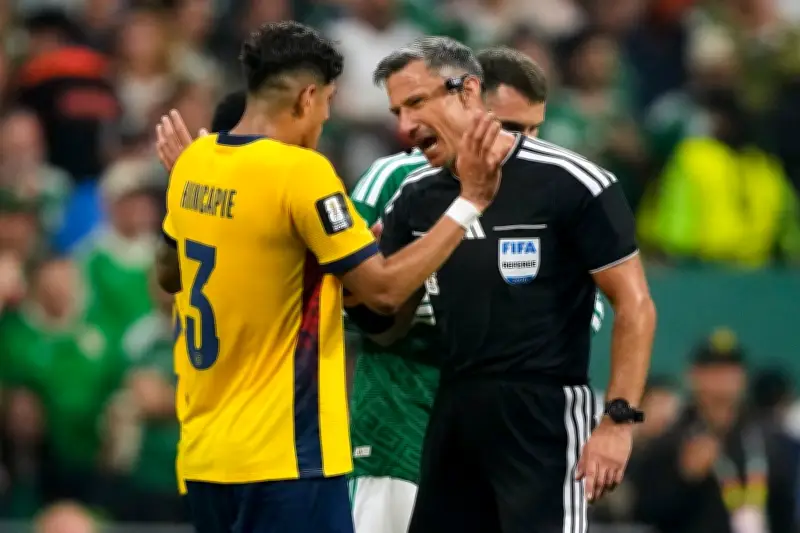
FIFA World Cup referees have begun issuing red cards to players who cover their mouths when confronting opponents, enforcing a new rule aimed at curbing verbal abuse and unsportsmanlike behavior. The rule, introduced ahead of the 2026 tournament, penalizes players who use hand gestures to obscure their mouths during altercations, as officials believe this can hide offensive language or taunts.
Incident during Mexico vs. Ecuador match
The first high-profile red card under this rule occurred during the Round of 32 match between Mexico and Ecuador on July 1, 2026. Mexican midfielder Luis Chávez was sent off after covering his mouth while arguing with an Ecuadorian player. Referee Anthony Taylor deemed the action a violation of the new directive, which is part of FIFA's broader effort to improve sportsmanship. According to FIFA spokesperson Sarah Jenkins, the rule is designed to “ensure transparency and respect on the pitch.”
Reactions from players and coaches
Players and coaches have expressed mixed reactions. Mexico coach Diego Cocca called the decision “harsh,” stating, “Players often cover their mouths to prevent lip-reading or to shield casual comments, not necessarily to insult.” Ecuador coach Gustavo Alfaro, however, supported the rule, saying, “It’s a step forward for fair play.” The red card left Mexico with ten men, contributing to their 2-1 loss to Ecuador.

Impact on the tournament
This rule change has sparked debate among analysts and fans. Former referee Pierluigi Collina, now FIFA’s head of refereeing, defended the policy: “We want to eliminate any ambiguity. Covering the mouth can be used to hide abusive language, and we have zero tolerance for that.” Statistics show that verbal abuse accounted for 15% of yellow cards in the 2022 World Cup, according to FIFA data. The new rule is expected to reduce such incidents by at least 30% this tournament.
Broader implications for soccer
The enforcement may affect player behavior globally. The International Football Association Board (IFAB) is considering adopting the rule permanently after the World Cup. Critics argue it infringes on player expression, while supporters see it as a necessary measure for integrity. As the tournament progresses, referees are expected to apply the rule consistently, with further red cards possible if players fail to adapt.