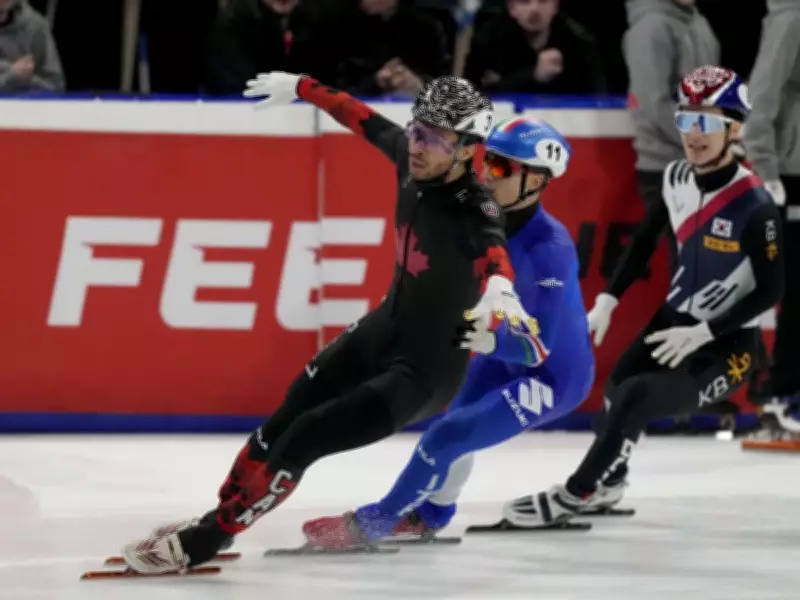
Quebec's Speedskating Star William Dandjinou Prepares for Olympic Takeoff in Italy
Montreal-based speedskater William Dandjinou has transformed Olympic disappointment into world dominance as he prepares to lead Canada's powerhouse short-track team at the 2026 Winter Games in Milan Cortina. The 24-year-old athlete from Sherbrooke has risen to become the world's pre-eminent short-track speedskater after being left off the Canadian Olympic team for Beijing 2022.
From Olympic Snub to World Leadership
Dandjinou's journey to Olympic contention represents a remarkable comeback story. After facing the crushing disappointment of missing the Beijing Games, the skater rebounded with unprecedented success, winning the Crystal Globe as the top overall male skater for two consecutive years. He became the first Canadian male to achieve this honor, with Courtney Sarault of New Brunswick becoming the first Canadian woman to win the same title in November.
The Montreal athlete excels in three distances and will compete in the 500-meter, 1,000-meter, and 1,500-meter events at Milano Cortina, with expectations he'll also participate in relay competitions. His current season performance has been nothing short of spectacular, with eight individual podium finishes including seven gold medals and one silver across various distances.

Quebec Dominance in Canadian Short-Track
Canada's position as world leader in short-track speedskating owes much to its Quebec contingent. Remarkably, eight of the ten athletes named to Canada's men's and women's short-track teams for the 2026 Winter Games hail from Quebec. The men's roster features an all-Quebec lineup, with Dandjinou leading fellow provincial athletes Steven Dubois, Maxime Laoun, Jordan Pierre-Gilles, and Félix Roussel.
The women's team continues this Quebec representation with three of five members coming from the province: Danaé Blais, four-time Olympic medallist Kim Boutin, and Florence Brunelle. This concentration of talent has earned the team the nickname Canadian Ice Maples, and they've secured multiple gold medals at ISU Short Track World Tour events in recent seasons.
Family Roots and Athletic Development
Dandjinou's connection to ice sports traces back to his family's immigration story. His parents, both microbiologists from Ivory Coast, moved to Sherbrooke in 1990 to escape civil unrest. His father Alain secured work making ice for Université de Sherbrooke's outdoor rink, despite having no prior experience.
"You need to respect the ice," Alain Dandjinou told the CBC last March. "You need to make it your friend. You can do so many things on the ice when you're well-equipped, and I think that's what William is doing now."
This family connection led to William being put in skates at age two. By twelve, he was competing provincially, and at seventeen, he had earned a spot on the Canadian team for the World Junior Championships. His potential was recognized early by Quebec short-track legends Charles Hamelin and Marc Gagnon, who now serves as the team's coach.
Physical Advantages and Competitive Mindset
Standing at 6-foot-3, Dandjinou brings unusual height to a sport typically dominated by more compact athletes. He has successfully translated his lengthy stride into competitive advantage, becoming a giant in both physical stature and athletic achievement. His trademark wings celebration—moving his arms like an eagle upon crossing the finish line—has become a signature of his personality-driven approach to the sport.
"If you want the sport to grow and to have the fans interact with us, we have to show our emotions," Dandjinou explained about his distinctive victory move.
Canada's Olympic Legacy and Future Prospects
Since short-track speedskating joined the official Winter Games program at Albertville 1992, Canada has established itself as a consistent medal contender. The country has accumulated 37 Olympic medals in the discipline (10 gold, 13 silver, 14 bronze), tying for second all-time among competing nations. This makes short-track Canada's second-most successful Winter Olympics event, trailing only long-track speedskating.

Dandjinou's leadership comes at a crucial moment for Canadian short-track. After considering leaving the sport following his Beijing disappointment, he adopted a new perspective focused on the joy of the journey rather than fixating solely on Olympic medals. This renewed outlook has propelled him to unprecedented success and positioned him as a key figure in maintaining Canada's storied Olympic history in the sport.
As the 2026 Winter Olympics approach, all eyes will be on Dandjinou and his Quebec teammates as they aim to add to Canada's medal count while showcasing the strength of Canadian speedskating on the world's biggest winter sports stage.