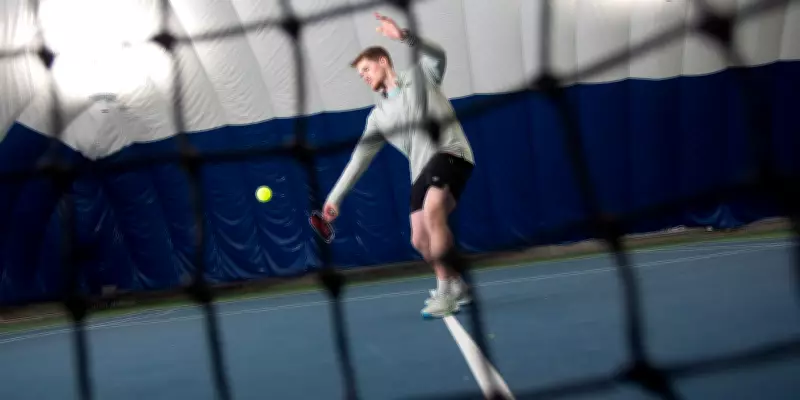
TORONTO — Susie Sheffman is caught in a love triangle. Her two lovers? Tennis and pickleball.
"People feel really hellbent on wanting me to choose, and I don't understand," said the 66-year-old from Toronto. "I really am torn between two loves, and I don't know why I have to choose. Why can't I date both?"
Sheffman's history with tennis began 30 years ago. As a kid, she had no hand-eye coordination and avoided sports. Later in life, her ex-husband and friends helped her learn the fundamentals. She's played regularly ever since.

Pickleball — described as a cross between tennis, table tennis and badminton — came into her life four years ago. She was instantly hooked.
During the summer, Sheffman splits her time evenly between tennis and pickleball — lest she favour one. She hits their respective courts multiple times each and every week. This year, because of tears in her shoulders, she said she will try to avoid playing both sports on the same day.
When Sheffman described why she loves tennis, she mentioned its quiet elegance, its timeless, refined beauty and the sport's deep sense of tradition. "It takes years to perfect. It's more sophisticated. It's less scrappy. You have to be much more thoughtful," she said.
Pickleball, however, is aggressive, fast and very, very loud, she said. "It's extremely social, it's high energy, it's highly competitive, and it's just plain fun," Sheffman said. "All of those qualities are qualities I would want to have. Yes, I want to be more elegant, quiet and refined, but I also want to be scrappy and high energy and have a lot of fun. I'm definitely on the team of doing both — or not having to compare them."
History of the Sports
There are theories that the origins of tennis-like games trace back to ancient Egypt and Greece, according to the Lawn Tennis Association, but the version we're familiar with started in France in the 12th century, when monks used their hands to bat a ball against monastery walls or over a strung rope. Rackets were introduced in the 16th century. The sport was primarily played indoors until the 18th century, when lawn tennis — played outdoors on grass courts — was created in Britain. Today, tennis is a global activity with 106 million players in 2024, according to the International Tennis Federation, up from 84.4 million in 2019.
In Canada, tennis is in a healthy place. Recent data from Tennis Canada and YouGov Canada said more than six million Canadians played tennis in 2025 — an increase of more than one million since 2023.
By comparison, pickleball is a much younger sport, with a North American origin. According to USA Pickleball, Joel Pritchard, a politician, and Bill Bell, a businessman, improvised a new game in 1965 on Bainbridge Island, Wash., using table tennis paddles and a perforated plastic ball over a badminton net. The unique name was the brainchild of Pritchard's wife, Joan, who was inspired by the rowing term pickle boat.
In the U.S., there were roughly 4.2 million pickleball players in 2020, according to the Sports and Fitness Industry Association. In 2025, that number was 24.3 million. In Canada, Pickleball Canada reported in February 2025 that an estimated 1.54 million people were playing, a 57 per cent increase since 2022.
Demographics and Appeal
While both sports report positive participation numbers, demographics differ, according to the Sports360 Study conducted by The Strategic Counsel. Active tennis players skew more male, with 61 per cent male, while pickleball is balanced at 50-50. Tennis is concentrated in large cities, while pickleball is more evenly distributed. The median age of active pickleball players is 52, compared to 42 for tennis.
What's driving people to pickleball? The list is varied, from its relative affordability — basic equipment can be bought on Amazon for less than $50 — to its accessibility at parks and community centres. One oft-cited reason is the lower barrier to entry compared to tennis. Natalie Araya, a Toronto-based coach, explained that tennis is hard to learn and master, while pickleball is easier to pick up. "After an hour and a half, you can get players who just started the game to get an understanding of the sport and be able to play on their own. I couldn't say the same for tennis," she said.

Pickleball also excels as a community-oriented, socially driven sport. Sheffman likened the experience to "a mood enhancer." "When I was starting pickleball, I literally just went to the park, and I didn't know anybody. Five minutes later, I had new best friends for life," she said. Mary Stein, 57, from Toronto, found the sport inclusive. "With rare exceptions, people are very kind, they're encouraging, they want you to learn," she said.
Techniques and Strategies
David Summers, a 27-year-old physiotherapist in St. John's, Nfld., started playing pickleball after his tennis season was halted due to COVID restrictions. He challenged two older men to a match, confident his tennis skills would prevail. Instead, he and his partner lost badly. "It was like the most humbling experience ever," Summers said. "It wasn't even close. It was like a completely different sport."
Experienced pickleballers say the sport is not miniature tennis. Power alone isn't a viable strategy. Gloria Gardner, 67, from Bracebridge, Ont., has witnessed tennis players migrate to the smaller court with predictable results. "It's kind of amusing to me for a tennis player to come on to the pickleball court for the first time, because that is exactly what they want to do, stand at the baseline and pound the ball back and forth," she said. Pickleball encourages play close to the net in the non-volley zone, or "kitchen," where soft shots called dinks control play before attacking an opponent's mistake.
Racket Wars
Brian Laski, 47, a former professional tennis umpire, turned to pickleball two years ago for a new challenge. While his daughters eventually relent to playing, his tennis buddies refuse. "(They) refuse to pick up a pickleball paddle," he said. "They'll look at me and shake their head in dismay."
The tennis vs. pickleball rivalry is real. Purists may claim that playing pickleball hampers their tennis game, though players interviewed reported the opposite. Gardner, who plays both, said, "People vastly underestimate what their brains are capable of, because I go back and forth between the two of them all the time."
Some tennis players simply prefer the more physically rigorous sport, while others find the high-pitched sound of pickleball annoying — the distinct thwack of paddle on perforated ball has been the subject of noise complaints. Friction has also arisen over sharing court space. In 2023, a group of tennis players on Mayne Island, B.C., lost a petition to prevent pickleball players from using their courts. In Toronto, some public tennis courts have been replaced by pickleball courts. In Milford Bay, Ont., a compromise was reached to include painted lines for both sports on one court.
However, the growing pains appear to be easing. Former tennis stars like Andre Agassi and Canadian Eugenie Bouchard have played pickleball professionally, helping the sport gain acceptance. Summers has also received less razzing as more tennis players join in. "As you age, typically, it's harder to play tennis; it's a bigger court to cover, especially in singles," he said. "It's a really nice transition."
Health Benefits and Risks
The United States Tennis Association has touted tennis as the world's healthiest sport. The Copenhagen City Heart Study, published in 2018, suggested playing tennis could add up to 9.7 years to an individual's life. Dr. Martin Juneau, a cardiologist at the Montreal Heart Institute, said racket sports combine aerobic and muscular training, making them among the best. "A lot of experts think that mixed sports are probably the best sports," Juneau said.
But both sports come with injury risks. Dr. Kevin Willits, an orthopaedic surgeon at Fowler Kennedy Sport Medicine Clinic in London, Ont., said tennis players often suffer chronic upper extremity injuries and acute lower extremity injuries. Pickleball injuries are predominantly acute lower extremity, such as Achilles tendon injuries, due to its stop-and-start nature. Willits has seen an increase in pickleball-related injuries, which he attributes to its popularity and older demographic. Despite this, he supports an active lifestyle through pickleball. "We think that's actually a very positive thing for lifestyle and for overall complete body health. But there is a price to be paid, sometimes with a rise in these injuries," he said.
Future of the Sports
Jordan Horrobin, 29, started playing pickleball with his dad and views it as a long-term investment. "My 60s version of myself might thank me," he said. Pickleball's popularity shows no signs of abating, and the sport appears here to stay.
Tennis remains the stalwart of the racket sports family, but pickleball has its place as a democratic and accessible alternative. Lovers of both sports say it's time for a peace deal. "I'm not sure why they have to be in competition," said Sheffman. "I think they're very different sports. Yes, they both involve rackets and balls, but they're very different, and they're both incredibly enjoyable to me. And I don't see why I have to choose."