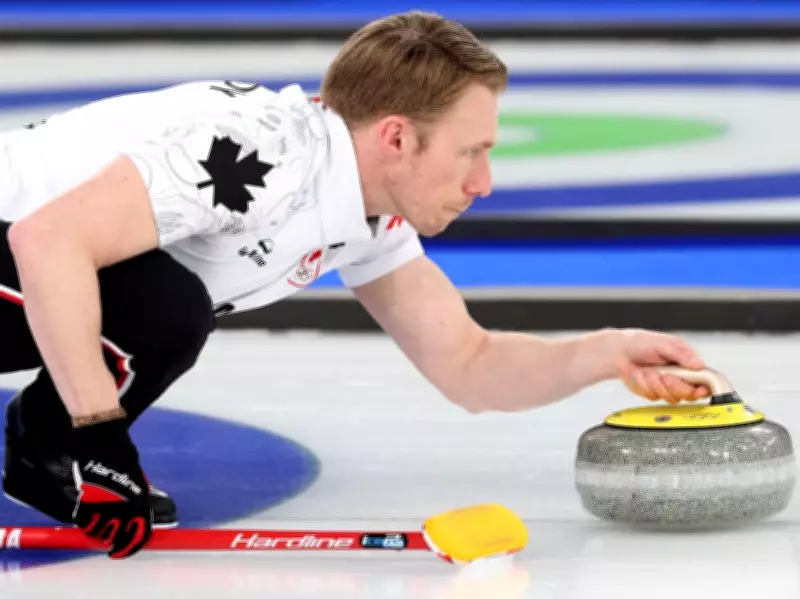
The Enduring Mystery of Curling Physics
The recent Olympic curling controversy involving Canadian athletes and allegations of rule violations has faded from headlines, but a far more fundamental question about the sport remains unanswered: why do curling stones actually curl? Despite advanced scientific research and modern technology, the precise physics behind this signature movement continues to elude complete explanation.
From Corn Brooms to Electron Microscopes
The evolution of curling equipment tells a story of technological advancement. Gone are the days of corn brooms that created the distinctive "thwack-thwack-thwack" sound that comedian Bill Cosby famously mimicked during his 1980s performances. Modern push brooms made from synthetic materials have replaced them, providing more effective sweeping by slightly melting the ice ahead of the stone to reduce friction.
Yet even with electron microscopes and precise measurement tools, researchers cannot fully explain the curling phenomenon. The basic principle involves rotation and friction, but curling stones behave opposite to everyday objects. When you slide a spinning glass across a table, it curves in one direction based on its rotation. Curling stones do the exact opposite.

Competing Scientific Theories
Three main theories have emerged to explain the curling mystery. The traditional Canadian theory suggests that friction at the front of the stone melts the ice, creating greater friction at the back and causing the stone to curl in the direction of its rotation.
Swedish researchers proposed an alternative explanation about fifteen years ago, suggesting that curling stones actually create microscopic scratches in the ice. According to this theory, the front of the stone scratches out a track that the back follows, producing the curl.
British Columbia researchers added a third possibility: the "pebbled" surface of curling ice, created by spraying thousands of tiny water droplets, causes the stone to deflect off these microscopic barriers as it travels, gradually pulling itself in the direction of its rotation.
The Appeal of Uncertainty in a Measured World
There's something compelling about this scientific uncertainty, especially in today's highly regulated Olympic environment where every advantage is measured and controlled. From ski jumping suits with precisely calculated additional material to standardized luge equipment and sensors in curling stone handles, modern sports have become increasingly mechanical and controlled.
The mysterious physics of curling serve as a reminder that even with advanced technology and regulation, human understanding has limits. This scientific puzzle points toward metaphysical questions about control and knowledge in competitive sports.
Canadian Sportsmanship Amid Controversy
The recent profanity-laden exchange between Canadian curler Mark Kennedy and Swedish competitors represents one side of Canadian curling, but another incident from 2016 shows a different character. During the men's world championships, when sensors malfunctioned and cost the Swiss team a stone, Kennedy's skip Kevin Coe broke protocol to advocate for allowing the Swiss to rethrow their stone, demonstrating gracious sportsmanship that reflects better on the sport.
As curling gains international attention through Olympic controversies and increased media coverage, the fundamental mystery of why the stones curl continues to fascinate scientists and enthusiasts alike. This enduring scientific puzzle adds an extra layer of intrigue to a sport that combines precision, strategy, and physical skill with elements that still defy complete explanation.