Simmons: McDavid, MacKinnon, and Makar Should Have Secured Gold for Canada
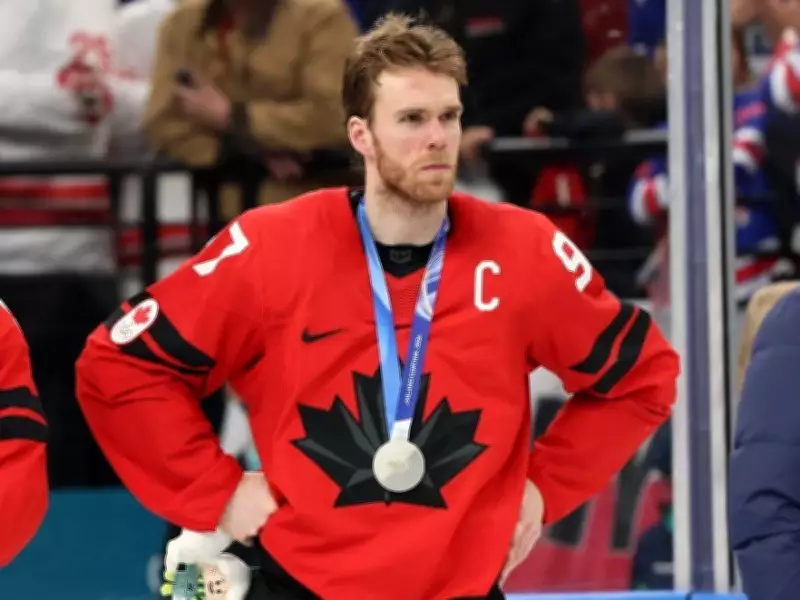
The three finest players in hockey—Connor McDavid, Nathan MacKinnon, and Cale Makar—were united on the ice when Jack Hughes shattered the hearts of a nation he partially grew up in. Nobody appreciates concluding gold medal games, or any Olympic hockey contests, with 3-on-3 overtime. It is even more challenging to lose a game you nearly dominated when your roster features those three athletes, the world's greatest, playing collectively for Team Canada and ultimately falling short together.
It is particularly difficult to accept defeat when the three best players globally each commit an error on the decisive goal. The reality is, there has never been a gold medal game of this caliber before. Not this rapid. Not this explosive. Not this emotionally charged. Not this back-and-forth, with broken teeth, late penalties, missed empty nets, exceptional goaltending, and perhaps the two finest periods Team Canada has ever played in any Olympics involving NHL participants.
Unprecedented Speed and Skill in Olympic History
There may have been superior games historically—the Canada-Russia clashes of 1972, the Canada-Soviet matchups of 1987—but none resembled this one. This occurs 54 years after Paul Henderson's iconic goal and 39 years after the Canada Cup final featuring Wayne Gretzky and Mario Lemieux. The sport has evolved; it is faster than ever, and the skill level has never been higher.

I was privileged to attend the gold medal games in 2002 in Salt Lake City and 2010 in Vancouver, as well as the one-sided 1-0 semifinal victory over the Americans in Sochi in 2014. Those games did not resemble or feel like this contest, even as I recall the tension in Vancouver's arena from fifteen years ago.
Sunday's gold medal game provided better theater than all those Olympic finals. You should remember it for that reason—a hockey game unlike any we have witnessed before, at speeds never before observed. Television does not always convey the true velocity of the game, but this time it succeeded. Canada dominated the second and third periods in every aspect except the scoreboard.
Hellebuyck's Heroics and Superstar Struggles
However, it was Connor Hellebuyck, goaltending this season for one of the NHL's weakest teams in Winnipeg, delivering the performance of his lifetime at the most critical moment of his athletic career. He accomplished what McDavid, voted tournament MVP, aspired to achieve. He left his mark. He achieved what MacKinnon could not and what Makar ultimately failed to complete.
Following all the debates about who should or should not have played for Team Canada—the unofficial national pastime of roster selection—the gold medal game did not hinge on who participated or was absent for Canada. It did not depend on Jordan Binnington, enduring a dismal year in St. Louis, or Canadian goaltending faltering.
It boiled down to one flaw—or strength—that Team Canada was constructed around and coach Jon Cooper strategized around. Team Canada was destined to triumph or fail with their superstars. The entire tournament was orchestrated that way by Canada.
McDavid, MacKinnon, and Macklin Celebrini combined for 30 points in the six games Canada contested. They recorded none on Sunday afternoon. They were neutralized—although Celebrini generated more scoring chances than any player on either team in the gold medal game—by the finest assembly of American hockey players ever assembled, featuring the deepest defense, four quality lines, and a goaltender who won the Hart Trophy last year and delivered his acceptance speech on the ice in Milan.
Crosby's Absence and American Depth
It is not a minor detail that Canada competed without captain Sidney Crosby, the most accomplished winner in hockey history. Precisely where Crosby would have made an impact is uncertain, but you know he would have contributed something—perhaps around the net, on the 5-on-3 power play, or late in the game—simply because he is Crosby, and that is his nature. Losing is uncommon for him when wearing Canadian colors; the rest of the sport must strive to match his standard.

Hughes, who spent part of his youth in Toronto and played in the GTHL, emerged from a third line including Dylan Larkin and Tage Thompson to score his team-leading fourth goal with the overtime winner. Thompson, who along with captain Auston Matthews may rank as the top two shooters in the NHL, tallied three Olympic goals. That line accumulated nine goals throughout the Games.
All Canadian forwards not named McDavid, MacKinnon, Crosby, or young Celebrini did not score that many combined. Somehow, Team Canada underutilized Sam Reinhart, a mystery akin to the Americans not employing Kyle Connor. They barely played Reinhart, which may have been his decision or theirs. Regardless, what seemed evident did not succeed for Team Canada.
What succeeded for Team USA was a clear comprehension of their roster from the moment general manager Bill Guerin began selecting players. He assembled four lines with coach Mike Sullivan. The first line amassed 19 points in the tournament. Their second line, centered by captain Auston Matthews, collected 13 points. The third line, led by Jack Hughes, accrued 15.
Defensive Battles and Final Reflections
The defense was the most profound in American history, spearheaded by Quinn Hughes, Jaccob Slavin, and Charlie McAvoy. Yet, the Canadians overpowered that defense for the final 40 minutes of regulation, outshooting Team USA 33-18.
Devon Toews, who mishandled the first American goal by Matt Boldy, had a magnificent opportunity to win the game in the third period. How Toews failed to score from the crease and how Hellebuyck made the save from close range remains incomprehensible.
McDavid attempted to win the game single-handedly at the end, a feat he is capable of, but hockey does not always operate that way. Teams ultimately prevail; individuals do not. The superior individuals here lost the gold medal game.