Mike Keenan's Covert Plan to Pair Hockey Legends in 1987
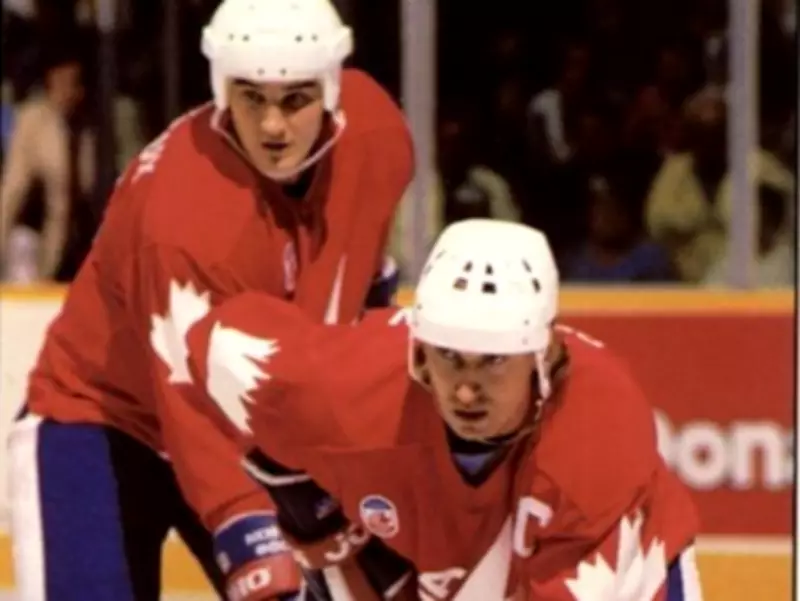
In the summer of 1987, while relaxing at his cottage, Mike Keenan had a groundbreaking idea that would shape hockey history. The head coach of Team Canada contemplated uniting Wayne Gretzky and Mario Lemieux, the two finest players of their era, on the same line for the upcoming Canada Cup tournament. This strategic move, kept entirely under wraps, aimed to secure victory against formidable opponents like the Soviet Union.
A Strategy Shrouded in Secrecy
Keenan, now reflecting from Italy during the Milano-Cortina Winter Olympics, emphasized his clandestine approach. "I didn't tell anyone what I was thinking," he admitted. "Not the coaches, not management, and certainly not Gretz or Mario." His decision stemmed from a desire to maintain unpredictability, a coaching philosophy starkly different from today's collaborative bench management. With Gretzky and Lemieux dominating NHL scoring charts—finishing first and second in 1986—Keenan saw an opportunity to leverage their unparalleled skills without alerting rivals.
Backed by a staff including John Muckler, Jean Perron, and Tom Watt, Keenan operated solo, making all lineup calls himself. "I made all the calls," he stated, highlighting an era where coaches relied more on instinct than extensive game planning. His primary goal was to outmaneuver the Soviet Union in what would become a legendary three-game championship series.

Echoes in Modern Olympic Hockey
Fast forward to the 2026 Winter Olympics, where Team Canada coach Jon Cooper has drawn comparisons by uniting Connor McDavid and Nathan MacKinnon on a single line, alongside young star Macklin Celebrini. Keenan observed this development with a smile, noting similarities to his 1987 strategy. "I figure he either studied what we did or (Rick) Tocchet told him about it," Keenan speculated, referencing Tocchet's roles as a player in 1987 and current assistant coach.
Just as Keenan paired Gretzky and Lemieux with Dale Hawerchuk, Cooper's trio showcases high-caliber talent. McDavid and MacKinnon, top NHL scorers, bring experience from Stanley Cup finals, while Celebrini adds youthful prowess. Keenan praised this alignment, stating, "When it matters, you want to put the game in the hands of your best players."
The Unforgettable Moment and Lasting Legacy
Keenan's secrecy extended to the players themselves. Gretzky and Lemieux were unaware of the plan until their names were called during games. "There was no reaction when I called their names," Keenan recalled. "It was business as usual." This culminated in the iconic Canada Cup-winning goal, scored by Lemieux and assisted by Gretzky—a moment etched in hockey lore. Despite their synergy, the duo never played together again after that tournament.
Reflecting on their talents, Keenan marveled at Gretzky's record 936-point lead over other players and Lemieux's resilience through health challenges. Statistically, Gretzky leads with 1.92 points per game, followed closely by Lemieux at 1.88, and McDavid at 1.53 in a more competitive era. "Gretzky, Lemieux, McDavid—top three offensive players, ever," Keenan affirmed, underscoring the timeless impact of strategic player pairings.
As hockey evolves, Keenan's 1987 strategy remains a testament to the power of secrecy and elite talent convergence, inspiring current coaches like Cooper to innovate for Olympic glory.