From Promising Start to NHL's Basement: Canucks' Dramatic Fall
It all looked so promising on opening night for the Vancouver Canucks. On October 9 at Rogers Arena, they built a commanding 4-0 lead en route to a dominant 5-1 victory over the Calgary Flames. Filip Chytil scored twice with five shots and eight attempts, while Brock Boeser, Kiefer Sherwood, and promising prospect Jonathan Lekkerimaki also found the net. Goaltender Thatcher Demko appeared healthy and sharp. What could possibly go wrong?
The Unraveling Begins
How about everything? The Canucks have since plummeted to the bottom of the NHL standings, forcing the franchise into a pragmatic rebuild to offer some hope to an increasingly apathetic fan base. To understand the shocking transformation that has occurred in less than two years, consider this: a total of 15 players from the 2024 playoff lineup are now playing elsewhere.
For this season alone, 10 players from the opening night lineup won't play in Monday's game against the Ottawa Senators. They've either been traded (4), are injured long-term (4), are in the AHL (1), or are prospects (1). The injury bug bit early and often. Just ten days after the opener, Chytil and Teddy Blueger were lost to long-term ailments, sidelined for 43 and 44 games respectively. Chytil is out again and has missed seven additional games.

Injury Woes and Roster Construction
Lekkerimaki suffered a shoulder injury on October 19 and underwent season-ending surgery on February 26. The sidelined list grew to nine players in a condensed schedule that invited fatigue and injury. Nils Hoglander suffered a freak ankle fracture in a preseason game at Abbotsford, missing 29 games. Derek Forbort lasted just two regular-season games with a persistent lower-body ailment and has yet to return.
While many teams succumbed to injuries this season, Vancouver's lack of success is fundamentally about roster construction, long-term commitments, and questionable trade decisions. The rebuild gained momentum when unrestricted free agent winger Kiefer Sherwood, who led the club in goals and hits, was traded to the San Jose Sharks on January 19.
Lukas Reichel and David Kampf became anchors and were moved for sixth-round 2026 draft picks on Friday, shedding that baggage was crucial. However, the season began going sideways almost immediately.
The Hughes Departure and Cultural Shift
The Canucks couldn't gain traction, and a July 1 play to appease captain Quinn Hughes and keep the core intact for a playoff push didn't pan out. Conor Garland, Boeser, and Demko received contract extensions, but winning and a clear vision for the future were paramount to an increasingly uneasy Hughes. In the end, it didn't matter—he had no intention of signing long-term, speaking volumes about the franchise's direction.
When Hughes was dealt to the Minnesota Wild in a blockbuster trade on December 12, it triggered the transition. The Canucks gained a first-round 2026 pick, promising prospects Liam Ohgren and Zeev Buium, plus battle-tested Marco Rossi. But they lost a game-changer who was appointment viewing. Hughes has since dazzled with offensive-zone forays and precision passing, accumulating 39 points (4 goals, 35 assists) in 31 games with the playoff-bound Wild.
The Canucks actually won four straight road games after the Hughes trade, which offered temporary encouragement, but it wouldn't last. "We're trying to change the culture with our standards," Canucks head coach Adam Foote said at the outset of that run. "It will bring consistency. The process every day won't change, but with a lot of new young players, there's going to be catch-up and development."
The Mirage of Success
That brief run proved to be a mirage. The adrenaline of newcomers and being away from home-ice pressure brought a blip of wins, followed by 11 straight setbacks that set a franchise record for futility. Five weeks after the Hughes move, the Canucks dealt 30-year-old unrestricted free agent winger Kiefer Sherwood to the San Jose Sharks, where he secured a five-year, $30 million extension.

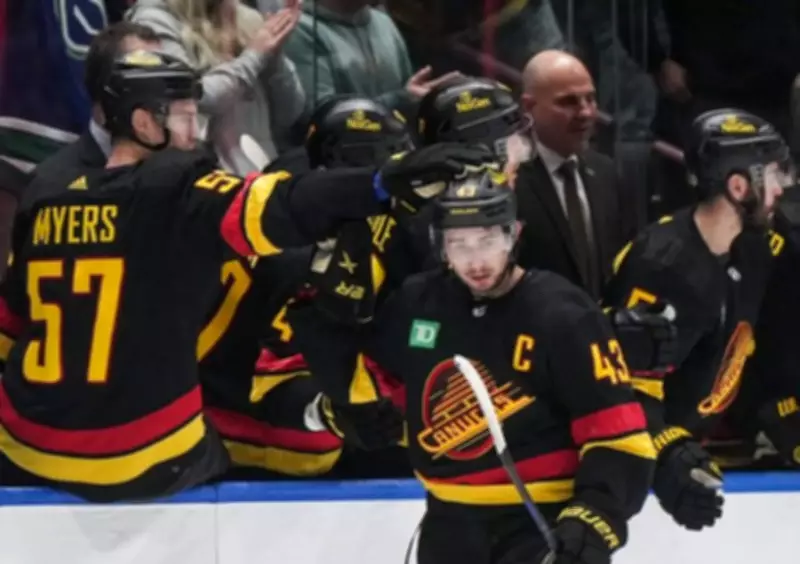
When Tyler Myers, 36, and Garland, 29, were moved last week, they represented prudent plays. The Canucks received a second-round pick (2027) and a fourth-rounder (2029) from the Dallas Stars for Myers. The Garland trade to the Columbus Blue Jackets brought a third-round pick (2026) and a second-round pick (2028) before his six-year, $36 million extension kicks in on July 1.
Rebuilding the Core
What happens now matters most for the Canucks. They opened this season with Elias Pettersson between Jake DeBrusk and Boeser as the first line, combining for 42 goals heading into Monday's game. The rationale was that Pettersson would rebound from a dreadful 2024-25 season that included locker-room drama with J.T. Miller, but he produced just 45 points (15 goals, 30 assists) in 64 games.
DeBrusk was coming off a career-high 28 goals, and Boeser was capable of building on his 25 goals from 2024-25. However, Pettersson hasn't scored in 17 games and has just 18 shots. The streaky DeBrusk has two goals in his last 20 games with 42 shots. Boeser does have three goals in his last two games but went 21 outings without finding the net, though he managed 37 shots during that drought.
Does management commit to this trio? Pettersson's enormous contract and ineffectiveness are difficult to sell. DeBrusk could be moved, as his $5.5 million cap hit for five more seasons might be palatable for a contender. Boeser is a harder sell at $7.25 million for six more seasons. If this is the supportive rebuild core along with Filip Hronek and Demko, they must become much more prominent.
The Canucks are currently second last in goals scored, have given up the most goals, and possess the worst penalty kill in the league. The dramatic roster regression has indeed produced a pragmatic push to rebuild, leaving fans to wonder what the future holds for this once-promising franchise.