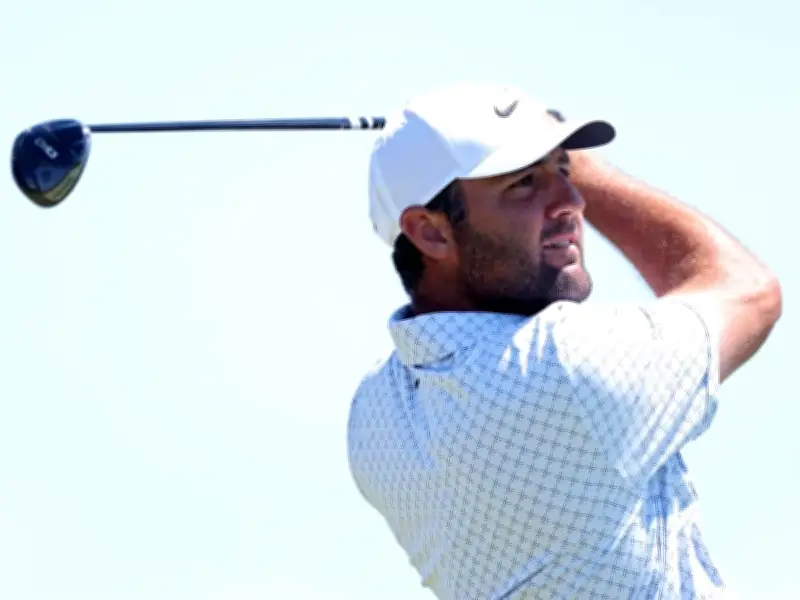
SOUTHHAMPTON, N.Y. — Scottie Scheffler has a chance this week at the U.S. Open to become the unlikeliest winner of golf's career grand slam and he could prove an important point to modern athletes along the way.
Last year, with two Masters wins already under his belt, Scheffler's dominating victories at the PGA Championship at Quail Hollow and the Open Championship at Royal Portrush left him a U.S. Open shy of becoming the seventh player to win all four major championships.
“Would it be a dream to win the U.S. Open? Of course,” Scheffler said ahead of play at Shinnecock Hills in New York. “But at the end of the day, the grand slam has never been a motivating factor for me. I always just wanted to be the best version of myself, and that got me this far.”

In just a couple of sentences, Scheffler conveyed what differentiates him from the golf greats whose orbit he quickly has entered.
“If I was feeling so good about all my successes, I probably wouldn't be too much fun to be around,” Scheffler said when explaining why he tries not to focus on his results.
How is Scheffler different from many greats?
Aside from the career grand slam, take a moment to think about the 21st century superstars Scheffler is following: Tiger Woods, Phil Mickelson and Rory McIlroy. It may seem unfair to lump those three greats together, but it's safe to say, despite whatever personality differences they have, all of them have zero issues with showing the world, and those around them, that they feel very, very good about their success. And it's not hard to picture any one of them satisfyingly scratching lines across all the names they have surpassed in golf history.
Scheffler's role as something of a reluctant hero has proven a difficult one for the wider sport's world to fall in love with, but it's a valuable lesson for modern athletes who are having an increasingly difficult time dealing with the external pressures of life in the spotlight in the social media age.
“No matter what, I think as a player and as a professional athlete, you're never going to live up to the expectations of people,” Scheffler said.
Social media and its band of trolls and army of idiots have pulled the curtain back on the uglier parts of society, and along the way it has sharply shown professional athletes that the glory of victory is fleeting. The pedestal athletes are foisted upon is no longer tall enough to drown out the jeers. Ben Hogan wasn't reading posts from haters five minutes after enjoying a ticker-tape parade down Broadway.
This isn't to say modern sports greats shouldn't share some of the blame. By looking to tell their own stories to fans, athletes end up finding new avenues for angst and pressure, exposing vulnerabilities along the way.
“I think sometimes when you look at more of kind of a wider view of the sport and where your game's at, second is not always that bad, but man, does it frickin' hurt at the same time,” he added. “So you can feel like a failure in this sport oftentimes just because you're not winning, and I think that's just part of it. That's why I said I try not to focus too much on my successes or my failures, one, because you get beat up an awful lot in this game. It's a tough sport.”
What lesson can Scheffler's career teach others?
It's commonplace these days to hear athletes spouting the sport psychologist's mantra of focusing on the process rather than the result. But that's much easier in theory than in practice and, in golf, it's easier said on a Wednesday than accomplished on a Sunday. To see a superstar athlete come by this naturally like Scheffler can seem unnatural, almost off-putting, considering how conditioned we have become to judging excellence by the desire for greatness and the constant pursuit of history.
The question that Scheffler's career will help answer is: Can all-time greatness be achieved without a destination? The chase has been sport's great motivator for generations. Whatever the sport is, catching the guy in front of you is often what keeps you going, whether it's literal or metaphorical. There's a reason horses run faster when racing. There's a reason Tiger had Jack Nicklaus' records on the wall. But there's also a reason so many athletes are left with existential questions when it's all over.

McIlroy described an emptiness rather than a fullness in the weeks and months after completing the career grand slam.
“I think sometimes that's a little bit of the fallacy in our sport is like, ‘if I win the U.S. Open, then I'm going to be satisfied,'” Scheffler said. “I've won all the tournaments and my career is essentially over, and I've accomplished everything I could want to accomplish. But I think the goal posts are always just moved further and further.”
Everything in sport has evolved. The athletes are better. The technology is better. The strategies are better. Perhaps it's time to rethink motivation. Maybe that's the lesson that Scheffler's career will teach us.
“So when it comes to this golf tournament, like I said, I'm going to step on the first tee and remind myself I've done everything I possibly could in order to play well, and now it's just a matter of going out there and trying to execute and kind of going back to enjoying the competition versus feeling like you have to win for some reason,” he said.