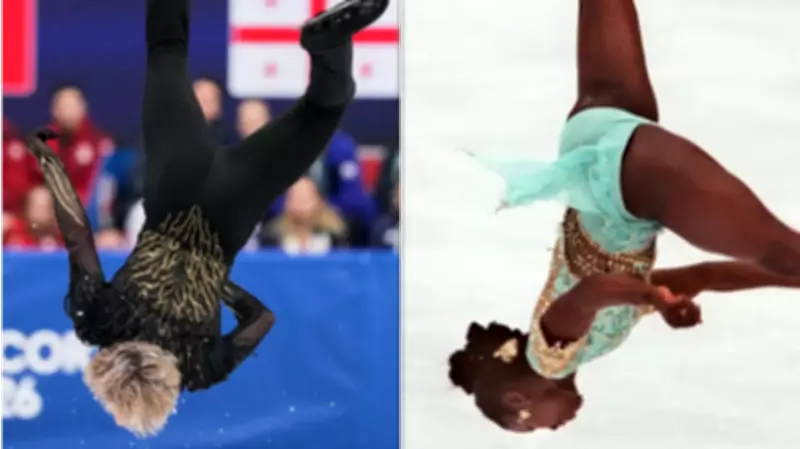
Ilia Malinin's Historic Olympic Backflip Reopens Discussions on Skating's Past
The 2026 Milan-Cortina Winter Olympics witnessed a groundbreaking moment in figure skating history. Ilia Malinin, the 21-year-old American skater famously known as the "Quad God," became the first athlete to legally execute a backflip landing on a single skate blade during Olympic competition. This pivotal move occurred during his free skate performance on Sunday night, contributing significantly to the American team's gold medal victory.
The Bonaly Flip: A Legacy Overshadowed?
While Malinin receives widespread acclaim for his athletic achievement, many observers are drawing attention to the pioneering figure who first performed this daring maneuver under very different circumstances. The backflip is commonly referred to as "the Bonaly flip" in honor of French skater Surya Bonaly, who executed the same move at the 1998 Nagano Games when it was explicitly prohibited by competition rules.
The contrasting reception between Malinin's celebrated performance and Bonaly's penalized execution has sparked significant conversation across social media platforms and within the skating community. Numerous commentators are questioning whether racial bias and changing attitudes within the sport have created an unequal legacy for these two athletes.

Historical Context: From Ban to Celebration
The backflip's journey in competitive figure skating reveals a complex history:
- 1976: American skater Terry Kubicka became the first to perform a backflip at the Olympics, landing on two skates. The International Skating Union promptly banned the move, citing safety concerns.
- 1998: Surya Bonaly deliberately violated ISU regulations during her final professional performance at the Nagano Games, executing a backflip with a single-blade landing despite knowing it would cost her points.
- 2024: The ISU lifted its decades-long ban on backflips in an effort to modernize the sport and attract younger audiences.
- 2026: Ilia Malinin incorporated the now-legalized backflip into his competitive routines, culminating in his historic Olympic performance.
Voices from the Community
Ari Lu, a 49-year-old figure skating enthusiast, expressed a sentiment shared by many on social media platforms like TikTok. "Something a Black person used to be derided for is now celebrated when done by a white person," Lu stated in a text message to The Associated Press. She emphasized that while Malinin is praised for his athleticism, Bonaly faced criticism that often focused on her appearance rather than her technical skill.
In a telephone interview from Minnesota, Bonaly reflected on the evolution of figure skating since her competitive days. "I was born too early," she remarked, noting that she arrived at a time when the sport was less receptive to innovation and diversity. "I broke ice for other skaters. Now everything is different. People welcome anyone as long as they are good and that is what life is about."
Looking Forward: A Changed Landscape
Bonaly expressed enthusiasm about seeing the backflip performed on Olympic ice, acknowledging that such innovations help elevate the sport to new levels. Her tenth-place finish in Nagano stands in stark contrast to Malinin's gold medal achievement, highlighting how rule changes and shifting cultural attitudes can dramatically alter an athlete's competitive outcomes and legacy.
The ongoing discussion surrounding these two skaters underscores important questions about recognition, historical context, and equity within figure skating. As the sport continues to evolve, the contributions of pioneers like Surya Bonaly remain essential to understanding its complete narrative.