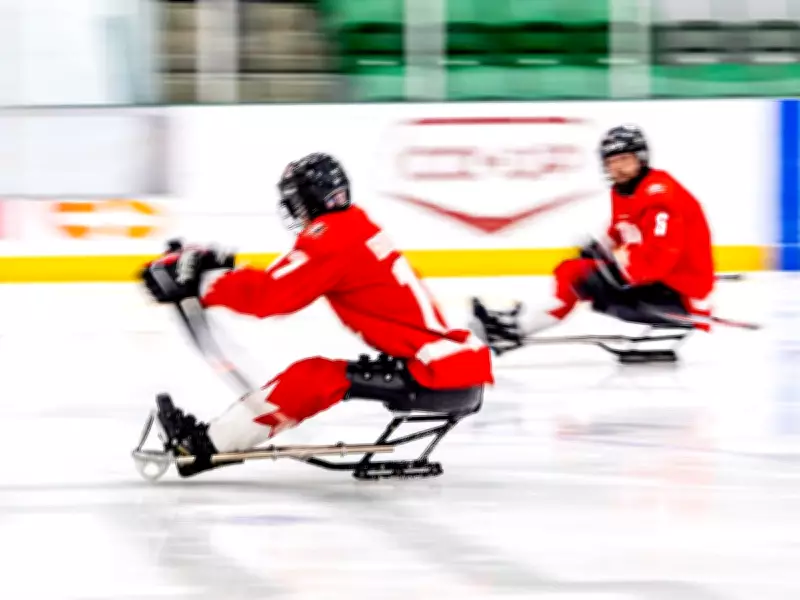
Canada's 'next gen' para hockey team is fostering young talent during a development series in Saskatoon this week. Assistant coach Dean Seymour says training opportunities like this series are crucial for sharing the knowledge needed to develop athletes across the country.
Development Series in Saskatoon
At this week's para hockey development series in Saskatoon, Captain Shawn Burnett is bringing inspiration from a difficult-to-prepare-for moment: experiencing the energy of more than 11,000 spectators during a gold-medal game at the recent Milano-Cortina Paralympic Games. Burnett, 22, is one of two players on the development roster who competed in Italy, and he is working to model the level of excellence he saw from his national teammates for a new generation of players.
“Here, there are those people in the stands, but it’s not the same kind of atmosphere,” Burnett said, comparing the series to the Paralympics. “But I feel like our motto is just to prepare every game like if it was a gold medal game … That’s kind of what we did today,” the defenceman added after beating the USA's development team in Game 1 of the three-game series at Merlis Belsher Place.

Building on Paralympic Experience
Burnett, who is bilingual and from McMasterville, Que., picked up the sport after a serious skydiving accident in 2021. The Paralympic gold-medal game set a new all-time attendance record for the growing sport. “Now, as a leader with the development team, (I’m) just trying to bring everything that I learned with the veterans of the national team and bring it for the young guys,” he said.
Para ice hockey, formerly known as sledge hockey, is played by athletes with a physical impairment in the lower part of the body. Both men’s and women’s programs are quickly gaining momentum in Canada, but some barriers remain.
Coaching Philosophy
Assistant coach and Saskatoon-native Dean Seymour says training opportunities like this series are crucial for sharing the knowledge needed to develop elite athletes across the country. However, coaches are tasked with walking a fine line, as players need to focus on the task at hand: fending off Team USA over three games.
“We’ve got to balance a fine line between over-delivering information and allowing (athletes) to play their style of game,” said Seymour, who was also part of the Paralympic coaching staff. He believes hard work will surpass skill against the cross-border opponents. “We’re going to have to keep things simple, and I’m not saying straight line simple, but we’re going to have to shoot pucks, retrieve pucks, and shoot pucks again, and then retrieve pucks and shoot them some more,” Seymour explained.
Developing National Best Practices
As the fast-paced sport continues to take hold, athletes are still training in relatively isolated hubs across Canada. But the development series makes national best practices more accessible. “When we bring them in like this, and we send them back to their hubs, hopefully they understand where they need to grow, as far as individual skills, habits, but also … concepts and tactical information,” Seymour said.