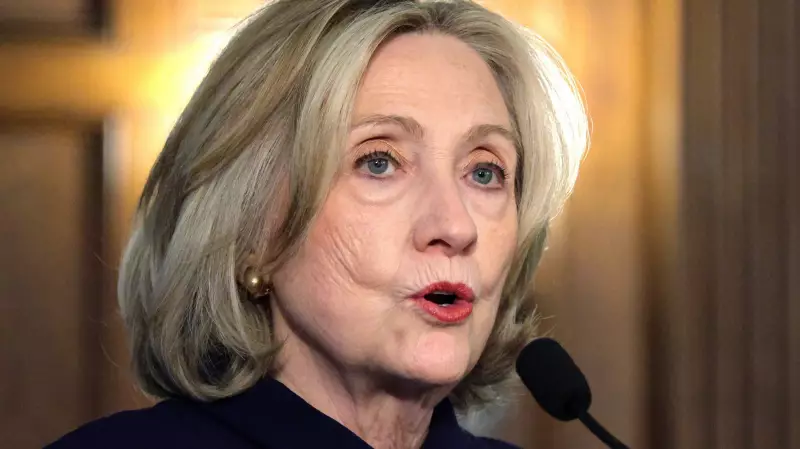
Former U.S. Secretary of State Hillary Clinton has issued a stark warning about the dangerous influence of misinformation on social media, particularly in shaping how young people understand the complex conflict between Israel and Palestine.
Clinton's Concerns at Israel Hayom Summit
Speaking at a summit hosted by the right-wing Israeli newspaper Israel Hayom in New York City, Clinton expressed deep concern about where younger generations are getting their information. She highlighted that more than 50% of young people in America now get their news primarily from social media platforms.
"Just pause on that for a second," she told the audience, framing the trend as a fundamental challenge. Clinton zeroed in on the prevalence of short-form video content on apps like TikTok, noting that these videos are often misleading or completely fabricated. "They are seeing short-form videos, some of them totally made up, some of them not at all representing what they claim to be showing, and that’s where they get their information," she stated.

A 'Serious Problem' for Democracy and Historical Context
Clinton specifically addressed how this dynamic applies to news about the Israel-Palestine conflict. She pointed out that for many young people, social media was their primary source for learning about Hamas's October 7, 2023, attacks on Israel and the subsequent events. "It’s a serious problem for democracy, whether it’s Israel or the United States, and it’s a serious problem for our young people," she argued.
Reflecting on discussions with students, including at Columbia University, Clinton said she found it "shocking" how little they knew about the historical context behind the occupation. "When you would try to talk to them to engage in some kind of reasonable discussion, it was very difficult because they did not know history. They had very little context," she explained. Clinton characterized much of the content they consume as "not just one-sided, it was pure propaganda."
She added that criticism of Israel is no longer confined to "the usual suspects," claiming that even "a lot of young Jewish Americans" lack a firm understanding of the conflict's historical background.
Shifting Public Sentiment in the U.S.
While the direct impact of misinformation is hard to measure, American public opinion regarding Israel has shifted noticeably since the nation escalated its military campaign in Gaza following the October 7 attacks. A Pew Research Institute study released in March found that 53% of U.S. respondents reported an unfavorable opinion of Israel, marking an 11% increase from similar polling conducted in 2022.
Clinton's remarks underscore a growing anxiety among political figures and educators about the role of algorithm-driven social media platforms in forming worldviews, especially on geopolitically sensitive issues where historical nuance is critical.