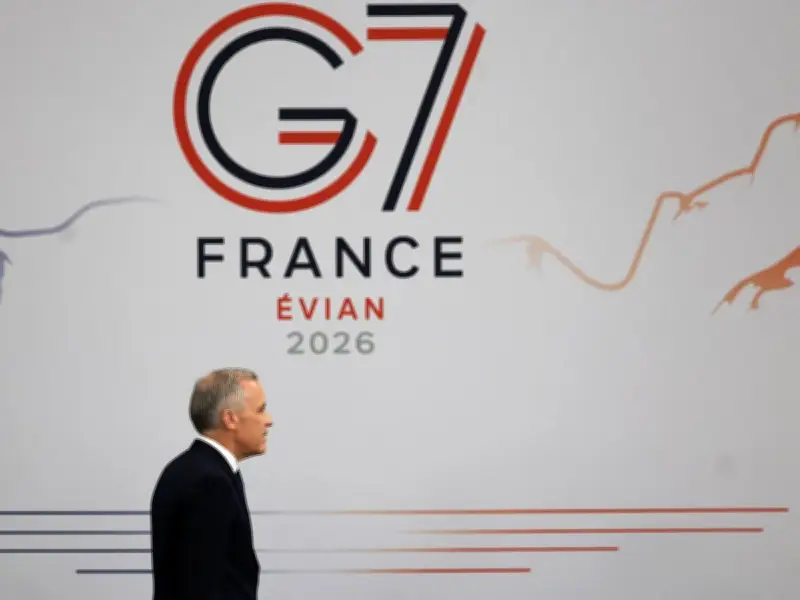
EVIANS-LES-BAINS, FRANCE – Prime Minister Mark Carney wrapped up his appearance at the G7 Leaders’ Summit on Wednesday, having engaged in multiple conversations with U.S. President Donald Trump on a broad range of issues, despite the absence of a formal bilateral meeting.
“I had seven or eight discussions with President Trump over the course of the last 36 hours, I’ll have more today,” Carney stated during his closing press conference at the G7 meeting on Wednesday.
Carney disclosed that the subjects discussed with the president included the economy, Trump’s birthday, artificial intelligence, Ukraine, and the Iran peace deal. The prime minister also had the opportunity to address trade matters with Trump.

On Tuesday, a hot mic captured Carney reassuring the president about Canada’s electric vehicle (EV) deal with China. Carney explained that he was responding to a question Trump had asked him about the agreement. “It was one of many interactions with him, and I was explaining the actual structure of the deal,” Carney said. “I’m not surprised that the president of the United States doesn’t follow every detail of every agreement that Canada has, and he likes the structure.”
The prime minister noted that he had a follow-up conversation with Trump on the agreement, which permits 49,000 Chinese-made EVs to enter the Canadian market at a 6.1 percent tariff rate.
Canada-U.S. trade is currently in a period of intense negotiation, as the Canada-United-States-Mexico-Agreement (CUSMA) is set for renewal in July.
When asked about Industry Minister Mélanie Joly’s trip to China and the potential for increased Chinese auto investment in Canada, Carney emphasized that he is not interested in “knockdown kits,” where most production occurs in China before being shipped to Canada for assembly. “We’re not interested in kits being put together in Canada,” Carney told reporters. “We’re interested if there are joint-venture partnerships, Canadian controlled, substantial value-add, Canadian labour standards, substantial jobs, et cetera, that are consistent with that.”
The G7 leaders’ statement on geopolitical issues welcomed Canada’s potential to deliver “significant” additional energy capacity for global markets. Carney said Canada can supply the energy Europe needs, with more agreements in the works on Canadian liquefied natural gas (LNG). “Canada has the ability to do several things, and we’re on the path to do several things, 150 megatons of LNG by the end of the year,” Carney stated.
In late May, Germany and Canada signed an offtake agreement to ship gas from the proposed Ksi Lisims LNG facility, a floating natural gas liquefaction production, storage, and offloading plant on the north coast of British Columbia, to Germany starting in the 2030s.