Alberta Municipalities Decry $1 Billion Infrastructure Shortfall in Provincial Budget
Alberta Municipalities, the organization representing over 264 municipal governments across the province, has issued strong criticism of the provincial government's Budget 2026, highlighting a significant infrastructure funding gap and expressing deep concerns about increased property tax burdens on residents.
Substantial Infrastructure Funding Deficit Identified
Dylan Bressey, President of Alberta Municipalities, stated that while infrastructure funding remained steady in Budget 2026, it fell approximately $1 billion short of what municipalities actually require to maintain and develop essential public infrastructure. "Municipal governments have already tightened their belts and they're stretching every dollar in their budgets, but efficiency can't make up for the billions of dollars that are needed for infrastructure," Bressey emphasized during his assessment of the budget announcement.
The organization also expressed disappointment that social infrastructure funding remained stagnant, particularly pointing to the family and community support services (FCSS) allocation, which stayed at $105 million for the 2026-27 fiscal year despite growing community needs.

Education Property Tax Increase Draws Sharp Criticism
Beyond the infrastructure concerns, Alberta Municipalities raised serious objections to the continued increase in education property taxes (EPT), which they argue unfairly burdens municipal taxpayers. Bressey articulated that property taxes represent a particularly problematic form of taxation during economic uncertainty. "The problem with property taxes is they're a form of taxation that doesn't go down when people's or family's incomes decrease or if businesses struggle," he explained.
Bressey further argued that "property taxes are not the right lever to pull if we care about affordability and investment in this province," suggesting that the provincial government should instead collect its own taxes directly rather than requiring municipalities to act as collection agents for provincial education funding.
Budget 2026 Projects Significant Deficits
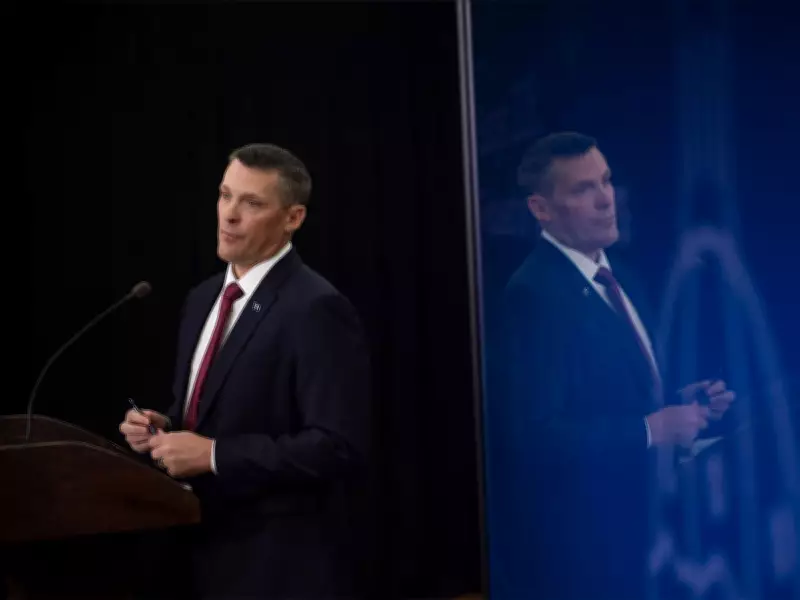
Finance Minister Nate Horner presented Budget 2026, titled "Focused on What Matters," on Thursday, February 26, 2026, at the Queen Elizabeth II building in Edmonton. The budget projects a substantial $9.4 billion deficit for the upcoming fiscal year beginning April 1, with additional deficits of $7.6 billion and $6.9 billion forecast for the following two years respectively.
Minister Horner acknowledged the challenging fiscal situation, stating "I recognize this is a tough pill to swallow," while attributing the province's financial difficulties primarily to persistently low oil prices that have reduced provincial revenues.
Specific Municipal Funding Allocations
Budget 2026 allocates $7.1 billion over three years toward Municipal Infrastructure Support, including $3.9 billion specifically designated for municipal infrastructure projects and programs through mechanisms like the Local Government Fiscal Framework (LGFF). While Alberta Municipalities acknowledged the government's fulfillment of its commitment to restore the grants in place of taxes program, they maintained that this positive development is overshadowed by the broader funding shortfalls and tax increases.
Direct Impact on Alberta Homeowners
The practical consequences of these budgetary decisions will be felt directly by Alberta homeowners. In the 2026-27 fiscal year, Edmonton homeowners will see a $154 increase for median households, while Calgary homeowners face a more substantial $340 hike for median households, with these amounts coming on top of regular municipal property tax obligations.
The new rates establish that homeowners will pay $2.84 per $1,000 of equalized assessments for residential or farmland properties, while non-residential properties will be taxed at $4.17 per $1,000 of equalized assessments. These increases come at a time when many Albertans are already experiencing financial pressures, leading to concerns about affordability and economic stability across the province.