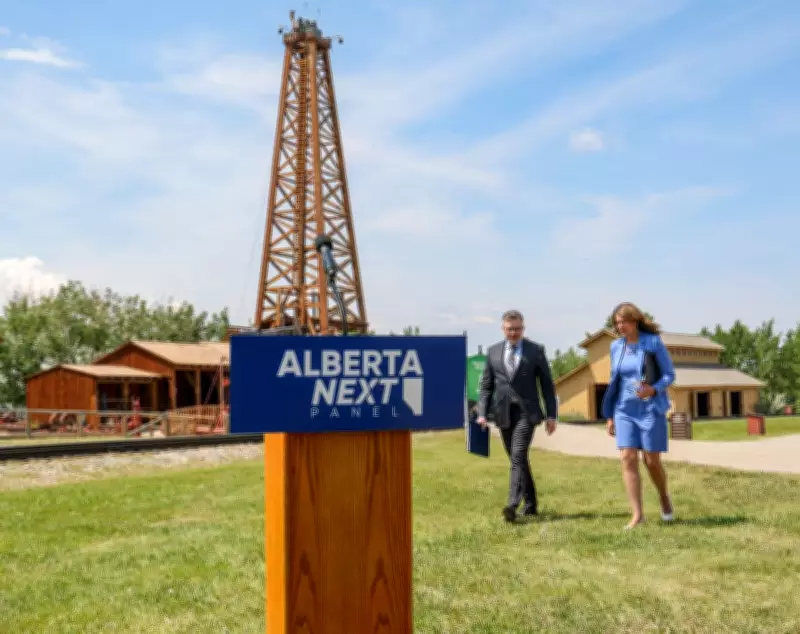
Alberta Government Found in Violation of Access Laws Over Survey Secrecy
An independent adjudicator has determined that the Alberta government improperly withheld hundreds of pages of survey results from public scrutiny, violating provincial freedom of information legislation. The ruling comes after Postmedia filed multiple requests seeking early responses from the government's Alberta Next consultation initiative.
Multiple Requests Denied Despite Public Interest
Throughout the summer months, Postmedia submitted five separate access to information requests seeking preliminary results from online surveys concerning several critical provincial matters. These included questions about a potential Alberta pension plan, proposals for a provincial police service, and immigration policies. The requests also sought written responses submitted by participants after completing the online survey forms.
The government's executive council and communication department both refused to provide the requested records, citing exemptions within the Freedom of Information and Protection of Privacy (FOIP) Act. Officials claimed disclosure could reasonably reveal pending policy or budgetary decisions, a justification that has now been thoroughly rejected by the privacy commissioner's office.

Adjudicator Rejects Government's Arguments
In five nearly identical court-enforceable orders issued recently, Office of the Information and Privacy Commissioner (OIPC) adjudicator Teresa Cunningham systematically dismantled the government's position. Cunningham ruled unequivocally that the province broke its own legislation by refusing to release the consultation records.
"At the time of the consultation, members of the public did not know what the public body was going to decide," Cunningham wrote in one of her rulings. "As a result, disclosing the views of members of the public cannot reasonably be expected to disclose a pending policy decision."
The adjudicator further noted that the survey responses contained diverse and often conflicting opinions on key issues, making it impossible to argue that any single response revealed government intentions. "Moreover, the opinions in the records differ on many key points so it is not possible to point to an opinion and argue that it discloses a pending policy decision," the ruling stated.
Timing Control Versus Legal Obligations
Postmedia argued in its submissions that the government's refusal had little to do with protecting decision-making processes and everything to do with controlling when survey results became public. The media organization noted that other government departments had provided similar survey results in response to access requests as recently as the previous summer, suggesting inconsistent application of FOIP exemptions.
Cunningham's orders require the Alberta government to release all requested records to Postmedia within 50 business days, setting a deadline of April 20 for compliance. The government has stated it intends to follow the orders, though it had previously published only a summary of multiple-choice survey results in late December, excluding 213 pages of written responses submitted by participants.
Broader Implications for Government Transparency
This case highlights ongoing tensions between government control of information and statutory transparency requirements. The Alberta Next initiative, launched with considerable fanfare in June 2025, was presented as a comprehensive public consultation effort. However, the government's resistance to releasing early results raises questions about how genuinely transparent such consultation processes remain when subjected to public scrutiny.
The adjudicator emphasized in her rulings that "it is the role of government to make policy and budgetary decisions, not members of the public," suggesting that public input cannot be equated with government decision-making for FOIP exemption purposes. This distinction may have significant implications for how future public consultations are conducted and disclosed across provincial ministries.

As Alberta continues to debate major policy shifts including pension reform, policing models, and immigration approaches, this ruling reinforces that public consultation processes must remain genuinely transparent to maintain public trust in government decision-making.