

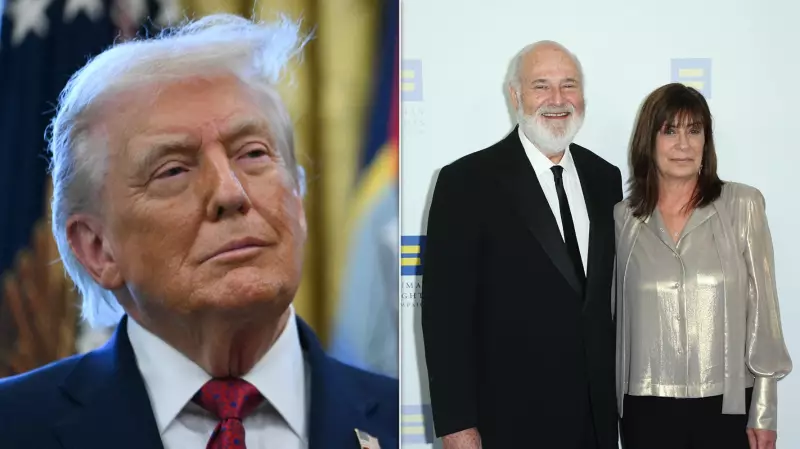
The sudden deaths of filmmaker Rob Reiner and his wife, Michele, prompted an outpouring of grief online. However, the response took a starkly political and divisive turn when former U.S. President Donald Trump weighed in on his platform, Truth Social.
A Controversial Response to Tragedy
On Monday night, Trump posted a message that shifted focus from the tragedy to his own political grievances. He suggested Reiner's passing was linked to what he termed "Trump Derangement Syndrome (TDS)," describing it as a "massive, unyielding, and incurable affliction." Trump claimed Reiner was "tortured" by an "obsession" with him, concluding with, "May Rob and Michele rest in peace!"
The post, which mixed insults with a perfunctory condolence, was widely criticized as tasteless and self-absorbed. Notably, even some of Trump's supporters on Truth Social called the response "tacky," "heartless and uncalled for," and "unnecessary." Despite this, the post garnered significant engagement, with 9.31 thousand reposts and 38.9 thousand likes at the time of reporting.

This incident followed recent conservative criticism of "insensitive critiques" of the dead after other events, highlighting a perceived hypocrisy that psychologists sought to explain.
The Psychology of Blame and Online Dehumanization
Experts told HuffPost that Trump's reaction, while extreme, fits established psychological patterns. John Jost, of New York University, called it typical of destructive narcissism. "It is no real surprise that Trump made it all about himself," Jost said, noting the use of projection.
Daniel R. Stalder, a social psychologist, identified elements of victim-blaming. "In general, unfortunately, it’s relatively common to respond to tragedy by searching for and finding some reason to blame the victim(s)," he explained. This can satisfy a need to believe the world is just and that similar tragedies can be avoided.
Psychotherapist Gina Simmons Schneider pointed to the role of online distance in enabling cruelty. "The more distant we feel from others, the easier it is to inflict harm. That’s why we see so much cruelty online," she said. This dehumanization is amplified when normalized by influential figures.
Extreme Partisanship and the Role of Leadership
Jay Van Bavel, director of NYU's Center for Conflict & Cooperation, said such polarized reactions have grown worse with each partisan death. This escalation is fueled by social media algorithms that promote outrage and deepen in-group vs. out-group dynamics.
"Part of it is empathy," Van Bavel said. "There’s greater empathy for members of our own group." Conversely, research even shows people can derive pleasure from the misfortune of rival groups, leading to "political schadenfreude."
Jost argued that the "both sides" narrative fails here, as Trump's leadership has fostered an environment where "hypocrisy and dishonesty is not a problem for one’s constituents." When leaders model dehumanizing behavior, followers often emulate it. Van Bavel confirmed this, stating, "People who follow politics closely tend to mirror the policies, positions and statements of their leaders."
Navigating a Divided Society
Simmons Schneider reported a considerable uptick in anxiety related to political conflicts within families. The challenge is maintaining a collaborative spirit in a polarized climate.
Van Bavel recommended focusing on shared values and remembering that extreme online voices are not representative. "The most incendiary, extreme voices do not represent the average member of the parties," he said, citing a Pew statistic that 10% of users create 97% of political posts.

Ultimately, the tone set by leaders is critical. "When political leaders are signaling that it’s OK to do this, we are far more likely to do it," Van Bavel warned. "It’s really significant when someone like Donald Trump does this. It sends a signal that it’s acceptable." The incident underscores the profound impact of rhetoric from the top on public discourse and social cohesion, a concern relevant to observers in Canada and worldwide.





