

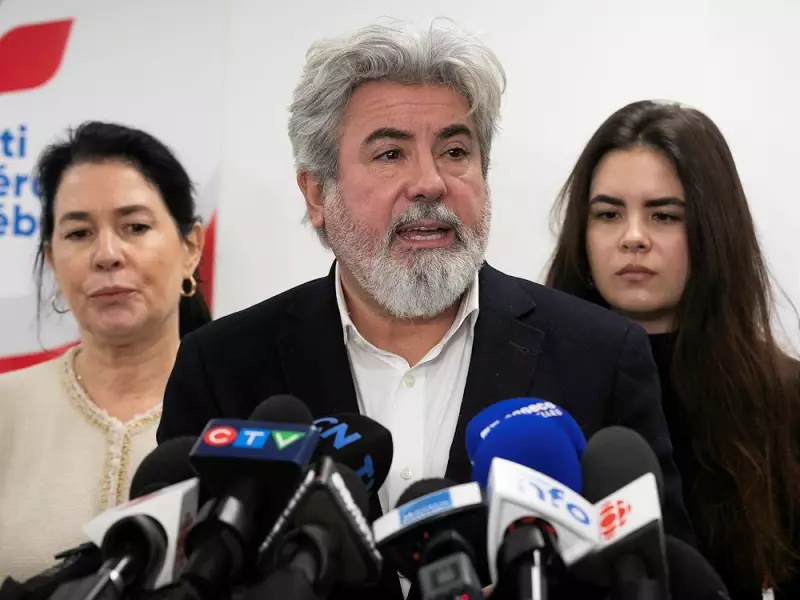
The political landscape in Quebec has been rocked by a scandal that analysts warn could be the catalyst for a third referendum on the province's separation from Canada. The sudden resignation of Quebec Liberal Party leader Pablo Rodriguez on December 18, 2025, amid serious corruption allegations has critically weakened the primary federalist force in the province.
Cash Envelopes and a Leadership Crisis
Rodriguez stepped down as leader this week, facing two major misconduct allegations against his party. The most striking accusation involves literal envelopes full of cash, evoking old-fashioned vote-buying scandals. While Rodriguez, flanked by his wife Roxane and daughter Beatrice during his announcement, maintained his personal innocence stating he "regrets absolutely nothing," the damage to the party's credibility appears severe.
This development comes at a perilous time for Canadian unity. The incumbent Coalition Avenir Québec (CAQ) government, led by Premier François Legault, is experiencing record-low popularity. For years, the Quebec Liberal Party has been viewed as the last major federalist bulwark capable of stopping the sovereigntist Parti Québécois (PQ) from taking power.

Polling Points to a Parti Québécois Sweep
Under Rodriguez's leadership, the Liberal party's support has cratered. A poll released by the Angus Reid Institute on December 17, 2025, paints a stark picture: the Parti Québécois commands 40% support among decided voters, compared to a mere 18% for the Liberals.
This commanding lead positions the PQ, under leader Paul St-Pierre Plamondon, for a potential landslide victory in the next provincial election, scheduled for 2026. Such a result would deliver the PQ its most powerful majority in decades. St-Pierre Plamondon has been unequivocal: once in power, he will pursue all necessary steps to hold a third referendum on Quebec independence.
The PQ is already laying the groundwork for a potential country. It has been serializing its "livre bleu" (blue book), a detailed blueprint for an independent Quebec. Recent chapters have outlined plans for a Quebec foreign service, naming which countries would receive ambassadors, and the creation of "Équipe Québec" to represent the nation at international sporting events.
The Federal Legacy of Pablo Rodriguez
Pablo Rodriguez is a familiar figure in federal politics. Before entering the Quebec provincial arena, he served as Heritage Minister under Prime Minister Justin Trudeau. In that role, he was the architect of two of the government's most contentious internet regulation laws.
He championed the Online Streaming Act, which grants federal regulators the power to impose Canadian content requirements on digital platforms like Netflix and YouTube. He also spearheaded the Online News Act, legislation whose fallout led Meta to block news sharing on Facebook and Instagram across Canada.
Rodriguez's departure from federal politics in September 2024 was part of a wider exodus of senior Liberals leaving the Trudeau government as its electoral fortunes declined.
The implosion of the Quebec Liberals removes the most significant obstacle on the PQ's path to power. With the CAQ faltering and the federalist alternative engulfed in scandal, the conditions for a renewed push for Quebec sovereignty are aligning in a manner not seen in a generation. The consequences of this provincial scandal may ultimately redefine the future of Canada itself.






