

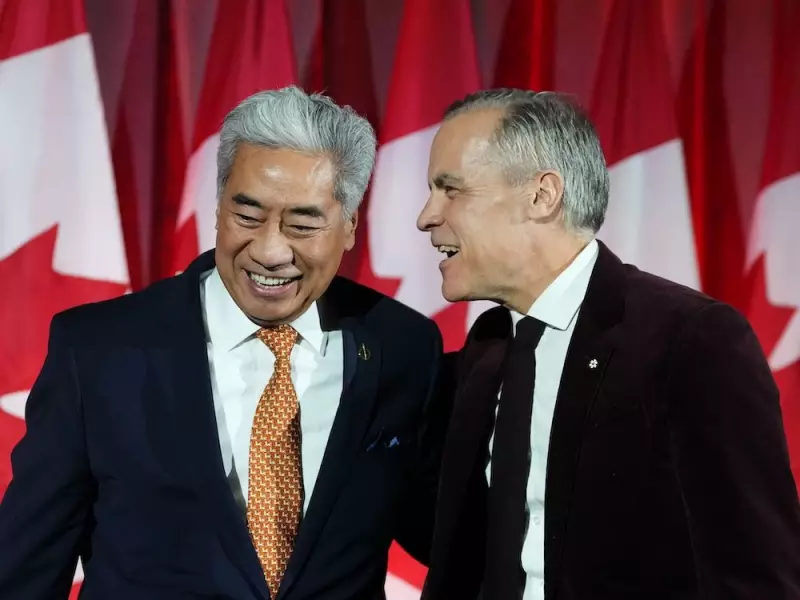
The federal Liberal government's path to a stable majority in the House of Commons may have just gotten shorter, but the destination could be a procedural quagmire. The recent defection of Conservative MP Michael Ma to the government benches has ignited speculation about the Liberals finally securing the magic number of 172 seats needed for a simple majority. However, parliamentary experts warn that achieving a bare, one-seat majority might be the worst-case scenario for Prime Minister Mark Carney's agenda, not the panacea many imagine.
The Illusion of 172
The significance of the number 172 was the subject of jovial banter at the Liberal caucus holiday party on December 11, 2025, just hours after Ma's dramatic floor-crossing. With his move, the government finds itself tantalizingly close to that crucial threshold. The allure is clear: a majority government commands a majority on all parliamentary committees, where opposition MPs currently have significant power to delay and scrutinize legislation. Presently, 11 of the government's 20 bills are stalled at second reading or in committee, a bottleneck a majority could theoretically clear.
Yet, the reality of a 172-seat majority is far more complex. According to constitutional lawyer and parliamentary law specialist Lyle Skinner, a one-MP majority is, in many ways, a worst-case scenario for a governing party. The critical complication lies with the Speaker of the House of Commons, Liberal MP Francis Scarpaleggia. By convention, the Speaker votes only to break a tie and is expected to act in a non-partisan manner.

A Recipe for Deadlock
In a House where the government holds exactly 172 seats, the math becomes precarious. With the Speaker not voting routinely, the government's effective voting strength is reduced to 171 MPs. The combined opposition would also command 171 votes. This sets the stage for a potential constant legislative deadlock, with every vote potentially ending in a tie.
This would repeatedly force Speaker Scarpaleggia into the politically awkward position of breaking ties. While in a partisan world one might assume a Liberal Speaker would side with his former party, parliamentary convention dictates otherwise. The Speaker is expected to vote to maintain the status quo, a principle firmly established by former Speaker Peter Milliken, who cast a record five tie-breaking votes during his tenure from 2001 to 2011.
Governance in a Procedural Straitjacket
Therefore, despite technically holding a majority of seats in the Commons, a Liberal government with 172 MPs could find itself functionally stymied. The government has shown little inclination this session to court opposition votes for support, making the prospect of navigating a 171-171 split with the Speaker as the perpetual decider a daunting one. The power to control committees would be offset by the fragility of its control on the floor of the House itself.
As rumours persist about more potential defections to the Liberal ranks, the political calculus in Ottawa grows increasingly intricate. Crossing the 172-seat threshold would symbolically end the minority government era for Mark Carney, but it could simultaneously usher in a new era of procedural instability, where every vote is a high-stakes gamble and the Speaker's chair becomes the most powerful seat in the chamber.






