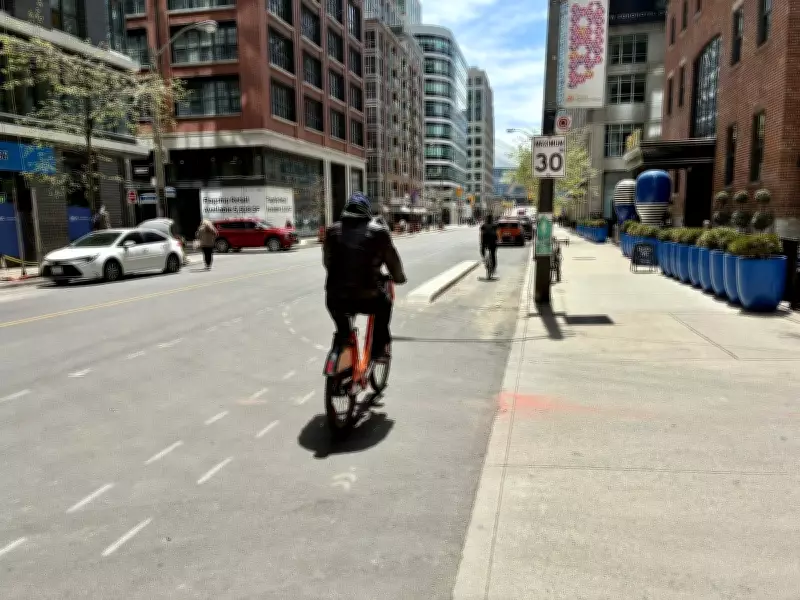
If baseball is a game of inches, cycling might be more like 5.5 inches. A concrete barrier not even half a foot tall is now separating trucks and other vehicles on a stretch of Blue Jays Way from a new bike lane, which is being built amid a long legal battle over the concept between the provincial government and the City of Toronto.
Construction and Configuration
When work officially ends next week, Toronto’s bike lane system will run through both Peter Street and Blue Jays Way, connecting the Rogers Centre by bicycle with points north. Construction began on April 13, and while not yet finalized, cyclists are already using the lane. The reconfiguration turns what had been a four-lane road into two lanes for vehicles, occasional parking spots and turning lanes, and a cycling lane separated by a concrete barrier that the Toronto Sun measured as about 14 cm tall – less than half a foot.
Mixed Reactions from the Public
Tom O’Reilly, a self-described suburban “road biker” who previously criticized the city’s bike lane strategy alongside the advocacy group Balance on Bloor, told the Sun that even after bike lane construction, people who would rather not drive to a ball game will likely just take the TTC. “No matter how you slice it, this will make driving more complicated for everybody,” he said.

However, Ashley Curtis, general manager of the city’s transportation services division, said there are “no concerns about the impacts on traffic, including foot traffic, associated with the extension and improvement to bike lanes on Blue Jays Way.” Curtis wrote in a statement: “The project installation involved safety improvements and an extension to the existing painted bike lanes. The design maintains the current one motor vehicle lane in each direction, with left-turn lanes at intersections, adds concrete curbs to separate the bikeway from the motor vehicle lanes, and did not involve changes to space for pedestrians.”
Community and Political Response
On Reddit’s pro-cycling “torontobiking” board, the reaction was mostly enthusiastic, although a few expressed concern that the curb would do nothing to stop an errant vehicle from striking a cyclist. One post suggested that like injured pitcher Bowden Francis, who gained attention for his on-bike commute, other Toronto Blue Jays could now cycle to work.
O’Reilly said he expects downtown condo dwellers will get use out of the lane, but while there have long been bike racks at the Rogers Centre, he doubts bike lanes will get many cyclists to the stadium, despite the city’s “silly strategy.” “I think it would be even more congested and more difficult to do than getting in your car or getting on the TTC. I gotta get down to Blue Jays Way and I gotta park my bike somewhere and hope it doesn’t get stolen, no matter how I lock it,” he said. “Then I gotta ride home, and if it’s at night – yeah, I guess if you’ve got all the right gear and the lights and all that stuff, and you’re really keen to do it, but this kind of leads into another thing: A lot of Blue Jays games are at night. So are you gonna ride your bike at night from Rogers Centre through the waterfront … Are you really gonna do that? Is anybody gonna do that?”
Brad Bradford, the presumed front-runner in this year’s mayoral race, argued the expansion of the city’s bike lane network has been mismanaged by Mayor Olivia Chow, and Blue Jays Way represents another spin of the bicycle wheel in the wrong direction. Isha Chaudhuri, Bradford’s press secretary, said in a statement that a city “that does not respect its residents’ time does not respect its residents at all.” “Toronto’s congestion and gridlock are not accidents. They are the result of years of decisions made in isolation: bike lanes, road construction, transit builds, each approved without a serious plan for how they work together. That is not leadership. That is management of a problem Mayor Chow helped create.”

Legal Context
The expansion of the Peter Street-Blue Jays Way cycling route comes even after the province moved to tear out bike lanes on three major Toronto arteries – Bloor Street, University Avenue and Yonge Street. While the province lost at a lower court, it has appealed that ruling. O’Reilly has been watching that court case closely and finds it hard to believe the city would build bike infrastructure knowing a legal defeat could come any day now. “They can’t be that dumb,” he said.
As for the barrier itself, O’Reilly said judging from a photo it looked like a cyclist would feel safe on the other side of it. “I would argue that that barrier … is actually preferable to these nonsensical things that they’ve stuck all over Bloor Street and other parts of the city, where they took the, as I call them, the concrete parking blocks and stuck bollards on the top of them,” he said. “An emergency vehicle, if it had to get into the bike lane for some reason to get around traffic or something, it could do so over that thing, whereas this junk they’ve put along Bloor Street, it’s beyond description how silly it is.”