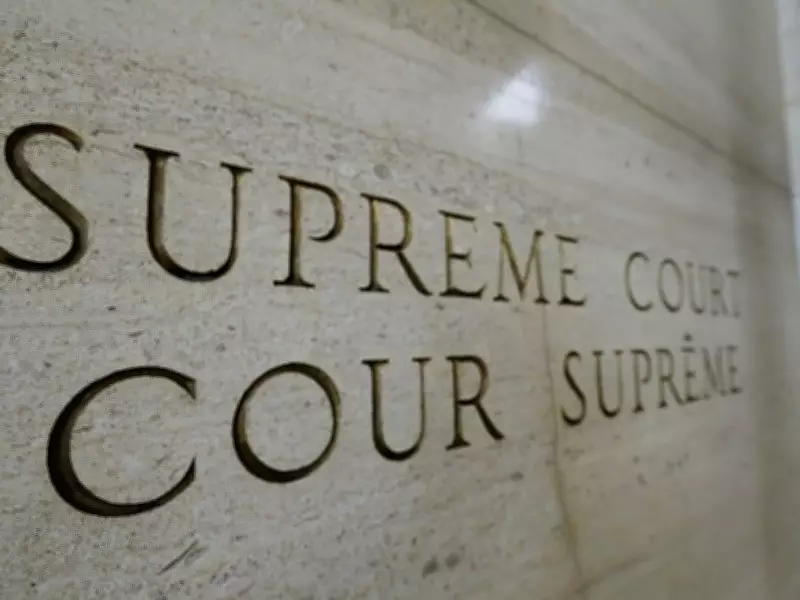
The Supreme Court of Canada has issued a landmark ruling, determining that victims of intimate partner violence can now pursue civil damages for the harm they have endured. The decision, released on Friday, establishes a new tort specifically for intimate partner violence, acknowledging the unique and comprehensive nature of such abuse.
Case Background
The ruling stems from the case of an Ontario woman who suffered both physical and emotional abuse from her husband throughout their 16-year marriage. The trial judge found that the husband had engaged in a pattern of coercive and controlling behavior, effectively breaking his wife's will and conditioning her to obey him from the very beginning of their relationship.
Initially, the woman sought $100,000 in damages. The trial judge awarded her $50,000 in compensatory damages and $50,000 in aggravated damages, along with an additional $50,000 in punitive damages for what was then considered a new tort of family violence. However, the Court of Appeal overturned the recognition of this new tort, arguing that existing legal remedies for assault and intentional infliction of emotional distress were sufficient, and reduced the damages by $50,000.

Supreme Court Decision
The woman appealed to the Supreme Court, which sided with her in a 6-3 decision. Writing for the majority, Justice Nicholas Kasirer emphasized that intimate partner violence is a pervasive social issue that demands comprehensive legal attention. He noted that such violence is not limited to physical or psychological injury but encompasses all abusive conduct through which one partner coerces and controls the other, stripping them of their autonomy.
Kasirer elaborated that victims often suffer from isolation, manipulation, humiliation, surveillance, economic abuse, sexual coercion, and intimidation. He argued that existing torts fail to address the specific harm to dignity, autonomy, and equality that intimate partner violence creates. While existing laws may cover isolated incidents, they do not account for the broader, qualitatively different consequences of coercive control over time.
Reactions and Dissent
The Women's Legal Education and Action Fund (LEAF) hailed the decision as a landmark victory for survivors. Kat Owens, LEAF's legal director, stated that the new tort recognizes the real and significant harms and financial burdens faced by survivors, affirming that these harms merit compensation.
However, three dissenting justices, led by Justice Mahmud Jamal, argued that the appeal should have been dismissed. They contended that existing remedies are adequate and that creating a new tort is unprecedented and unnecessary. Jamal wrote that courts should only recognize new torts when necessary to provide a remedy, and in this case, existing causes of action could fully compensate the plaintiff.
The ruling marks a significant shift in Canadian law, providing a clearer path for victims of intimate partner violence to seek civil justice and hold their abusers accountable.