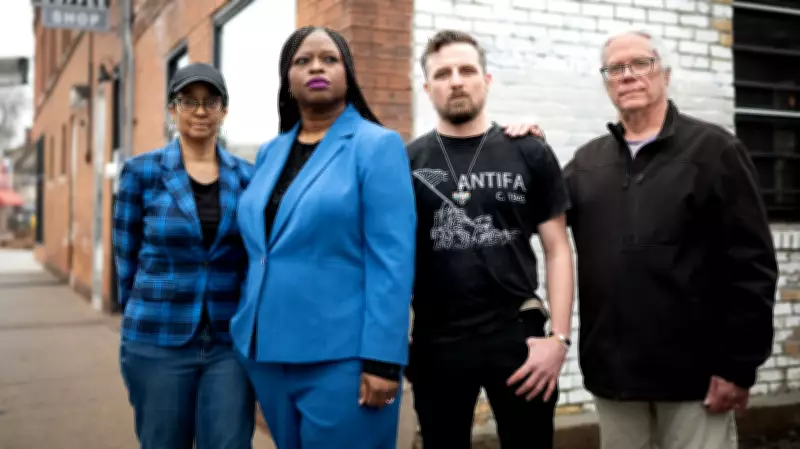
Activists Confront Federal Charges Following ICE Protest at Minnesota Church
Civil rights attorney Nekima Levy Armstrong experienced a shocking revelation after spending a night in a Minnesota jail on federal charges. Upon release, she encountered a White House-altered photograph depicting her in handcuffs with significantly darkened skin and fabricated tear-streaked features. "The federal government could not break me during my arrest, so they put out an image attempting to portray me as being broken," Armstrong stated. "Historically, it's not unlike the ways in which Black people have been caricaturized, using these images of Sambos and mammies and darkened skin."
A "Demonic and Godless" Display
Armstrong, former president of the Minneapolis NAACP, was detained after federal agents arrested her for leading what the Trump administration's top civil rights attorney labeled a "demonic and godless" demonstration. The protest briefly interrupted a service at Cities Church in Saint Paul, where David Easterwood, director of Enforcement and Removal Operations at ICE's Saint Paul field office, serves as a pastor. Journalist Don Lemon, a former CNN anchor, livestreamed the event, propelling it to national headlines.
Subsequent aggressive arrests identified alleged protesters, resulting in 39 individuals, including Lemon, facing federal charges that could lead to years of imprisonment. As prosecutors prepare to argue that protesters violated congregants' religious liberty, eight defendants spoke about being targeted by the Trump administration. Many described treatment seemingly intended to humiliate and intimidate them, including confrontations with heavily armed federal agents, detention in multipoint shackles, and forced posing with agents for "trophy" images.

The Protest's Origins and Execution
The defendants, including two co-founders of Black Lives Matter Minnesota and a Saint Paul School Board member, represent veteran Twin Cities activists with decades of racial justice advocacy. Following the police murder of George Floyd in 2020, global protests erupted, but Twin Cities activists had been organizing for years, including an 18-day occupation after the 2015 police killing of Jamar Clark.
The Cities Church demonstration emerged from a flyer Armstrong posted on social media, according to the indictment. On January 18, eleven days after ICE agent Jonathan Ross fatally shot Renee Good, protesters arrived to denounce Easterwood's dual roles. "It doesn't add up to us, people who were raised Christian, to have a minister preaching the word of God... while also being a leader of Minneapolis-Saint Paul ICE, which is systematically oppressing people by race," said protester Ian Austin.
Some protesters joined the service before Armstrong, an ordained reverend, interjected to announce Easterwood's ICE role to the congregation. As chants of "Justice for Renee Good!" began, the church amplified music, seemingly to drown out voices. Video evidence shows no violence or obstruction of church pathways, contradicting federal allegations of "acts of oppression, intimidation, threats, interference, and physical obstruction."
Arrests Designed for Spectacle
Arrest procedures appeared calculated for humiliation. Armstrong was initially permitted to turn herself in at the federal courthouse, but authorities reversed course, insisting on a hotel arrest where agents recorded footage later manipulated into a racist White House meme. Other defendants described similar experiences.
Drew Edwards awoke at 6 a.m. to federal agents pointing long guns and flashlights at his face before battering down his door, handcuffing him without allowing retrieval of pants or shoes. Hours passed before clothing was provided, during which agents photographed him at the Whipple federal building, an ICE hub. "There was no reason to knock my door down," Edwards said, "except to put me in danger, to be destructive, and to try to intimidate."
Independent journalist Brixton Hughes (David Okar) also had his door battered down, encountering an agent pointing a gun at his head. Authorities seized cell phones, sometimes withheld warrant paperwork, and transported detainees to the Whipple building for DNA swabs and mug shots before court appearances. Shackles restrained wrists, waists, and feet.

Legal Challenges and Broader Implications
Prosecutors charged protesters with "conspiracy against rights," a Reconstruction-era statute protecting Black churches from the Ku Klux Klan, and violations of the Freedom of Access to Clinic Entrances Act (FACE Act), typically used against abortion clinic blockers. The superseding indictment alleges actions "resulted in a bodily injury to one of the congregants," referencing an affidavit claiming someone slipped and broke an arm while exiting.
Legal experts have criticized the charges as "overkill" and "overreach at best." Magistrate Judge Douglas L. Micko initially crossed out FACE Act charges due to "NO PROBABLE CAUSE" and refused warrants for five defendants, though prosecutors later secured a grand jury indictment. Micko recently admonished prosecutors for discovery delays, calling their pace "unacceptable."
All arraigned defendants have pleaded not guilty, with some filing motions to dismiss. Austin's attorney argues that even if allegations are true, they don't constitute federal offenses. Convictions could bring up to 10 years for conspiracy charges and six months to 10 years for FACE Act violations, with higher penalties if bodily injury is proven.
Personal Resolve and Community Impact
Despite intimidation tactics, defendants expressed determination. Austin, an Army veteran who deployed to Afghanistan six times, said protesting ICE aligned with values he fought for: "I'm being charged by my own government with federal felonies for having the audacity to stand up and say, 'Hey, stop fucking oppressing people by race.'"
Monique Cullars-Doty, a BLM Minnesota co-founder, described the protest as "a righteous action—it was just, it was necessary." When arrested at 4:30 a.m., she felt "a blanket of peace," praising God in the agents' van. "It's in God's hands. Worst-case scenario? Where can I go that he is not?" she stated, adding that even if convicted, "I would have a prison ministry. But I believe that we will win."
The charges risk sidelining seasoned activists, who now face potential custody if they encounter law enforcement in a city with hundreds of federal agents. Hughes admitted the case "has put that fear in me," making him hesitant to cover protests. Crews believes the indictment aims to silence grassroots leadership, especially during an election year.
Armstrong framed the government's actions as retaliation: "We're being criminalized by the federal government for standing up for what is right... to punish dissent, and to try to silence our voices. We know that we're standing on the right side of history."