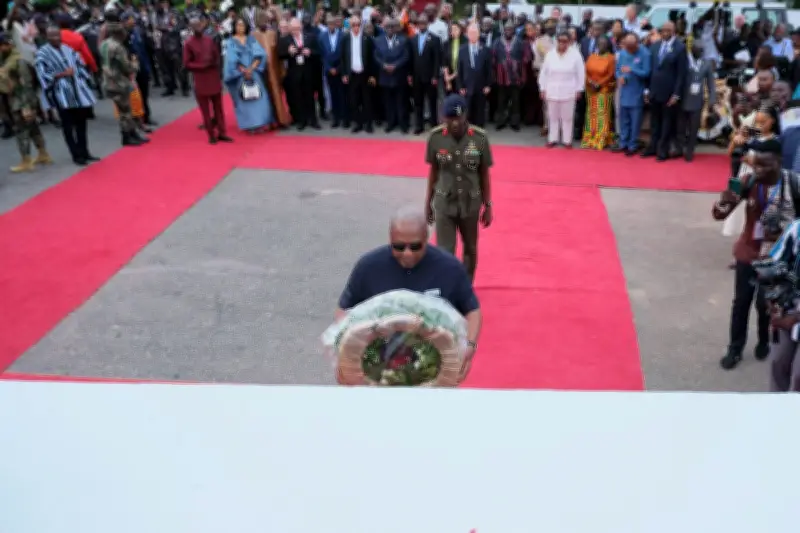
President John Dramani Mahama laid a wreath in a ceremony to honor victims of the transatlantic slave trade at Christiansborg Castle during a Juneteenth commemoration ceremony in Accra, Ghana, on Friday, June 19, 2026. The event coincided with a conference urging nations involved in the slave trade to issue formal apologies and reparations.
Conference Demands Action
The conference, organized by WorldNewsGhana, brought together activists, historians, and government officials to discuss the legacy of the transatlantic slave trade. Participants called on European nations and the United States to acknowledge their historical role and provide reparations to affected communities.
According to organizers, the conference aimed to build momentum for a global movement seeking justice for the millions of Africans who were enslaved. “We cannot heal the wounds of the past without acknowledgment and restitution,” said a spokesperson for the event.

Juneteenth Ceremony
The wreath-laying at Christiansborg Castle, a former Danish slave trading post, marked Juneteenth, the U.S. holiday commemorating the end of slavery. Mahama’s participation underscored Ghana’s role as a focal point for the African diaspora’s remembrance of the slave trade.
“This is a moment for reflection and action,” Mahama said in his address. “The transatlantic slave trade was a crime against humanity, and we must ensure that its victims are never forgotten.”
Global Reparations Movement
The conference is part of a broader push for reparations, which has gained traction in recent years. Caribbean nations have formed a reparations commission, and some U.S. cities have explored local reparations programs. However, no major European nation has issued a formal apology or paid reparations for the slave trade.
Historians estimate that over 12 million Africans were forcibly transported across the Atlantic during the slave trade, with millions dying en route. The economic impact on Africa and the enduring social inequalities in the Americas continue to fuel demands for justice.