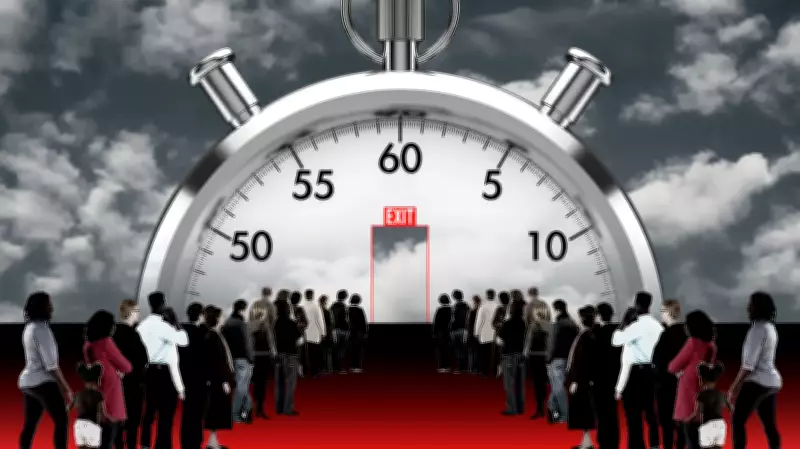
Imagine your life in America — family, job, friends, car, home, health insurance, pets, everything you have come to know or painstakingly built for yourself — is suddenly illegal. You must figure out where to go and what to do next, and you must do it within two months. That is the threat facing Dahlia Doe and potentially the 1.3 million other people lawfully living in the U.S. with a designation known as "temporary protected status," or TPS, for those whose countries of origin have been designated too dangerous to return to.
"I don't even know where to begin," she told HuffPost in an interview this month as she considered the future. Doe is the lead plaintiff in Mullin v. Dahlia Doe, one of two cases before the Supreme Court challenging the Trump administration and former Department of Homeland Security Secretary Kristi Noem's attempt to terminate TPS for 13 of 17 protected countries last year, including Haiti and Syria. Doe's case was consolidated with that of Fritz Emmanuel Lesly Miot, a neuroscientist who also challenged the Trump administration's termination of TPS for Haiti.
Like many TPS holders living in the United States — on average, they reside in America for 20 years — Dahlia Doe, an alias she must use to protect her identity, has made a full life here. She arrived in 2015, works as a white-collar professional, and owns a home where she is the primary breadwinner and caregiver to her elderly father, who has Parkinson's disease. Though she is ethnically Syrian and holds citizenship there, Doe has never lived in Syria. She was born in another country in the Middle East and her parents, who are U.S. green card holders, left the region long ago as war and infrastructure collapse threatened their existence.

But if the court rules that the administration is allowed to end the status for the selected nations, it starts a terrifying countdown: Once TPS is terminated for a country, TPS holders have just 60 days to make major life decisions and leave the country. It is a shockingly short time frame for people to uproot and move their lives after decades — and for the system to force them to do so.
"It's just not enough time to pack up your whole life and potentially go to a country you've never lived in," Sadaf Hasan, staff attorney with Muslim Advocates, a group also representing TPS holders from countries like Ethiopia and South Sudan, told HuffPost.
Doe said she has not made any worst-case plans. She cannot even contemplate where to start if the court rules against them. "To even consider the option of going to a country that I don't know, to a country where I have nobody and to a country that, frankly, is not in a position to support me as a newcomer because they are rebuilding … I can't even imagine being forced to go there," she said. "I might have to be forced to do it. But in my head, I'm not even considering it or planning for it. That might be naive of me, but my entire family is here. This is where I've built my whole life."
What Is Temporary Protected Status?
TPS was first established by Congress in 1990 and authorizes the Department of Homeland Security to give legal status to people from foreign nations who cannot safely return to their home countries because of "armed conflict, natural disaster or other extraordinary and temporary conditions." The statute requires the DHS secretary to conduct periodic reviews of TPS designations and decide only after "consultation with appropriate agencies" whether the status can remain intact. The Supreme Court case alleges that Noem did not follow procedure in ending status for the affected countries.
The status covers a vast array of permissions for the basic necessities of life: It allows people to get legal permits to work, obtain necessary documents like driver's licenses, and even qualify for things like healthcare (which is already slated to be canceled in 2027) and residency requirements for higher education. If the status is cut off, all those things become impossible.

"If someone loses TPS status, it's not only being subjected to risk of immigration detention and being put into removal proceedings. It's everything else, too," Hasan said. For example, according to research from the Catholic Legal Immigration Network, as of 2019, half of all TPS holders from two of the largest TPS populations in the U.S. — those from Haiti and El Salvador — own homes. Without a way to work legally and meet mortgage payments, displacement and foreclosure is inevitable. Doe, for example, recalled lawyers telling her and others to find a power of attorney as soon as possible because they might be forced to leave the U.S. before being able to close bank accounts or sell homes.
Right now, it is a confusing mess for TPS holders as well as their employers, clients, university registrars — anyone who depends on them or they depend on — since all are unsure of what happens next. "Hundreds of thousands of people are going to wake up on whatever day the court decides to issue the opinion and potentially have their lives completely upended. It's really an unfathomable situation for all of these folks just waiting to hear what the court says," Hasan said.
Personal Stories of Uncertainty
Arya, a 23-year-old full-time university student who came to America in 2014 as the war in Syria was escalating, says the initial attempts to remove TPS pulled her right back to the moment when she had to flee her home country, with all the same questions and uncertainty. "It was the first time I experienced what it means to be living in survival mode since my life in Syria when I was a child," said Arya, who is being identified by only her first name to protect her identity. "It felt like my entire life was threatening to fall apart and I was only given 60 days to come to terms with that. We were all panicking. We didn't know how we would sell our belongings, what we could take with us, who we would leave our cats with. Were my brother and I going to finish our degrees?"
If the Supreme Court rules against Doe and Miot, it will not mean that Immigration and Customs Enforcement agents will show up at Syrian or Haitian TPS holders' doors and start detaining people right away. But it is not clear how the Supreme Court will treat the 60-day countdown, such as if it will be retroactive to when Noem first terminated a nation's status or if the clock will start anew.
"It really makes you wonder: How is a family who built a life for over a decade supposed to dismantle everything in 60 days?" Arya said. "We have to worry about jobs, school, housing and community. None of that can just be stopped or started that quickly."
Although termination for Syrians has been put on hold until the justices rule, people with TPS are still being put in removal proceedings, Hasan said. "Even though TPS was designed to protect people against removal proceedings and immigrant detention," Hasan noted.
Impact on U.S. Citizen Children
If the Supreme Court blesses the Trump administration's bid to remove TPS protections for all of the countries DHS has terminated or attempted to terminate, that would expose 260,000 U.S. citizen children to potential separation from their parents. When the termination notice first came out for Syria, Doe said TPS holders in her community, especially those with children, panicked as they tried to figure out who, if anyone, they could leave their children behind with in the U.S. for a "normal life."
"Many of them have children who are U.S. citizens who have only known America to be their home and now they are going to be faced with a decision of 'Do we pick up and leave and take our children to a country they have never been?' Some children don't even speak Arabic. How are they going to move to Syria?" Doe said.
Dangerous Conditions in Home Countries
Both Haiti and Syria have had TPS renewed multiple times in the past 15 years. In Haiti, the Western hemisphere's poorest nation, natural disasters and political unrest have kept the country in a constant state of crisis with over 3 million children today requiring humanitarian support, according to UNICEF. War and violence continues in Syria, and its infrastructure remains shattered. UNICEF reports that 40% of Syria's hospitals are nonfunctional, water and food is scarce, and sanitation infrastructure has collapsed. Some 6.2 million people are internally displaced in Syria, with more than a million of them living in makeshift camps. (And just this month, Israel lobbed bombs into Syria.)
Though Noem declared in her terminations for Haiti and Syria that conditions in both nations no longer posed a serious threat to anyone who would return there, the State Department views Syria and Haiti as fundamentally unsafe for travel. Commercial flights are not even permitted in Haiti's capital, Port-au-Prince.
Arya recalls the danger that prompted her family to leave in 2014: That year, humanitarian observer groups reported upward of 75,000 deaths due to the war. She was only 11 and told HuffPost she remembers it as a "very chaotic time." Speaking of the final straw that forced her family to leave Syria, Arya said: "It was a bomb dropping on top of a building where my mom and I were shopping. She was inside the building, and I was waiting for her." Her mother survived and her family made an arduous escape to the U.S. where she and her brother, mother and father began cobbling together a new life.
"That meant everything to me. It's allowed me to go to school, pursue higher education and build a real life. Twelve years is a long time," she said.
Immigration System Overload
Beyond the pressure on the TPS holder, there is also the immense squeeze that an abrupt flood of litigation would put on the already inundated immigration court system. "By removing TPS and that person's status, in some cases, the administration is relegating folks to this limbo where they are now vulnerable to the administration's detention and deportation machine," said Lupe Aguirre, deputy director of U.S. litigation at the International Refugee Assistance Project.
People who lose TPS can attempt to fight their removal on appeal or attempt to procure a green card. But once removal proceedings are initiated against a person, they cannot pursue a green card. The short window TPS holders have makes it next to impossible for people to pursue a new legal status. "The 60-day notice doesn't actually allow people to regularize their status, and that point is really important because if someone has any gap in accruing unlawful status, that affects what immigration pathways they have," Hasan said.
Immigration courts are already completely inundated. Data from U.S. Citizenship and Immigration Services shows there is a backlog of 11.6 million immigration cases as of September 2025, according to the American Immigration Council. A removal of TPS protections for Syrians and Haitians could add roughly 400,000 more people to that backlog, should they each attempt to navigate through the system with their own unique challenges. "The system itself is broken. There's already a huge backlog of folks in removal proceedings and trying to get pathways to stay in the U.S. I just know people would wait years to have a hearing," Hasan said.
Even if they get it, it is an uphill battle. "Their cases will be adjudicated by immigration judges who are subject to significant pressure by this administration to deny humanitarian claims for relief from deportation," Aguirre said. "TPS holders will be subject to a slew of hostile new rules and practices that make it nearly impossible for noncitizens to access a fair hearing in immigration court."
Limited Alternatives
The Trump administration has closed off other legitimate and legal pathways to stay in the U.S. already. In November, USCIS paused the processing of all asylum applications following the shooting of two National Guard members in Washington, D.C., by an Afghan national. In March, the administration lifted the total asylum ban but kept it in place for 40 countries, including Syria and Haiti. The nations still barred from seeking asylum are largely African countries, though Yemen, Afghanistan and the Palestinian territories are also on the list.
"People think surely there are other immigration paths to pursue, but the reality is there is not," Arya said. She said her family members have been scrambling to find other solutions and have talked to a half dozen attorneys. "But our hands are completely tied … it feels like the system itself has essentially stopped moving for people in my situation. We are being put in an impossible situation here. There is simply no realistic way for things to unfold positively if TPS were to end," she said.