

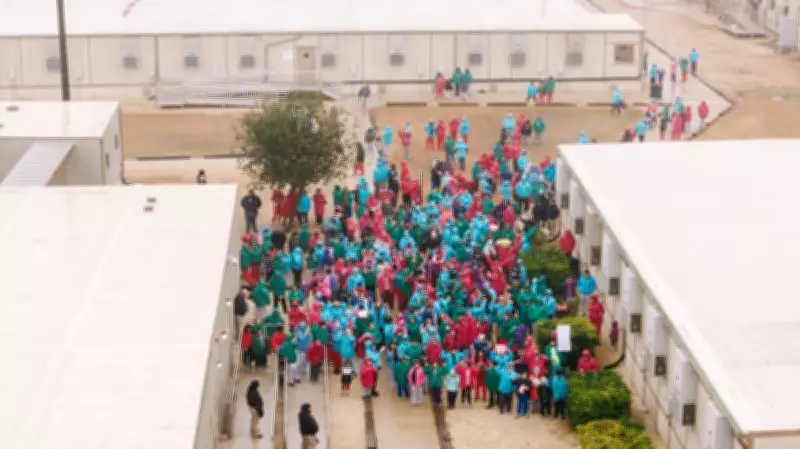
Nightmarish Conditions at Dilley Immigration Processing Center
Detainees at the Dilley Immigration Processing Center in Texas, the largest detention facility in the United States for children and families, are reporting horrific living conditions including moldy food, contaminated drinking water, and severely limited medical care. In a letter sent to ProPublica, one child revealed that the only medical advice they receive from doctors is to drink more water, despite concerns that the water itself may be making people sick.
Measles Outbreak and Lockdown
At least two cases of measles, a highly contagious and potentially deadly disease, have been detected within the facility, prompting officials to implement a lockdown. Representative Joaquin Castro (D-Texas), who visited the center, described the situation in a livestreamed video, stating, "They are literally being treated as prisoners. This is a monstrous machine."
For many parents, however, keeping their children at Dilley remains preferable to the alternative: facing detention and possible deportation without them. Chris Godshall-Bennett, a Washington, D.C.-based civil and prisoner rights lawyer, explained, "You're putting people into an impossible choice. They can pursue the freedom of their children at the cost of their separation."

Skyrocketing Detention Numbers Under Trump
Since Donald Trump returned to office, the number of children in immigration detention has increased dramatically. Approximately 3,500 people have been held at the Dilley Immigration Processing Center since it reopened last year, with more than half being children, including a two-month-old infant.
Godshall-Bennett represents multiple clients at the center, including a woman detained with her five children for nearly nine months. Her youngest children are five-year-old twins. "The mental health toll that this has taken on them is profound," Godshall-Bennett told HuffPost. "One of the twins is drawing fairly disturbing images, all black and gray with people behind bars."
Asylum Seekers Trapped in Legal Limbo
Like many detainees, this family was seeking asylum, fearing persecution in their home country and looking for safety in the United States. They had entered the U.S. on a tourist visa that expired while their asylum application was pending. Asylum seekers' claims are typically rejected if they leave the country, making overstaying the visa expiration date their only realistic option.
"Overstaying the visa is a technical violation," Godshall-Bennett noted. "These are people that normally wouldn't be in immigration detention." Trump's aggressive anti-immigrant policies have meant that even families seeking asylum now risk detention.
Historical Context and Policy Changes
The Dilley Detention Center originally opened during the Obama administration, specifically built for detaining families. It was shut down by the Biden administration and then reopened last year. According to Godshall-Bennett, the difference is one of scale rather than fundamental policy. "This has always been an aspect of immigration enforcement. The authority has always been there, but it's been discretionary as to what extent they will actually use that authority."
Life Inside the Detention Center
Describing conditions inside the facility, Godshall-Bennett stated, "I mean, it's a jail. The kids are not in school and the parents have to try to parent their children in a facility that is not an appropriate place for children to be." With the measles outbreak, everyone is on lockdown and isolated, creating long-term psychological effects for children whose first memories may be of detention.
"Even when there's nothing newsworthy happening, other than the fact they're there, this place is wreaking havoc on these children's lives," he added. "It's not a facility that is capable of giving a child everything they need, and I imagine that creates a great deal of stress for parents who have to navigate raising their children in a place that really shouldn't have any children in it at all."

Medical Care Concerns and Young Detainees
While the two measles cases are reportedly being treated, and the facility is on lockdown to prevent further spread, Godshall-Bennett expressed concern about containment in such an environment. "You effectively are confining people to their cells, further isolating them from each other and further restricting their freedom in a place they didn't even have to be in."
He noted that the presence of very young children is not an aberration but rather the facility's purpose. "My understanding is that there are a lot of kids there, many around the age of five. They're trapped there because their parents have been detained."
Legal Framework and Discretionary Detention
The two main reasons for immigration detention are danger to the community or flight risk, neither of which typically applies to families at Dilley. "These are people who have every incentive to go to their hearings," Godshall-Bennett explained. "And there are lesser restrictions, like ankle monitors, if you're really worried. But there's no reason for it. It's not a policy. It's not required by law. It's discretionary. But they're doing it anyway."
The Impossible Choice Facing Families
Regarding the legality of holding children for extended periods, Godshall-Bennett stated, "The legality is almost irrelevant. However, when you detain their parents, you force people into a situation where they might have a mechanism to get their children out, but they have to choose between that and separation."
Even if parents wanted to get their children out, practical questions remain: Where would they go? Do they have someone to care for them? With rapid removal proceedings, families risk being separated by borders if parents are deported while children remain.
Government Intent and Psychological Impact
When asked if the federal government intends to make it appear that detainees are choosing to remain in detention with their families, Godshall-Bennett responded, "I'm sure that's part of it. But I think it's to maximize pain and distress by imposing detention. I think that's true in general, but it's especially true with people with families."
He added, "I'm sure that it's meant to incentivize people to give up on their immigration cases and just leave. I'm sure the government would love that."





