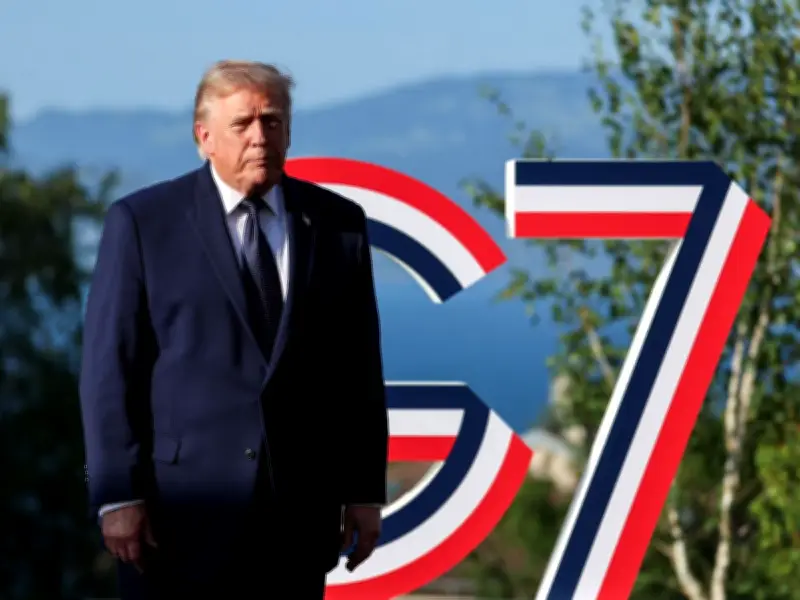
United States President Donald Trump keeps repeating that the Strait of Hormuz — through which one fifth of the world’s oil and liquefied natural gas supplies normally flow — will reopen by Friday. But on the sidelines of the Group of Seven summit, where Iran will dominate Monday’s dinner conversation, it’s clear that his European allies don’t share his optimism. They disagree that trade can resume by week’s end, like Trump promised, and have practical questions about what exactly was agreed before they can commit to de-mining missions and patrols.
Divergent Views on the Interim Agreement
While the U.S. and Iran both said they reached an interim agreement to reopen the strait, they offer different descriptions of what it says. According to one G7 official, speaking on condition of anonymity to discuss internal dynamics, there are serious difficulties in finding a common position among the group about how to deal with the situation in Iran. Few are expecting a joint communique, something that’s proved elusive during the Trump era.
European Allies Express Caution
Even Italian Prime Minister Giorgia Meloni, who for the most part has artfully avoided provoking Trump, said her country’s contribution is conditional on a cessation of hostilities in Lebanon, where Israel’s military has carried out strikes in recent days. She isn’t alone in questioning Trump’s accelerated timeline.

It doesn’t help that even within Trump’s own administration, there are prominent figures who didn’t go as far in promising that navigation along the vital chokepoint can go back to normal at the snap of a finger. One senior U.S. official said traffic in the waterway would ramp up over time, and it could take as many as two weeks for shipping to significantly increase — and even longer for it to return to the levels seen before the U.S. attacked Iran along with Israel in February. There are mines in the strait that still need to be cleared and shippers have different risk tolerances about navigating Hormuz, the official said.
Details of the Memorandum of Understanding
The official said the memorandum of understanding between the U.S. and Iran will make it explicit that the strait will be open toll-free for 60 days, and the U.S. will expect that provision makes it into a final agreement. The fact is that free navigation, once a given, is now the subject of negotiations that haven’t even started.
Upcoming Signing and G7 Discussions
Officials are due to sign the accord in Switzerland on Friday. U.S. officials have offered differing timelines for when the full text will be released, with Trump saying by week’s end at the earliest and another senior U.S. official saying within the next two days. Vice President JD Vance is likely to represent the administration at the signing. The G7 leaders will next decide a framework to de-mine the waterway, including an agreement from Iran and other involved parties, Bloomberg reported earlier. European leaders are planning to seek Trump’s approval for the mission at the G7.
Read More: Shipowners seek details on Hormuz deal before resuming transits; U.S. and Iran say they’ve agreed deal to reopen Hormuz.