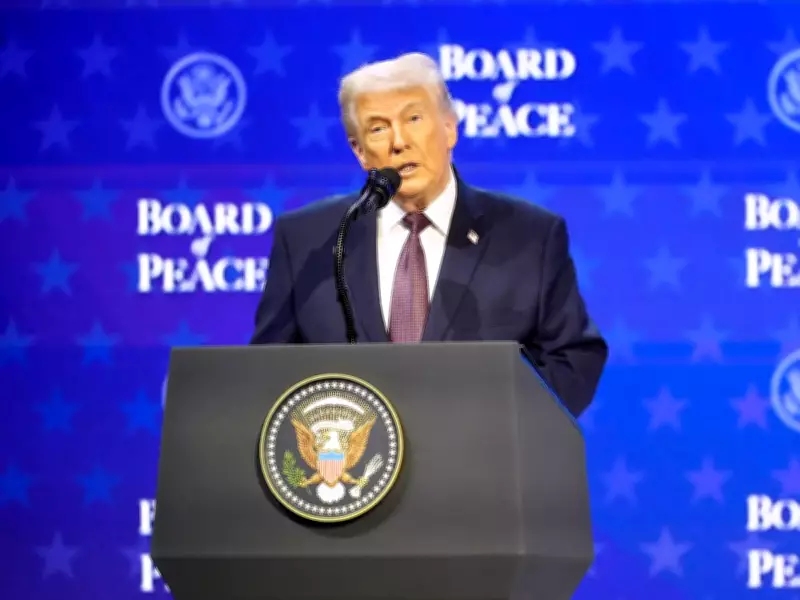
U.S. President Donald Trump gathered approximately two dozen world leaders and senior officials in Washington on Thursday for the inaugural meeting of his newly established Board of Peace, an institution primarily focused on advancing progress in Gaza while harboring broader global ambitions.
Gaza Reconstruction Takes Center Stage
The Board of Peace emerged following the Trump administration's collaboration with Qatar and Egypt to negotiate a ceasefire in October 2025, ending two devastating years of conflict in Gaza. U.S. officials have confirmed that Thursday's meeting specifically addresses Gaza's future, though they have also described the board's purpose in broader, more expansive terms, suggesting its potential to address other international conflict zones.
At the meeting, President Trump is expected to outline financial commitments exceeding US$5 billion dedicated to Gaza's reconstruction. The territory remains largely devastated, with most buildings reduced to rubble. In a characteristically unconventional proposal, the property-mogul-turned-president has suggested the potential development of resorts in the area.

Disarmament and Security Framework
The United States has announced that the peace plan has now progressed to its second phase, which concentrates on disarming Hamas. This Palestinian group's unprecedented attack on Israel on October 7, 2023, triggered the extensive military offensive that devastated Gaza.
The meeting will also examine plans to establish an International Stabilization Force to ensure security in Gaza. A significant contributor to this force will be Indonesia, the world's largest Muslim-majority nation, which has expressed readiness to deploy up to 8,000 troops pending confirmation of the force's formation.
Indonesian President Prabowo Subianto participated in the Washington gathering after attending the board's launch event at the World Economic Forum in Davos, Switzerland, last month.
Diplomatic Composition and Progress Claims
The assembly in Washington notably included several of Trump's authoritarian-leaning allies while virtually excluding the European democracies that traditionally align with U.S. initiatives. This composition reflects the administration's distinctive diplomatic approach.
U.S. officials, including Steve Witkoff—Trump's friend and roving negotiator—have maintained that substantial progress is underway and that Hamas is experiencing mounting pressure to surrender its weapons. Israel has proposed comprehensive restrictions, including confiscating small personal rifles from Hamas militants.
Israeli Prime Minister Benjamin Netanyahu recently emphasized the importance of removing AK-47 rifles, which he identified as the primary weapon causing significant damage. His government will be represented at the meeting by the foreign minister.
Challenges and Governance Developments
Jeremy Issacharoff, a strategic affairs expert at Israel's Reichman University, acknowledged that disarming Hamas would present considerable challenges but noted that Israel views a credible pathway as essential for determining the feasibility of the entire initiative.
In a step toward establishing new governance structures in Gaza, a technocratic committee was formed last month to manage day-to-day administration. This committee is headed by engineer and former official Ali Shaath.
Meanwhile, Hamas spokesman Hazem Qassem communicated to AFP that the Board of Peace should prioritize compelling Israel to cease its violations in Gaza and lift the long-standing siege of the territory.
The inaugural meeting of the Board of Peace marks a significant diplomatic moment, blending immediate focus on Gaza's reconstruction with ambiguous hints at broader international conflict resolution ambitions, all while operating through unconventional diplomatic channels that reflect the Trump administration's distinctive approach to global affairs.