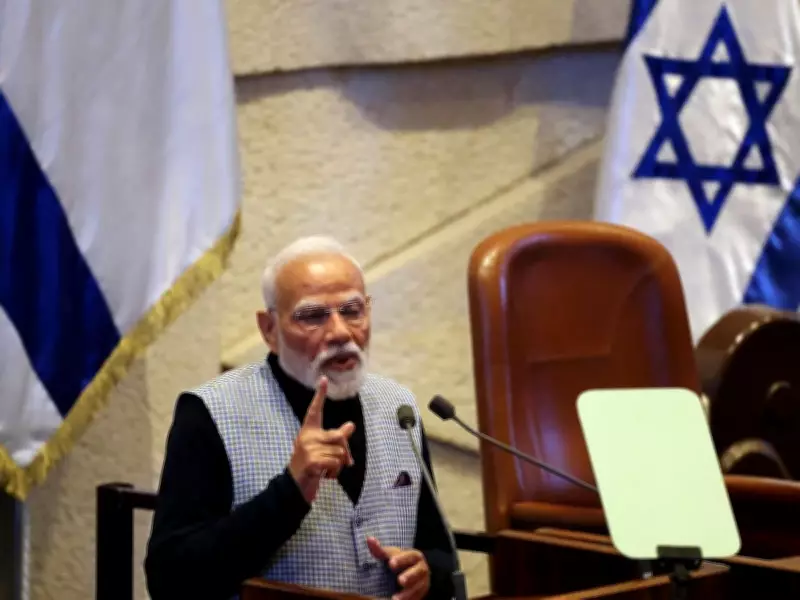
Narendra Modi's Historic Address at Israeli Parliament Strengthens Strategic Alliance
Friendship between nations is not built upon fleeting convenience or expedience, but rather upon the solid foundation of aligned interests and mutual respect. This principle was vividly demonstrated this week when Indian Prime Minister Narendra Modi delivered a powerful, statesman-like address before Israel's parliament, the Knesset, in Jerusalem. Despite the looming threat of potential Iranian aggression, Modi traveled to Israel to reinforce the deepening strategic partnership between the two nations.
A Display of Diplomatic Warmth and Strategic Alignment
The visible camaraderie between Prime Minister Modi and Israeli Prime Minister Benjamin Netanyahu highlighted the genuine affection and shared vision that characterizes the relationship between India and Israel. During his speech, Modi expressed profound respect for Israel's ancient civilization, stating, "It is a privilege and an honour for me to stand before this distinguished House. I do so as the Prime Minister of India, and as a representative of one ancient civilization addressing another." He extended greetings from India's 1.4 billion citizens, conveying a message of friendship, respect, and partnership.
This diplomatic milestone builds upon Modi's 2017 visit to Israel, which marked the first by an Indian prime minister and signaled a pragmatic shift in India's foreign policy. Modi's Knesset address emphasized the numerous commonalities between India and Israel, suggesting these shared interests may outweigh India's traditional alliances with Palestinian authorities.

Shared Security Concerns and Counter-Terrorism Cooperation
Prime Minister Modi explicitly addressed the threat of terrorism that both nations face, referencing the devastating Hamas attack of October 7th. "India has also endured the pain of terrorism," Modi declared. "We feel your pain. We share your grief. India stands with Israel, firmly, with full conviction, in this moment and beyond." He emphasized India's "consistent and uncompromising policy of zero tolerance for terrorism, with no double standards," aligning perfectly with Israel's security posture.
The 2008 Mumbai terrorist attacks served as a crucial wake-up call for India regarding the global threat of Islamic terrorism, drawing the nation closer to Israel in security cooperation. Both countries confront significant internal and external security challenges:
- India's longstanding rivalry and territorial disputes with Pakistan
- Israel's multiple conflicts with neighboring states including Syria, Lebanon, and Iran
- Internal separatist movements (Khalistan in India, Palestinian aspirations in Israel)
Defense Partnership Forms Cornerstone of Relationship
Security and defense cooperation have become fundamental pillars of the India-Israel alliance. Long before the Abraham Accords normalized relations between Israel and several Arab states, India recognized the strategic benefits of aligning with Israel to bolster its own defense capabilities, particularly against Pakistan.
According to the Stockholm International Peace Research Institute, India accounted for approximately 34 percent of Israel's total arms exports between 2020 and 2024, amounting to roughly $20.5 billion. This substantial defense trade includes:
- Advanced missile systems and guidance seekers
- Sophisticated radar and sensor technologies
- Electronic warfare suites and countermeasures
- Unmanned aerial vehicle (UAV) technologies
- Various force multiplier systems
Canadian Context and Diplomatic Parallels
Following what the author describes as diplomatic missteps by the Trudeau government, there is growing recognition in Canada of the need to reset relations with India. Recent months have seen increased diplomatic engagement, including a visit by Mark Carney, as Canada seeks to strengthen ties with the world's largest democracy.

The article suggests that Canada could learn valuable lessons from Israel's approach to building relationships based on mutual interest and respect. There is hope that Prime Minister Modi might one day address Canada's House of Commons, expressing the historic unity between the two nations and reinforcing the importance of India as a strategic partner deserving of respect and thoughtful diplomacy.
As global alliances continue to evolve, the deepening partnership between India and Israel serves as a compelling example of how shared values, security concerns, and economic interests can forge enduring international friendships that transcend traditional diplomatic boundaries.